Editorial Technical Reference

Economic CNC Lathe

This page explains how Economic CNC Lathe is classified within Machinery and Equipment Manufacturing. Technical values and manufacturer relationships are research references; confirm the current specification and supplier evidence for each order.

Technical Definition & Core Assembly

A cost-effective computer numerical control lathe designed for precision turning operations in small to medium-scale manufacturing.

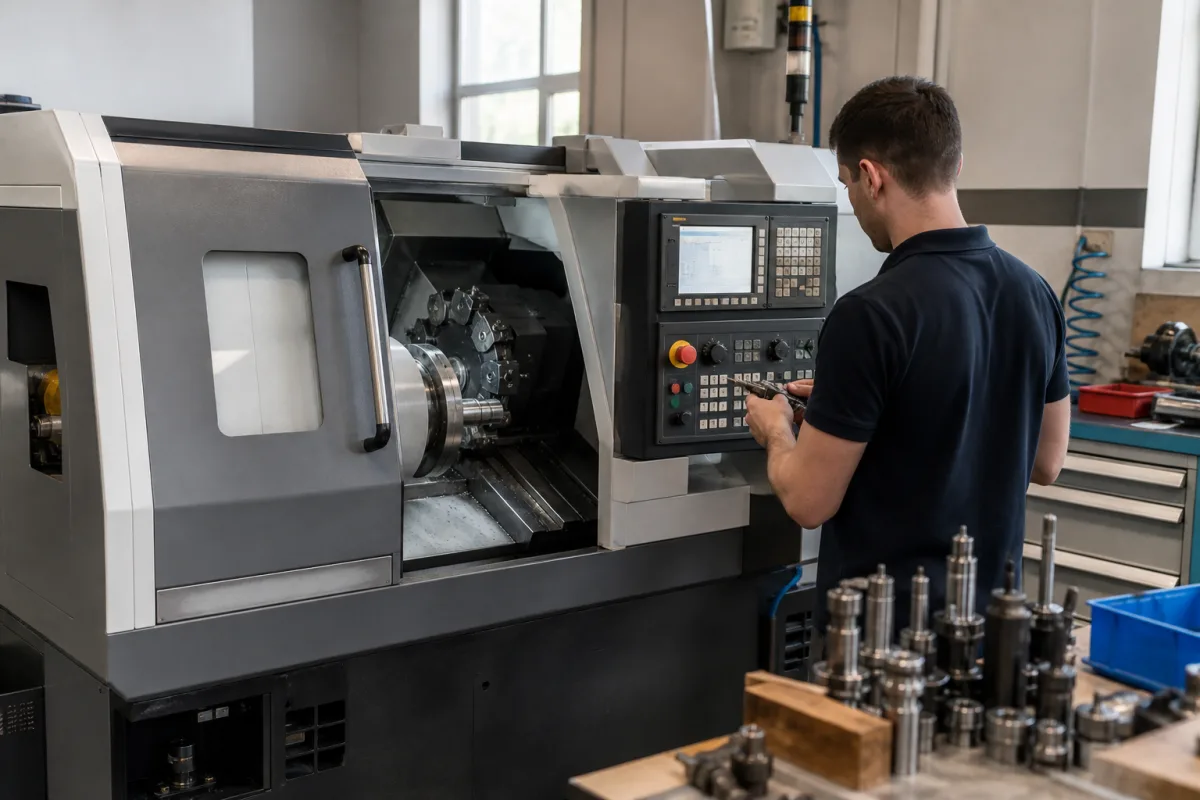
Representative product image. Confirm appearance and specifications with the manufacturer.

Product Specifications

Technical details and manufacturing context for Economic CNC Lathe

Definition
An economic CNC lathe is a computer-controlled machine tool that rotates a workpiece on its axis to perform various operations such as cutting, sanding, knurling, drilling, or deformation with tools applied to the workpiece. It offers automated control at a lower price point than high-end models, making it suitable for workshops and factories with budget constraints while maintaining essential CNC capabilities for producing symmetrical parts. This machine is typically used in small to medium-scale manufacturing environments where precision and repeatability are required but where the investment in a high-end CNC lathe may not be justified. The economic CNC lathe provides a balance between cost and functionality, offering essential features such as programmable control, multiple axes, and tool turrets, while omitting some advanced options found in more expensive models. It is constructed with cast iron and steel alloys, ensuring rigidity and durability. Key parameters include a swing over bed of 400–630 mm, maximum turning length of 750–2000 mm, spindle speed of 50–4000 rpm, spindle motor power of 5.5–15 kW, positioning accuracy of ±0.01 mm (per ISO 230-2), rapid traverse rate of 8–12 m/min, turret station count of 4–8, control systems compatible with FANUC, SIEMENS, or GSK, machine weight of 3000–6000 kg, operating temperature range of 5–40 °C, power supply of 380 V AC ±10% (three-phase, 50/60 Hz, per IEC 60038), and coolant system capacity of 50–100 L. These specifications are reference ranges and must be verified with the manufacturer for the specific model. The machine is designed for precision turning operations, producing cylindrical parts with high accuracy and repeatability. It is an ideal choice for businesses looking to automate their turning processes without incurring the high costs associated with premium CNC equipment. Always confirm model-specific values and standards with the legal manufacturer or supplier before procurement.
Working Principle
The CNC lathe operates by converting digital design data (G-code) into mechanical movements. A computer controller sends signals to servo motors that precisely position the cutting tool along multiple axes (typically X and Z) while the workpiece rotates at controlled speeds. The tool removes material from the rotating workpiece to create cylindrical parts with high accuracy and repeatability. The control system interprets the program and coordinates the movements of the spindle, turret, and axes to execute the machining operations. The operator inputs the part program, sets up the workpiece and tools, and monitors the process. The machine uses feedback from encoders to ensure precise positioning. The economic model maintains these core functions while offering a cost-effective solution for budget-conscious workshops.
Common Materials
Cast Iron, Steel Alloys
Technical Parameters
ParameterTypical rangeNotes & selection driver
Swing Over BedRequired400–630 mmMaximum diameter of workpiece that can be rotated over the bed
Maximum Turning LengthRequired750–2000 mmMaximum length of workpiece that can be machined
Spindle SpeedRequired50–4000 rpmRotational speed of the main spindle
Spindle Motor PowerRequired5.5–15 kWPower of the main spindle motor
Positioning AccuracyRequired±0.01 mmAccuracy of tool positioningISO 230-2
Rapid Traverse Rate (X/Z)8–12 m/minAffects cycle time
Turret Station Count4–8 stationsNumber of tools available
Control SystemFANUC/SIEMENS/GSKCompatibility with existing operations
Machine Weight3000–6000 kgAffects installation and floor loading
Operating Temperature5–40 °COutside range may affect accuracy
Power Supply380 ±10% V ACThree-phase, 50/60 HzIEC 60038
Coolant System Capacity50–100 LSufficient for continuous operation

Ranges are indicative industry figures for RFQ preparation, not a supplier commitment. Confirm every value and standard with the legal manufacturer before ordering.

Components / BOM
  • Bed
    Provides structural foundation and guides for moving components
    Material: Cast Iron
  • Headstock
    Houses the main spindle and drive motor to rotate the workpiece
    Material: Cast Iron with Steel Bearings
  • Carriage
    Moves the cutting tool along the bed (Z-axis) and cross-slide (X-axis)
    Material: Cast Iron with Steel Ways
  • CNC Controller
    Computer system that interprets G-code and controls machine movements
    Material: Electronic Components in Metal Housing
  • Tool Turret
    Holds multiple cutting tools and indexes them into position automatically
    Material: Steel Alloy
  • Tailstock
    Supports the end of long workpieces during machining
    Material: Cast Iron
  • Servo Motors
    Drive the X and Z axes to the positions the controller commands.
  • Position Encoders
    Report actual axis position back to the controller so the loop can close.

Industry Taxonomies & Aliases

Commonly used trade names and technical identifiers for Economic CNC Lathe.

Industrial Ecosystem & Supply Chain Structure

Complementary Systems
Downstream Applications
Specialized Tooling

Application Fit & Sizing Matrix

Operational Limits
pressure: N/A (mechanical system)
other spec: Max workpiece diameter: 300mm, Max workpiece length: 500mm, Spindle speed: 50-3000 RPM, Positioning accuracy: ±0.01mm
temperature: 15-35°C (operating environment)
Media Compatibility
✓ Aluminum alloys ✓ Mild steel ✓ Brass
Unsuitable: Abrasive composites (e.g., carbon fiber reinforced polymers)
Sizing Data Required
  • Maximum workpiece diameter and length
  • Required spindle speed range (RPM)
  • Desired tolerance and surface finish specifications

Reliability & Engineering Risk Analysis

Failure Mode & Root Cause
Spindle bearing degradation
Cause: Inadequate lubrication, contamination ingress, or excessive preload leading to increased friction, heat generation, and eventual bearing failure.
Ball screw wear/backlash
Cause: Lack of lubrication, chip accumulation, or misalignment causing abrasive wear, loss of positional accuracy, and increased play in the drive system.
Maintenance Indicators
  • Unusual grinding or whining noises from spindle or axis drives during operation
  • Visible metal chips or coolant contamination in lubrication systems or way covers
Engineering Tips
  • Implement strict lubrication schedule with manufacturer-recommended greases/oils and monitor consumption rates to detect early wear
  • Establish regular alignment checks and thermal compensation procedures to maintain geometric accuracy and reduce mechanical stress

Indicative industry ranges for design and RFQ preparation. Confirm the exact figures and applicable standard with the manufacturer before specifying.

Compliance & Manufacturing Standards

Applicable Standards
ISO 230-2:2014 (Geometric accuracy of machine tools) ANSI/ASME B5.57 - Methods for Performance Evaluation of Computer Numerically Controlled Lathes and Turning Centers CE Marking (Machinery Directive 2006/42/EC)

Quoted from the published standard.

Manufacturing Precision
  • Spindle runout: ≤0.005mm
  • Positioning accuracy: ±0.01mm
Quality Inspection
  • Laser interferometer accuracy test
  • Ball bar test for circular interpolation

Manufacturers of Economic CNC Lathe

1 company lists this product among what they make. Company figures are quoted from each company's own website; every card states where the relationship came from.

Tengzhou Borui CNC Machine Co., Ltd.
Tengzhou, Shandong, CN
Founded 2015
Listed on the company's own website · profile compiled by CNFX from public sources

Manufacturer listings support early research and capability understanding. They are not certification, ranking, or transaction guarantees.

Technical documentation
Request current drawings, revision history, and a signed specification sheet.
Manufacturing capability
Verify equipment lists, process limits, capacity, and representative production evidence.
Inspection readiness
Confirm test methods, calibrated equipment, sampling plans, and traceable reports.
Supplier transparency
Check the legal entity, factory address, ownership, certifications, and direct contacts.

CNFX does not score or rank suppliers. Buyers must verify all claims and documents with the legal manufacturer before ordering.

Supply Chain Commonly Integrated Components

Drive Motor

Electric motor that provides rotational power to drive the blending mechanism in pharmaceutical powder blending equipment

Explore Specs →
Air Handling Unit

A device that conditions and circulates air as part of a heating, ventilation, and air conditioning (HVAC) system

Explore Specs →
Cleaning-in-Place (CIP) System

An automated cleaning system that cleans processing equipment without disassembly, using spray nozzles, pumps, and cleaning solutions to remove residues and contaminants.

Explore Specs →
Vacuum System

A vacuum system that creates and maintains a controlled low-pressure environment for lyophilization by removing air and moisture from the chamber.

Explore Specs →

Frequently Asked Questions

What is the typical swing over bed range for this economic CNC lathe?

The swing over bed is typically in the range of 400–630 mm, which indicates the maximum diameter of the workpiece that can be rotated over the bed. This value should be confirmed with the manufacturer for the specific model.

What control systems are compatible with this lathe?

The lathe is compatible with FANUC, SIEMENS, and GSK control systems. The specific control system available may vary by model, so it is important to verify with the supplier.

What is the positioning accuracy of this machine?

The positioning accuracy is ±0.01 mm, as per ISO 230-2. This indicates the precision of tool positioning. Actual accuracy may depend on installation and operating conditions.

What are the power supply requirements?

The machine requires a three-phase power supply of 380 V AC ±10%, 50/60 Hz, according to IEC 60038. Ensure your facility meets these requirements before installation.

Data Basis

Editorial classification, named public sources where available, and source-reviewed manufacturer records.

Preliminary Technical Classification
This page supports structured research, RFQ preparation, and supplier evaluation. It does not replace buyer-led supplier qualification, standards review, or technical approval.
Buyer enquiry

Request manufacturing insight for Economic CNC Lathe

Ask for use case, specification boundaries, supplier type, and RFQ preparation information for this product.

Where it goes
Straight to the CNFX editorial desk, and to the manufacturer if this product is linked to a claimed profile. Nothing is broadcast to a supplier list.
Your details stay here
We do not sell or rent enquiry data, and we do not add you to a mailing list. Used only to answer this request.
No commission, no middleman
CNFX is a directory. We take no cut of any order and never negotiate on a supplier's behalf.
What we don't claim
A listing is not an endorsement. Qualify every supplier and verify every figure yourself before ordering.

Your business information is used only to process this request.

Thank you! Your message has been sent. We'll respond within 1–3 business days.
Sorry, we couldn't send your message. Please try again, or email us at contact@cnfx.com.

Need to Manufacture Economic CNC Lathe?

Compare manufacturer profiles with relevant product and process capability.

Previous Product
Eccentric Shaft
Next Product
Ejector Housing
Get QuotesChat