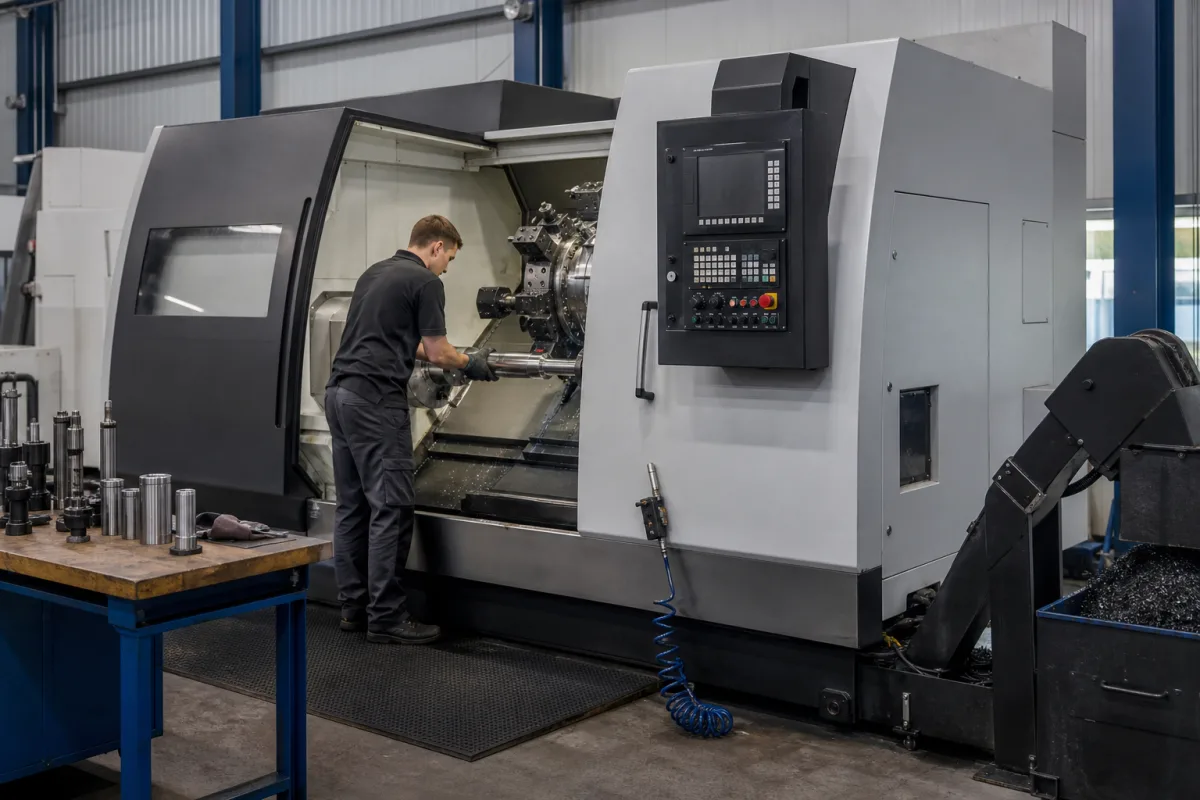
Turning · Swing and cutting length, spindle nose and chuck, power-chuck safety and acceptance
A universal CNC lathe turns, faces, bores and threads rotating workpieces under program control, on a flat or slant bed with a turret. Ask three things first: the diameters and lengths it can actually machine, the spindle, chuck and speed for your parts, and the workholding and guarding that keep the part clamped at speed.
Horizontal CNC lathes and turning centres, flat-bed and slant-bed, including models with live tooling. Vertical lathes, Swiss-type sliding-head lathes, manual lathes and CNC machining services are outside this page.
CNFX editorial research · Sources checked October 11, 2026 · 4 sources
SHS's flat-bed CNC lathe range shows why the headline swing is not enough: its CAK40/65 has a swing over bed of Ø400 mm but a swing over cross slide of Ø180 mm, and the range runs to Ø800 mm swing with 1,500 mm between centres. The maker advises that distance between centres and maximum workpiece length do not equal usable cutting length, because chuck jaws, tailstock, tooling and approach distances take space, and that long or slender parts may need a steady or follow rest. [2]
UNO's box-way turning centres list a 730 mm swing diameter but a 640 mm turning diameter and 740 mm turning length, with an A2-8 spindle nose and 10-inch or 12-inch chuck. [3]
Editorial calculation: over the cross slide the CAK40/65 swings 180 ÷ 400 = 45% of its swing over bed, and UNO's turning diameter is 640 ÷ 730 ≈ 88% of its swing. [2][3] Compare models on the turning diameter and length for your part, not swing alone.
Give the supplier the part drawing, material, blank diameter and length, mass, batch size, tolerances and surface finish, required spindle speed and power, chuck size and bar capacity, turret and live tooling, controller, and acceptance machining.
02
Check the chuck, clamping force and speed limits
Röhm's safety instructions for power-operated chucks on high-speed lathes require that the spindle start only after clamping pressure is built up and the piston is in its permissible range, that unclamping be possible only when the spindle has stopped, and that the workpiece stay clamped if clamping energy fails. If the lathe's maximum speed exceeds that of the chuck or cylinder, the machine needs a speed limitation device. [1]
The required clamping force must account for the centrifugal force of the jaws; an unsuitable lubricant can cut clamping force by more than 50%; clamping force should be checked with a load cell before restarting series work and between maintenance intervals; maximum speed is only for maximum actuating force and correctly working chucks; and after a collision the chuck must be checked for cracks. [1]
SHS also advises confirming turret, chuck, controller and guarding in the quotation rather than assuming catalogue options are included, and agreeing sample machining and measurable acceptance criteria instead of relying on catalogue accuracy. [2]
03
Flat-bed, slant-bed and box-way machines from seven lathe builders
SHS lists flat-bed CNC lathes from Ø400 to Ø800 mm swing; UNO lists box-way turning centres; Oturn lists slant CNC lathes and turning centres with machining centres; Borui, Leyan and Maiouke list flat- and slant-bed CNC lathes with other machine tools; Turntech lists CNC lathes and turning centres with Swiss-type lathes and bar feeders.
04
Read the turning envelope against swing and centres
Hurco's data sheet for its TM6i slant-bed turning center shows the same gap between headline and usable capacity on a smaller machine: a swing over bed of 405 mm but a swing over cross slide of 240 mm and a maximum turning diameter of 316 mm, and 402.5 mm between centres against a maximum turning length of 340 mm. It lists a 45 mm bar capacity, X and Z travel of 176 and 356 mm, an A2-5 spindle nose, 6,000 rpm, 11.5 kW, 100.7 Nm at 1,090 rpm, a 12-station turret indexing in 1.3 s adjacent and 2.6 s furthest, and 30 m/min rapids. [4]
Hurco adds that optimum machine performance relies on installation conditions such as power supply, air supply and ambient air, and that the information may change without notice. [4]
Editorial calculation: maximum turning diameter is 316 ÷ 405 ≈ 78% of swing over bed, and maximum turning length is 340 ÷ 402.5 ≈ 84% of the distance between centres. Torque times speed, 100.7 Nm × 2π × 1,090 ÷ 60 ≈ 11.5 kW, matches the stated spindle power, so the full power is available from about 1,090 rpm; ask for the torque curve below that speed if you rough large diameters. [4]
Capacities and acceptance values to agree before the lathe is built
Start with the swing and centres rows, where SHS warns that catalogue figures are not usable capacity; the accuracy rows carry no published value and belong in measurable acceptance tests.
Field
What it means and published values
Ask the supplier for
Maximum swing diameter (mm)
Over bed and over cross slide differ, e.g. Ø400/Ø180. [2]
SHS lists flat-bed lathes from Ø400 to Ø800 mm swing and UNO box-way turning centres; Oturn, Borui, Leyan, Maiouke and Turntech list flat- or slant-bed CNC lathes beside machining centres, conventional lathes or Swiss-type lathes.
Shenyang SHSCNC Precision Manufacturing Co., Ltd.
Manufacturing site to be confirmed for the order
Lists flat-bed CNC lathes from Ø400 to Ø800 mm swing.
Explore company information and manufacturing capabilities, then discuss the scope of your project with a relevant supplier.
Share this page
Compiled and source-reviewed by the CNFX editorial team.
Each manufacturer above links to the page on that company's own website where the product is listed, with the date we checked it. How we source and review
· Page last updated 13 October 2026
Buyer questions
Is swing over bed the largest diameter I can turn?
Not necessarily. In SHS's example, swing over the cross slide is Ø180 mm against Ø400 mm over the bed; ask for turning diameter. [2]
Is distance between centres the cutting length?
No. Chuck jaws, tailstock, tooling and approach distances reduce the usable cutting length. [2]
What limits safe spindle speed?
The chuck and cylinder ratings: if the lathe can run faster, Röhm says a speed limitation device is required. [1]
How much smaller is the turning diameter than the swing over bed?
On Hurco's TM6i data sheet, maximum turning diameter is 316 mm against 405 mm swing over bed (about 78%), and swing over the cross slide is 240 mm. [4]
Sources and what still needs a direct check
Sources checked 2026-10-11. Röhm is a chuck maker; its safety instructions cover its power chucks. SHS and UNO are suppliers listed on this page; their published ranges are used as examples, not recommendations.