Industry-Verified Manufacturing Data (2026)

Vacuum Chambers

Based on aggregated insights from multiple verified factory profiles within the CNFX directory, the standard Vacuum Chambers used in the Machinery and Equipment Manufacturing sector typically supports operational capacities ranging from standard industrial configurations to heavy-duty production requirements.

Technical Definition & Core Assembly

A canonical Vacuum Chambers is characterized by the integration of Vacuum port and Sealing gasket. In industrial production environments, manufacturers listed on CNFX commonly emphasize Stainless steel (304/316) construction to support stable, high-cycle operation across diverse manufacturing scenarios.

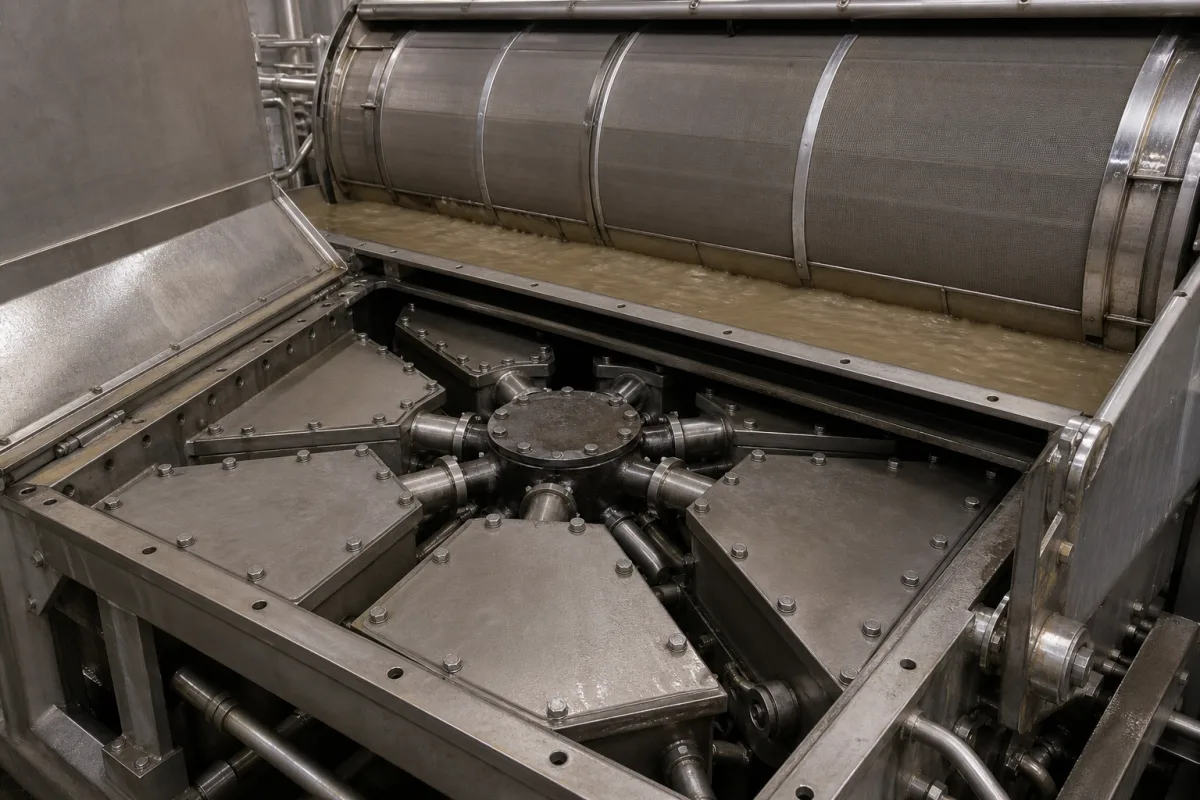
Enclosed compartments within a filter drum that create and maintain a vacuum environment to enhance filtration efficiency.
Product Specifications

Technical details and manufacturing context for Vacuum Chambers

Definition
Vacuum chambers are critical components integrated into filter drum systems that establish and sustain sub-atmospheric pressure zones. These chambers work in conjunction with the rotating drum to create suction through the filter media, significantly improving liquid-solid separation by increasing the pressure differential across the filtration surface. Within the filter drum assembly, vacuum chambers are strategically positioned to maximize contact area and optimize the dewatering process during the filtration cycle.
Working Principle
Vacuum chambers operate by connecting to a vacuum pump system that evacuates air from the sealed compartment, creating negative pressure. As the filter drum rotates through the slurry, the vacuum applied through these chambers draws liquid through the filter media while retaining solids on the drum surface. The chambers maintain consistent vacuum levels throughout the filtration zone to ensure uniform cake formation and efficient moisture removal.
Common Materials
Stainless steel (304/316), Carbon steel, Polypropylene
Technical Parameters
  • Chamber dimensions (length, width, depth) that match the filter drum's internal configuration (mm) Per Request
Components / BOM
  • Vacuum port
    Connection point for vacuum piping to the pump system
    Material: Stainless steel
  • Sealing gasket
    Prevents air leakage between chamber and drum interior
    Material: EPDM rubber
  • Support bracket
    Structural mounting component securing chamber to drum frame
    Material: Carbon steel
Engineering Reasoning
0.001-1.0 mbar absolute pressure
5.0 mbar absolute pressure (vacuum loss threshold)
Design Rationale: Atmospheric pressure differential exceeding chamber structural yield strength (304L stainless steel: 205 MPa yield) causing plastic deformation and seal failure
Risk Mitigation (FMEA)
Trigger Seal material outgassing rate exceeding 1.0×10⁻⁶ mbar·L/s·cm²
Mode: Vacuum pressure degradation to >5.0 mbar within 60 seconds
Strategy: Perfluoroelastomer (FFKM) seals with outgassing rate <1.0×10⁻⁸ mbar·L/s·cm² at 150°C
Trigger Thermal cycling between 20-200°C at >5°C/min rate
Mode: 304L stainless steel chamber wall fatigue cracking at weld joints
Strategy: Controlled heating/cooling at ≤2°C/min with stress-relieved welds (post-weld heat treatment at 1050°C for 1 hour)

Industry Taxonomies & Aliases

Commonly used trade names and technical identifiers for Vacuum Chambers.

Applied To / Applications

This component is essential for the following industrial systems and equipment:

Industrial Ecosystem & Supply Chain DNA

Complementary Systems
Downstream Applications
Specialized Tooling

Application Fit & Sizing Matrix

Operational Limits
pressure: Vacuum range: 0.1 to 500 mbar absolute, Max differential pressure: 1.5 bar
flow rate: Dependent on drum size and vacuum capacity, typically 5-100 m³/h per chamber
temperature: -20°C to 150°C (typical), up to 200°C with specialized seals
slurry concentration: Up to 40% solids by weight, particle size < 500 μm
Media Compatibility
✓ Chemical slurries (acids, bases, solvents) ✓ Mineral processing slurries (ore concentrates, tailings) ✓ Food/pharmaceutical suspensions (starch, protein solutions)
Unsuitable: Highly abrasive slurries with sharp, hard particles (e.g., silicon carbide, diamond dust)
Sizing Data Required
  • Required filtration area (m²) based on slurry volume and desired cycle time
  • Slurry properties (viscosity, particle size distribution, solids concentration)
  • Desired cake moisture content and production rate (kg/h dry solids)

Reliability & Engineering Risk Analysis

Failure Mode & Root Cause
Vacuum Seal Degradation
Cause: Thermal cycling, chemical attack from process gases, or mechanical wear of elastomer seals (e.g., O-rings) leading to leaks and loss of vacuum integrity.
Internal Component Corrosion/Contamination
Cause: Moisture ingress, outgassing from chamber materials, or deposition of process by-products (e.g., polymers, metals) causing electrical shorts, reduced conductance, or arcing.
Maintenance Indicators
  • Audible hissing or whistling indicating a vacuum leak, often near seals or flanges.
  • Visible discoloration, pitting, or unusual deposits on internal surfaces (e.g., walls, viewports) during inspection.
Engineering Tips
  • Implement a regular leak-checking schedule using helium mass spectrometry and replace seals proactively based on manufacturer specs and thermal cycle counts.
  • Use high-purity, compatible materials for internal components, maintain proper bake-out procedures to reduce outgassing, and install appropriate filtration for process gases.

Compliance & Manufacturing Standards

Reference Standards
ISO 21358:2020 - Vacuum technology - Vacuum chambers - Design and construction ANSI/ASTM E595-15 - Standard Test Method for Total Mass Loss and Collected Volatile Condensable Materials from Outgassing in a Vacuum Environment DIN 28400-1:2016 - Vacuum technology - Vocabulary - Part 1: General terms
Manufacturing Precision
  • Leak rate: ≤ 1×10⁻⁹ mbar·L/s (helium leak test)
  • Surface roughness: Ra ≤ 0.8 μm for sealing surfaces
Quality Inspection
  • Helium leak detection test (mass spectrometer method)
  • Residual gas analysis (RGA) for outgassing verification

Factories Producing Vacuum Chambers

Verified manufacturers with capability to produce this product in China

✓ 93% Supplier Capability Match Found

T Technical Director from Germany Jan 10, 2026
★★★★★
"Standard OEM quality for Machinery and Equipment Manufacturing applications. The Vacuum Chambers arrived with full certification."
Technical Specifications Verified
P Project Engineer from Brazil Jan 07, 2026
★★★★☆
"Great transparency on the Vacuum Chambers components. Essential for our Machinery and Equipment Manufacturing supply chain. (Delivery took slightly longer than expected, but technical support was excellent.)"
Technical Specifications Verified
S Sourcing Manager from Canada Jan 04, 2026
★★★★★
"The Vacuum Chambers we sourced perfectly fits our Machinery and Equipment Manufacturing production line requirements."
Technical Specifications Verified
Verification Protocol

“Feedback is collected from verified sourcing managers during RFQ (Request for Quote) and factory evaluation processes on CNFX. These reports represent historical performance data and technical audit summaries from our B2B manufacturing network.”

14 sourcing managers are analyzing this specification now. Last inquiry for Vacuum Chambers from Poland (1h ago).

Supply Chain Compatible Machinery & Devices

Automated Assembly Line System

Integrated production system for sequential component assembly operations

Explore Specs →
Automated Powder Coating System

Integrated industrial system for applying dry powder coatings to metal substrates.

Explore Specs →
Centrifugal Pump Impeller

Rotating component that transfers energy to fluid in centrifugal pumps.

Explore Specs →
High-Precision CNC Laser Cutting Machine

Computer-controlled industrial machine using focused laser beams to cut sheet metal with micron-level accuracy.

Explore Specs →

Frequently Asked Questions

What materials are available for vacuum chambers in machinery manufacturing?

Our vacuum chambers are constructed from durable materials including stainless steel (grades 304/316), carbon steel, and polypropylene to suit various industrial applications and environmental conditions.

How do vacuum chambers improve filtration efficiency?

Vacuum chambers create and maintain a controlled vacuum environment within filter drums, which enhances filtration by increasing pressure differentials, resulting in faster and more thorough separation of solids from liquids.

What components are included in the vacuum chamber BOM?

The standard bill of materials includes a vacuum port for connection to vacuum systems, sealing gaskets to maintain airtight integrity, and support brackets for secure installation within filtration equipment.

Can I contact factories directly on CNFX?

CNFX is an open directory, not a transaction platform. Each factory profile provides direct contact information and production details to help you initiate direct inquiries with Chinese suppliers.

Get Quote for Vacuum Chambers

Request technical pricing, lead times, or customized specifications for Vacuum Chambers directly from verified manufacturing units.

Your business information is encrypted and only shared with verified Vacuum Chambers suppliers.

Thank you! Your message has been sent. We'll respond within 1–3 business days.

Need to Manufacture Vacuum Chambers?

Connect with verified factories specializing in this product category

Add Your Factory Contact Us
Previous Product
UV-C Germicidal Lamp
Next Product
Vacuum Distribution Manifold