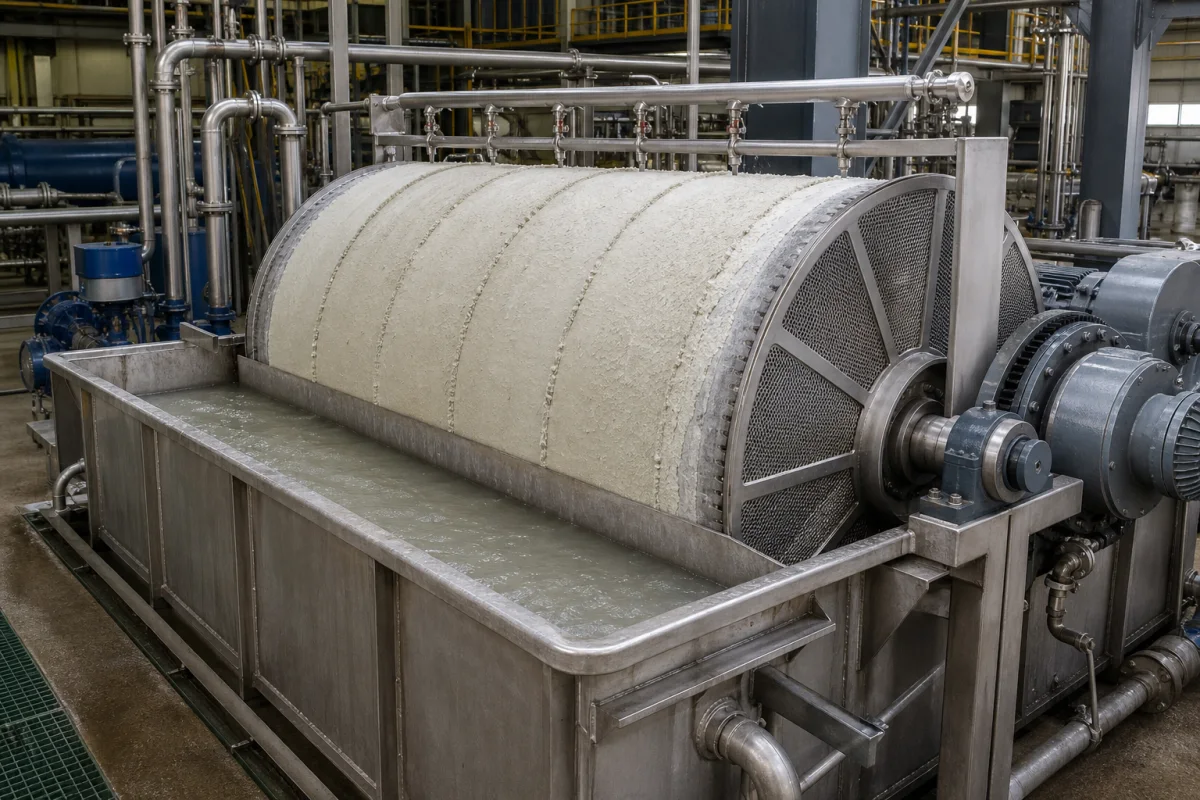
The filter drum is the core rotating component of an industrial rotary drum vacuum filter, consisting of a cylindrical structure covered with filter media. As it rotates through the slurry tank, vacuum applied to the interior creates a pressure differential that draws liquid through the filter media while solids accumulate on the drum surface, forming a filter cake that is subsequently discharged. The drum is typically constructed from stainless steel, carbon steel, or special alloys, with material grade options such as 304 or 316L per ASTM A240. Key parameters include diameter (1000–5000 mm), length (2000–12000 mm), filtration area (5–120 m²), rotational speed (0.1–5 rpm), operating pressure (-0.08 to 0.3 MPa), operating temperature (-20 to 120 °C), surface roughness (Ra 0.8–3.2 μm), weight (2000–15000 kg), and tolerance (±0.5 mm per ISO 2768-m). These values are reference ranges for directory purposes and must be confirmed for the specific model and application with the legal manufacturer or supplier. The drum's design influences filtration efficiency, cake thickness, and discharge effectiveness. Proper selection requires consideration of slurry characteristics, desired throughput, and material compatibility. Verification of actual specifications, including material grades and standards, is essential before procurement. Maintenance signals include uneven cake formation, reduced filtration rate, or visible wear on the drum surface. Failure boundaries may involve structural deformation, corrosion, or filter media damage, which can compromise performance and safety.
The filter drum rotates partially submerged in a slurry tank. Vacuum applied to the interior creates suction that draws liquid through the filter media covering the drum surface, while solids are retained on the exterior to form a filter cake. The rotation carries the cake through washing, drying, and discharge zones before returning to the slurry tank. The drum's rotational speed and vacuum level control cake thickness and residence time, affecting overall filtration efficiency.