Industry-Verified Manufacturing Data (2026)

Vial Positioning Nest

Based on aggregated insights from multiple verified factory profiles within the CNFX directory, the standard Vial Positioning Nest used in the Machinery and Equipment Manufacturing sector typically supports operational capacities ranging from standard industrial configurations to heavy-duty production requirements.

Technical Definition & Core Assembly

A canonical Vial Positioning Nest is characterized by the integration of Positioning Cavity / Bore and Base Plate / Mounting Plate. In industrial production environments, manufacturers listed on CNFX commonly emphasize Stainless Steel (e.g., 304, 316) construction to support stable, high-cycle operation across diverse manufacturing scenarios.

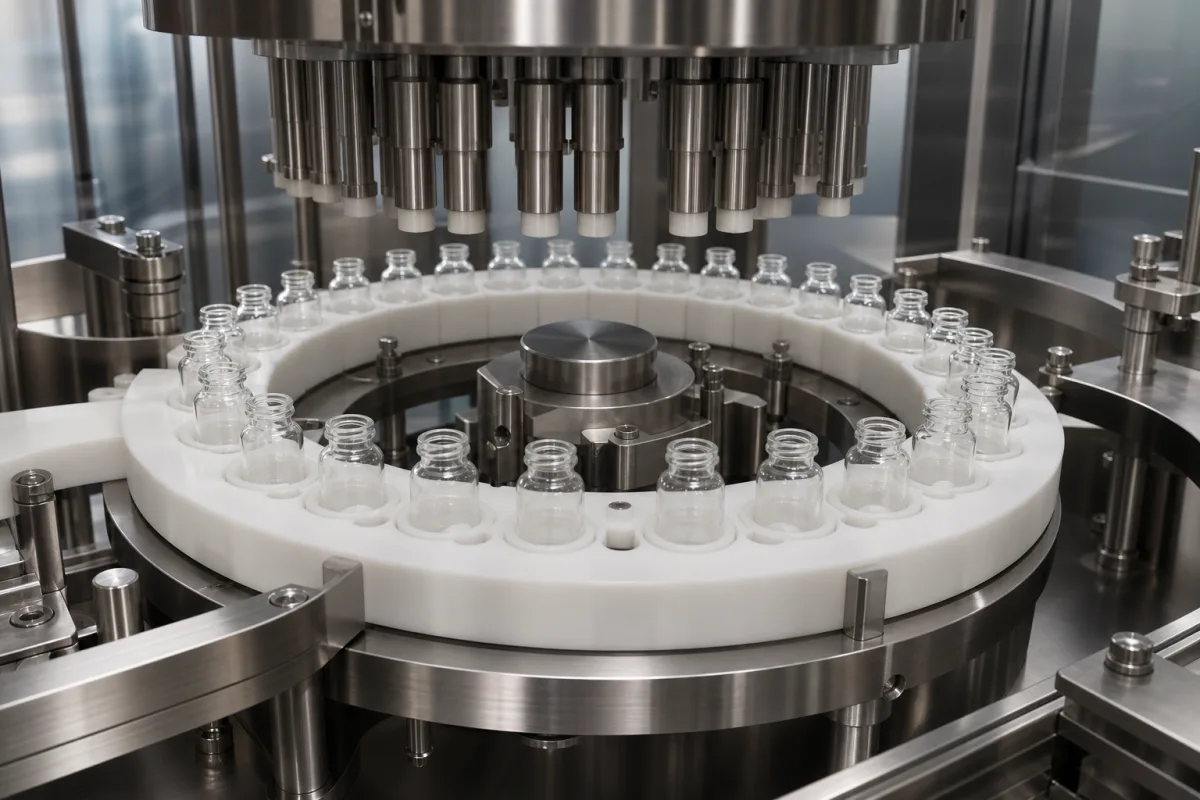
A precision fixture component within a stoppering station that securely holds and positions vials during the sealing process.
Product Specifications

Technical details and manufacturing context for Vial Positioning Nest

Definition
The Vial Positioning Nest is a critical component of the Stoppering Station in pharmaceutical or laboratory filling lines. It functions as a specialized fixture that precisely locates, secures, and aligns individual vials (typically glass or plastic containers) to ensure accurate and consistent placement of stoppers or caps. Its design ensures vial stability during the high-speed or automated stoppering operation, preventing misalignment, tipping, or damage that could compromise seal integrity or cause production downtime.
Working Principle
The nest operates by providing a custom-shaped cavity or receptacle that matches the vial's outer geometry (often the base or a specific section). Vials are fed into the nest, where they are held firmly by the nest's contours, sometimes assisted by spring-loaded elements, vacuum suction, or gentle clamping. This precise positioning ensures the vial's opening is correctly aligned under the stoppering head for the subsequent sealing operation.
Common Materials
Stainless Steel (e.g., 304, 316), Engineering Plastic (e.g., PEEK, Delrin), Aluminum Alloy
Technical Parameters
  • Critical dimensions include the inner diameter/depth to match specific vial outer diameters/heights, tolerance for precise fit, and mounting hole patterns for integration into the station. (mm) Customizable
Components / BOM
  • Positioning Cavity / Bore
    The main recess that accepts and centers the vial body.
    Material: Stainless Steel or Engineering Plastic
  • Base Plate / Mounting Plate
    Provides structural foundation and mounting points to integrate the nest into the stoppering station frame.
    Material: Stainless Steel or Aluminum
  • Retention Spring / Clip (Optional)
    Applies gentle lateral or downward force to secure the vial without marring.
    Material: Stainless Steel
  • Wear Insert / Liner (Optional)
    Replaceable contact surface to reduce wear on the main nest body from vial insertion/removal cycles.
    Material: PTFE, UHMW-PE, or other low-friction polymer
Engineering Reasoning
0.1-5.0 N clamping force, 0.01-0.05 mm positional tolerance, 15-35°C operating temperature
Clamping force exceeds 8.0 N causing vial deformation, positional error exceeds 0.1 mm causing misalignment, temperature exceeds 50°C causing thermal expansion beyond 0.02 mm
Design Rationale: Excessive clamping force induces plastic deformation via von Mises yield criterion (σ_vm > 250 MPa for 316L stainless steel), thermal expansion mismatch (α_vial=8.5×10^-6 K^-1 vs α_nest=17.3×10^-6 K^-1) creates interfacial stresses exceeding 150 MPa
Risk Mitigation (FMEA)
Trigger Accumulated particulate contamination (≥50 μm particles) on nest surfaces
Mode: Increased friction coefficient (μ>0.3) causing vial rotation during stoppering
Strategy: Integrate pneumatic purge system with 0.2 μm HEPA filtration and surface coating with DLC (Diamond-Like Carbon) layer (Ra<0.1 μm)
Trigger Cyclic thermal loading from repeated autoclaving (121°C steam, 1000+ cycles)
Mode: Stress corrosion cracking initiating at radiused corners (K_ISCC=25 MPa√m for 316L in chloride environment)
Strategy: Replace with precipitation-hardened 17-4PH stainless steel (H900 condition, σ_y=1310 MPa) and increase fillet radius to 2.0 mm

Industry Taxonomies & Aliases

Commonly used trade names and technical identifiers for Vial Positioning Nest.

Applied To / Applications

This component is essential for the following industrial systems and equipment:

Industrial Ecosystem & Supply Chain DNA

Complementary Systems
Downstream Applications
Specialized Tooling

Application Fit & Sizing Matrix

Operational Limits
pressure: Atmospheric to 2 bar (typical stoppering force context)
other spec: Vial positional tolerance: ±0.1 mm, Vial diameter range: 10-50 mm
temperature: -20°C to 150°C (sterilization range)
Media Compatibility
✓ Glass vials (Type I borosilicate) ✓ Polymer vials (COP/COC) ✓ Stainless steel vials
Unsuitable: Abrasive slurry environments with particulate >100 μm
Sizing Data Required
  • Vial outer diameter and tolerance
  • Required throughput (vials/hour)
  • Stoppering force specification

Reliability & Engineering Risk Analysis

Failure Mode & Root Cause
Misalignment-induced wear
Cause: Improper vial loading or repeated impact causing gradual deformation of positioning surfaces, leading to inaccurate vial placement and potential jamming.
Contamination buildup
Cause: Accumulation of particulate matter, residues, or biological contaminants in nest recesses, compromising positioning accuracy and increasing friction during vial insertion/removal.
Maintenance Indicators
  • Audible scraping or grinding noises during vial insertion/removal cycles
  • Visible misalignment or wobbling of vials when positioned in the nest
Engineering Tips
  • Implement regular precision alignment checks using calibrated gauges to detect early wear patterns before they affect performance
  • Establish a strict cleaning protocol with compatible solvents and non-abrasive tools to prevent contamination buildup without damaging nest surfaces

Compliance & Manufacturing Standards

Reference Standards
ISO 13485:2016 - Medical devices - Quality management systems ISO 14644-1:2015 - Cleanrooms and associated controlled environments CE Marking - Medical Device Directive 93/42/EEC
Manufacturing Precision
  • Vial Bore Diameter: +/-0.05mm
  • Nest Flatness: 0.1mm across entire surface
Quality Inspection
  • Dimensional Verification via Coordinate Measuring Machine (CMM)
  • Material Composition Verification via X-ray Fluorescence (XRF) Analysis

Factories Producing Vial Positioning Nest

Verified manufacturers with capability to produce this product in China

✓ 98% Supplier Capability Match Found

P Project Engineer from Singapore Feb 02, 2026
★★★★★
"The Vial Positioning Nest we sourced perfectly fits our Machinery and Equipment Manufacturing production line requirements."
Technical Specifications Verified
S Sourcing Manager from Germany Jan 30, 2026
★★★★★
"Found 27+ suppliers for Vial Positioning Nest on CNFX, but this spec remains the most cost-effective."
Technical Specifications Verified
P Procurement Specialist from Brazil Jan 27, 2026
★★★★★
"The technical documentation for this Vial Positioning Nest is very thorough, especially regarding technical reliability."
Technical Specifications Verified
Verification Protocol

“Feedback is collected from verified sourcing managers during RFQ (Request for Quote) and factory evaluation processes on CNFX. These reports represent historical performance data and technical audit summaries from our B2B manufacturing network.”

8 sourcing managers are analyzing this specification now. Last inquiry for Vial Positioning Nest from Turkey (1h ago).

Supply Chain Compatible Machinery & Devices

Hydraulic Press

Industrial machine using hydraulic pressure to compress, form, or assemble materials

Explore Specs →
Heavy-Duty CNC Plasma Cutting Machine

Industrial machine for precision metal cutting using plasma arc technology

Explore Specs →
Automated Assembly Line System

Integrated production system for sequential component assembly operations

Explore Specs →
Automated Powder Coating System

Integrated industrial system for applying dry powder coatings to metal substrates.

Explore Specs →

Frequently Asked Questions

What materials are available for the vial positioning nest?

Our vial positioning nests are manufactured from durable materials including Stainless Steel (304 or 316 grades), Engineering Plastics (PEEK or Delrin), and Aluminum Alloy to suit various application requirements and environments.

How does the vial positioning nest improve stoppering station performance?

The precision fixture securely holds and positions vials during the sealing process, ensuring consistent alignment and reducing product loss. Optional retention springs and wear inserts enhance stability and longevity in high-volume operations.

Can the vial positioning nest be customized for different vial sizes?

Yes, the positioning cavity/bore and base plate can be customized to accommodate various vial diameters and heights. Optional components like retention clips and wear liners can be tailored to specific production needs.

Can I contact factories directly on CNFX?

CNFX is an open directory, not a transaction platform. Each factory profile provides direct contact information and production details to help you initiate direct inquiries with Chinese suppliers.

Get Quote for Vial Positioning Nest

Request technical pricing, lead times, or customized specifications for Vial Positioning Nest directly from verified manufacturing units.

Your business information is encrypted and only shared with verified Vial Positioning Nest suppliers.

Thank you! Your message has been sent. We'll respond within 1–3 business days.

Need to Manufacture Vial Positioning Nest?

Connect with verified factories specializing in this product category

Add Your Factory Contact Us
Previous Product
Vessel/Shell
Next Product
Vial/Syringe Washer