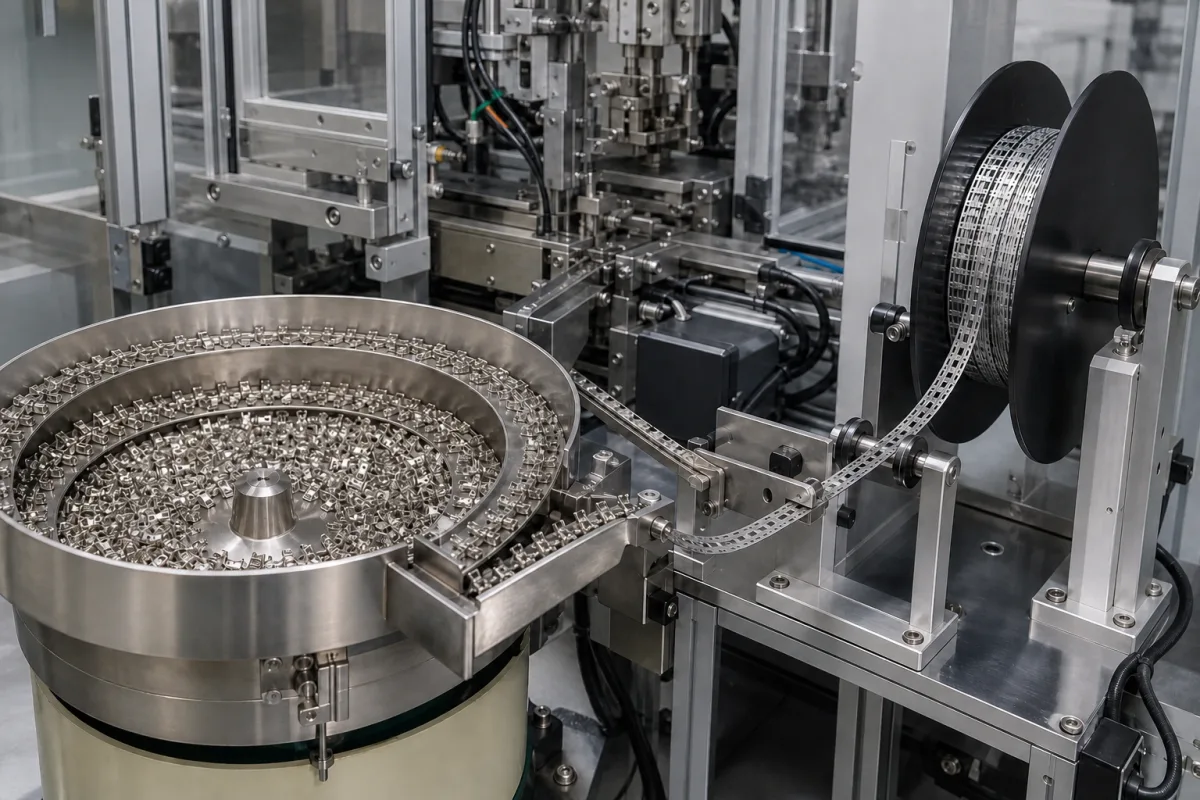
Vibratory bowl feeder and reel stand for terminal insertion: feeding loose parts and carrier-strip terminals into one machine
Part supply for terminal insertion machines · reel stand braking and interleaf take-up for carrier-strip terminals, strip feed and shear at the head, bowl tracks for loose pins and parts
A terminal insertion or terminating machine takes its metal parts in one of two forms. Terminals stamped on a continuous carrier strip arrive wound on a reel, with paper or foam between the layers, and need a reel stand that unwinds them at a steady pull and clears the interleaf. Loose pins, clips or housings arrive in bulk and need a vibratory bowl and track that orient them. Where a machine uses both, the questions are the reel size and weight the stand takes, how its drag is set from full to empty, how the strip is indexed and cut at the head, and which parts go through the bowl.
The supply station of terminal insertion and terminating machines: reel stands and dereelers for carrier-strip terminals, interleaf take-up, strip guides and feed, and vibratory bowls feeding loose pins or parts to the same machine. General vibratory bowl feeders, their drive bases, tooling and controllers are covered on the Vibratory bowl feeder page. Cable and hose reels, wire payoffs and the crimping applicator itself are outside this page.
CNFX editorial research · Sources checked October 12, 2026 · 8 sources
Holding drag on a terminal reel from full to nearly empty
Molex's terminal dereeling patent describes a typical terminal reel as about 24 inches in diameter, holding thousands of terminals wound with a paper or foam interleaf that keeps the layers from tangling. It explains the problem with a fixed shaft and friction retainer: drag high enough to stop a full reel overrunning makes terminals hard to pull as the reel empties, and excessive dereeling tension can break the carrier strip or prevent proper indexing. [1]
Molex's answer is a reel that turns with its shaft in a spindle bearing, with a spring plate pressed axially against the reel hub: the spring braking stops a nearly full reel over-rotating, and the bearing allows lower strip tension from a nearly empty one. A separate take-up reel, which in the patent may be driven by a DC motor that must not drive the terminal reel, winds up the interleaf along a path angled away from the terminal strip. [1]
A general-purpose bench dereeler shows the size limits such a stand works to. The Eraser Company's DE400 takes reels up to 483 mm (19 in) in diameter, 152 mm wide (254 mm with an extension kit) and 23 kg (50 lb), on hubs from 17.5 to 152 mm, and uses a spring-loaded friction clutch set to prevent overrun and jams without adding drag that affects the machine downstream. [2] Editorial calculation: the 24-inch reel Molex describes is about 610 mm across (24 × 25.4), larger than the DE400's 483 mm limit, so ask the reel stand supplier for its own maximum diameter, width, hub size and weight against your terminal maker's reel.
Send the terminal maker's reel drawing (outside diameter, width, hub bore, full weight), the interleaf type, the unwinding direction and which side of the machine the reel must stand on.
02
Reel carts that carry the reel and applicator together
Artos Engineering's two-reel terminal cart patent supports two terminal reels and two terminal applicators on one cart, so the applicators can be loaded with strip and rolled into the wire processing system's terminal station. A paper take-up reel on the cart is driven through a drive wheel that engages a drive motor on the machine, letting the machine control the take-up; gears or a separate motor on the cart are named as alternatives. [3]
Editorial note: if changeover time matters, ask whether the reel stand is fixed to the machine or mounted on a cart with the applicator, and how the interleaf take-up is driven in each case.
03
Feed finger, shear and pitch where the strip enters the insertion head
Zierick Manufacturing's patent describes features shared by semi-automatic PCB insertion equipment: terminals fed through a stationary feed track by an air-cylinder-driven feed finger, sheared from their integral carrier strip across the strip thickness, then pushed vertically into the board by a pneumatic plunger while the board is held on locating pins. [4]
The feed stroke has to match the strip's pitch. In a Whitaker (AMP group) feed-mechanism patent, the stroke is trimmed by a sleeve with 18 threads per inch on a 24-threads-per-inch bolt, giving about 0.014 inch of adjustment per turn, and a light flat spring holds the strip against vibration on the return stroke. [5] Editorial calculation: 0.014 inch is about 0.36 mm per turn.
Fine-pitch work is harder. AMP's terminal feeding patent notes chip carrier socket cavities spaced only about 0.025 inch apart, with terminals about 0.010 inch thick or less, and says a reciprocating insertion machine for these sizes running at high speed presents substantial difficulties. [6] Editorial calculation: about 0.64 mm pitch and 0.25 mm strip thickness, which a reel stand's tension must not bend or stretch.
Molex's dereeler adds a photo-optical sensor at a set multiple of the terminal pitch from the crimping tools: if the expected block-pass-block sequence of terminals does not occur within a preset time, the control module stops the press. [1]
04
Which parts come from the bowl: loose pins, blanks and housings
Parts that are not supplied on a strip are oriented in a vibratory bowl. Tangen Drives' pin-insertion patent runs a pin track and a blank track in one bowl, with the pin track discharging above the blank track; pins that stray onto the blank track drop off and recirculate, and the stated aim is a reject rate of 10 percent or less with automatic recycling of unassembled parts. [7]
AMP's loose-piece terminal patent lists the problems loose terminals bring compared with strip: difficulty in handling, orientation when mounting and protection once mounted, and describes a carrier housing that holds loose terminals aligned for mass insertion. [8] Editorial note: for each part on the machine, ask whether it is available on a carrier strip and reel; strip-fed parts go through the reel stand, and only the rest need bowl tooling.
05
Send the reel drawing, the strip pitch and the list of bowl-fed parts
Paste it into your enquiry below or into an email to a maker, then replace every bracket.
Terminal reel: [outside diameter; width; hub bore; full weight; interleaf paper or foam]
Unwinding: [direction; reel side of machine; fixed stand or cart]
Strip: [terminal pitch; strip thickness; carrier width]
Head: [feed finger stroke; shear; insertion force]
Sensing: [terminal presence sensor; stop on mis-feed]
Loose parts: [part drawings; rate per minute; orientation at discharge]
Explore company information and manufacturing capabilities, then discuss the scope of your project with a relevant supplier.
Share this page
Compiled and source-reviewed by the CNFX editorial team.
Each manufacturer above links to the page on that company's own website where the product is listed, with the date we checked it. How we source and review
· Page last updated 13 October 2026
Buyer questions
Why does a terminal reel stand need adjustable drag?
Molex explains that drag high enough to stop a full reel overrunning makes strip hard to pull near empty, and excessive tension can break the carrier strip or stop it indexing; its design combines a spring plate on the hub with a spindle bearing. [1]
How large a reel does a bench dereeler take?
The Eraser DE400 takes reels up to 483 mm diameter, 152 mm wide and 23 kg; Molex describes a typical terminal reel as about 24 inches across. [2][1]
What happens to the paper between terminal layers?
A take-up reel winds the interleaf as the strip feeds; Molex describes a motor-driven take-up, and Artos a take-up on a reel cart driven from the machine. [1][3]
How are strip terminals cut and inserted?
Zierick describes a feed finger advancing the strip through a feed track, a horizontal shear across the carrier strip, and a pneumatic plunger pressing the terminal into the board. [4]
Sources and what still needs a direct check
Sources checked 2026-10-12. The reel, strip-feed and bowl details come from patents by connector and machine makers (Molex, AMP and its Whitaker group, Zierick, Artos, Tangen Drives) and from one dereeler maker's operating manual. Patents describe their own designs; ask the supplier for the corresponding data on the stand quoted.