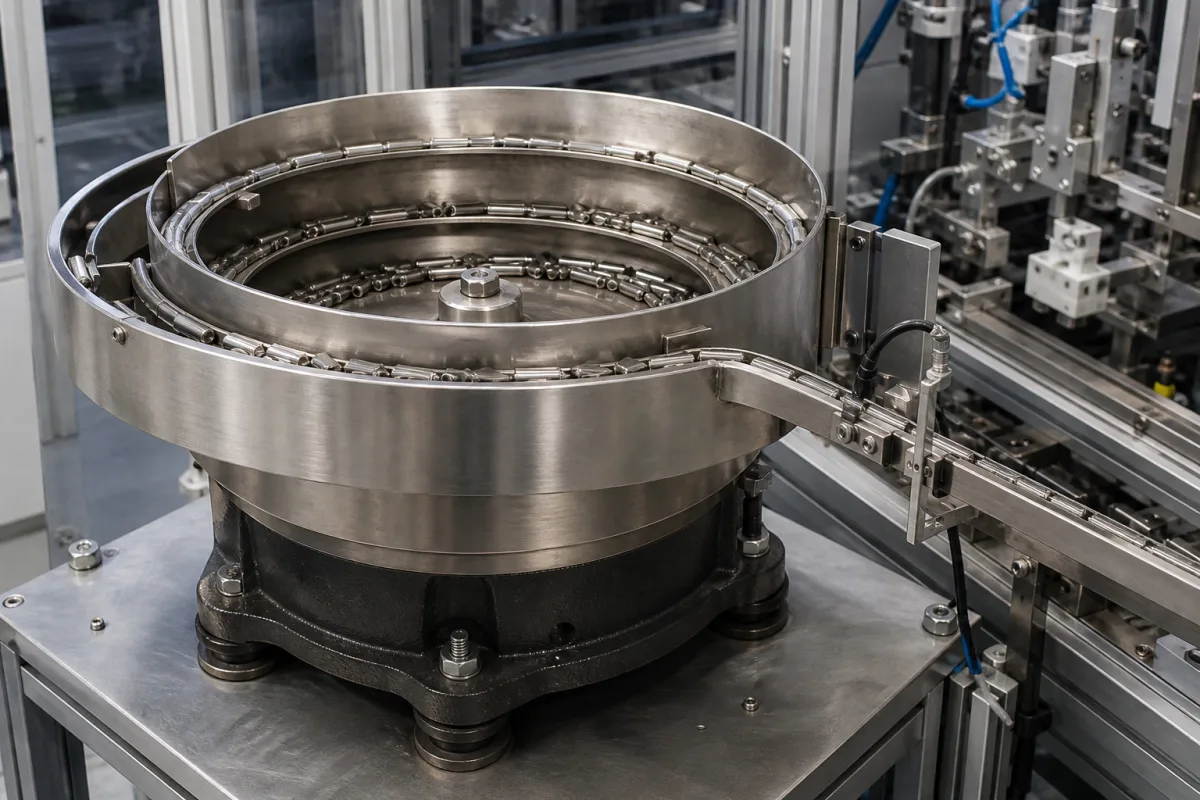
Parts feeding · Oriented rate, tooling, drive frequency, coatings and acceptance
A vibratory bowl feeder takes bulk parts and delivers them one at a time in a set orientation to an assembly, packaging or inspection station. Ask three things first: the part and the exact discharge orientation, the oriented rate the next station needs, and how orientation accuracy will be tested at acceptance.
Vibratory bowl feeders with drive units, custom tooling, linear tracks and controllers. Flexible (vision) feeders, step feeders and complete assembly machines are outside this page.
CNFX editorial research · Sources checked October 12, 2026 · 5 sources
Hoosier Feeder Company, a feeder maker, describes vibratory feeders as handling 1–250 oriented parts per minute, with rates outside that range possible depending on the part. The drive unit's electromagnetic coils vibrate the bowl at 60–120 Hz in Hoosier's description, and angled spring banks make the bowl throw parts up and forward around its circumference. Hoosier describes bowls as custom-fabricated stainless steel with tooling that manipulates the parts, sometimes with air jets, coatings or linings. [1]
The same white paper lists linings and coatings such as urethane and PTFE, bristle and rubber matting, and chrome or tungsten carbide plating, used to reduce noise, protect parts, add grip or extend feeder life; bowl styles it lists include straight-wall, wok and cascade. [1]
Write the discharge state precisely: which way up, which end leading, whether single file and whether parts may touch or overlap.
Give the supplier part drawings and samples, part material and finish, the exact discharge orientation, the oriented rate needed with margin, bulk capacity, downstream interface and track length, noise limits, supply voltage and frequency, and the acceptance test.
02
Test orientation accuracy, not only feed rate
RNA Automation, a feeder maker, warns that feed rate and orientation accuracy are different measures: a feeder can deliver a stable flow while sending a rising share of misoriented parts to a reject gate or an assembly station. RNA says raising amplitude can restore output after drift but adds part energy, with more bouncing, rotation and unpredictable contact with tooling; worn tracks, changed coatings or contamination can change how parts climb and rotate while the feed rate barely changes. [2]
Editorial calculation: at 200 parts per minute, a 2% misorientation rate means 4 wrong parts a minute, or 240 an hour, reaching the next station or reject gate. [2] Specify an acceptance run with a counted orientation result, not only a parts-per-minute figure.
Ask the supplier how orientation is verified at discharge (sensors, rejects, air jets), how track wear is inspected, and what spare tooling is supplied.
03
Expect conveying speed to change non-linearly with frequency and part
Vellingiri and Sadasivam (PSG College of Technology; Strojniški vestnik – Journal of Mechanical Engineering, 2023, open access) tested aluminium and brass prismatic parts of 50–200 g with length-to-width ratios of 1.0–2.5 on a horizontal linear vibratory track. A pilot study found no appreciable movement below 10 Hz or above 50 Hz, so they tested 15, 25, 35 and 45 Hz at 75–90% of input voltage in a Taguchi L16 design. [3]
The authors note that the part's own characteristics (mass and length-to-width ratio) contribute to conveying velocity alongside frequency, amplitude and friction, so a feeder tuned for one part will not deliver the same speed for a heavier or longer part on the same track. Their tests used a linear track; a bowl adds the helical climb and tooling described above. [3][1]
Editorial calculation: at 6 mm/s a 10 mm long part would pass a point about every 1.7 s nose to tail, about 36 parts per minute before any orientation rejects.
Finding (Vellingiri and Sadasivam, 2023)
Result
Frequency range with appreciable movement on their rig
10–50 Hz
Velocity at 15 Hz (50 g part, l/w 1)
6 mm/s
Effect of frequency on velocity
Highly non-linear: falls at 25 Hz, rises again at 35 and 45 Hz
Factor ranking by ANOVA
Frequency first, then coefficient of friction
Regression model fit
R² 99.3% (aluminium), 98.7% (brass)
Agreement with random confirmation runs
91.66%
Send sample parts of each variant (mass, size, material) and ask the supplier to run them at the proposed frequency and amplitude, reporting oriented rate and misorientation for each.
04
Choose the drive base by bowl size, supply and spring angle
Automation Devices, Inc. (ADI) publishes specifications for its vibratory feeder base units. Its "Model 15" base unit suits 15" – 24" vibratory bowls, comes in clockwise or counter-clockwise rotation, and runs on 120 VAC at 3.0A (Model 6000.1 controller) or 240 VAC at 1.5A (Model 6000.2), with a 25° spring angle and a shipping weight of 116 pounds. Its "Model 15FA" fast angle base unit lists the same supplies and weight with a 15° spring angle. ADI lists standard bases from Model 03 to Model 35, fast angle bases (05FA, 10FA, 15FA) and a low-profile 18XL. [4]
Hoosier explains that angled spring banks make the bowl throw parts up and forward around its circumference [1]; ADI offers the same size of base at two spring angles, 25° and 15° [4]. The page reviewed does not state which parts suit each angle, so ask the supplier why it chose the angle for your part and to demonstrate the oriented rate with it. RNA warns that raising amplitude to restore rate can reduce orientation accuracy [2].
ADI's 6000 series amplitude controllers vary the amplitude of vibration in vibratory and linear feeders, and the 6450 series is a variable frequency controller in NEMA-1 or NEMA-12 enclosures [5]. The PSG College track study found conveying velocity changing non-linearly with frequency [3]; ask whether the controller quoted adjusts amplitude only or frequency as well, and which sensors it accepts.
Editorial calculation: 120 VAC at 3.0A is 360 VA and 240 VAC at 1.5A is also 360 VA; 15" – 24" is 381–610 mm of bowl diameter; 116 pounds is about 52.6 kg. [4]
Fill the specification fields with values for your parts
A bowl feeder quotation needs values for your parts and line. The table explains each field, gives published values where a reviewed source states them, and says what to obtain from the supplier.
Field
What it means and published values
Ask the supplier for
Feeding speed (m/min)
Better stated as oriented parts per minute, e.g. 1–250. [1]
Oriented rate at discharge.
Bowl diameter (mm)
Bowl size; e.g. one base for 15–24 in (381–610 mm) bowls. [4]
Explore company information and manufacturing capabilities, then discuss the scope of your project with a relevant supplier.
Share this page
Compiled and source-reviewed by the CNFX editorial team.
Published product pages show what a company offers, not tested performance. Confirm the legal seller, factory and scope for your order. How we source and review
· Page last updated 13 October 2026
Buyer questions
How fast can a vibratory bowl feeder run?
Hoosier Feeder Company gives 1–250 oriented parts per minute, with higher or lower rates possible depending on the part. [1]
Why can a bowl feeder keep its rate but misorient parts?
Higher amplitude, worn tracks or changed surfaces alter how parts bounce and rotate, so orientation can degrade while output looks stable. [2]
What frequency do bowl feeder drives use?
Hoosier says electromagnetic drives vibrate at 60–120 Hz, with angled springs throwing parts forward. [1]
Does feeder frequency change part speed in a simple way?
No: a 2023 study on a linear vibratory track found velocity varied highly non-linearly over 15–45 Hz and that frequency, then friction, had the largest effect. [3]
What size drive base does a 15–24 inch bowl feeder need?
Automation Devices lists its Model 15 base unit for 15–24 inch bowls, on 120 VAC at 3.0 A or 240 VAC at 1.5 A with a 25° spring angle; its Model 15FA fast angle version has a 15° spring angle. [4]
Sources and what still needs a direct check
Sources checked 2026-10-12. Hoosier Feeder Company and RNA Automation are feeder makers; their materials describe general practice. Supplier pages describe their own offers.