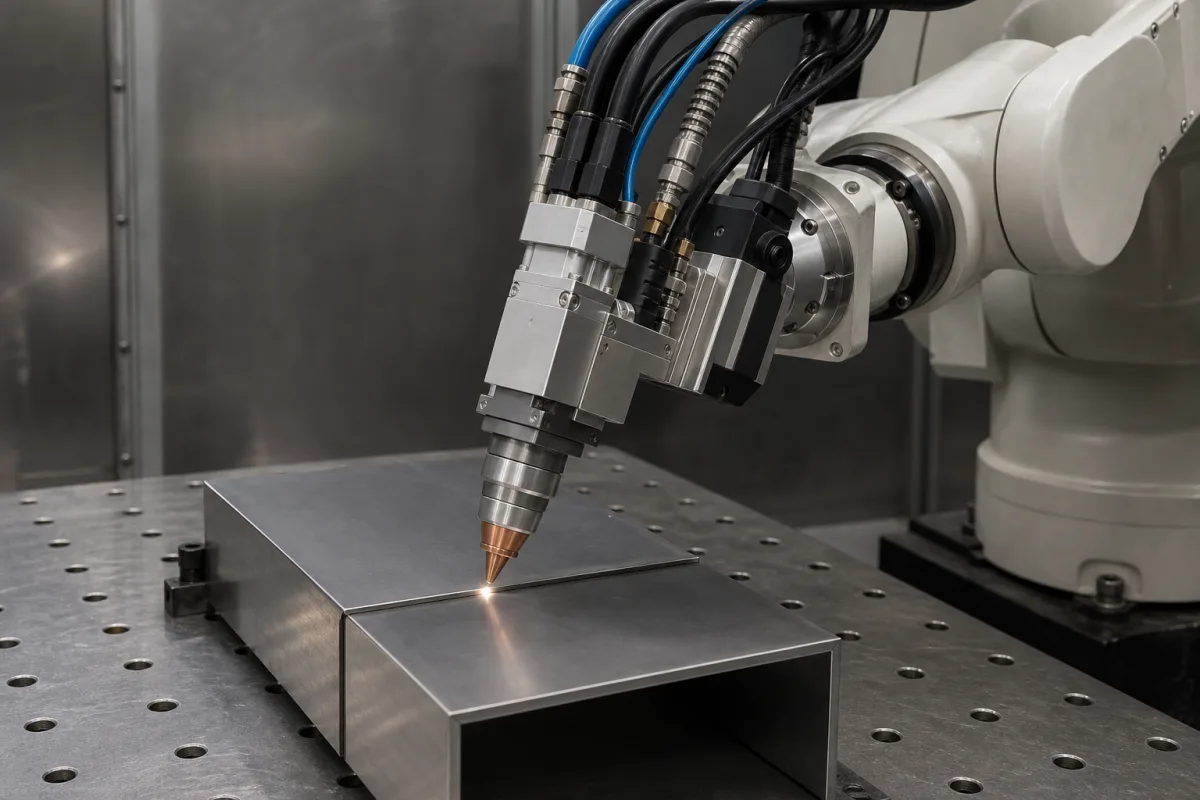
Sensor-equipped robot laser welding head (seam-tracking and in-process monitoring head)
Robot laser welding heads with their own joint sensing · filler-wire tactile tracking, camera and laser-line seam finding, photodiode and depth monitoring
A plain laser welding head puts the focused beam where the robot program says the joint is. The heads on this page carry extra hardware that checks where the joint really is and how the weld is going: a filler wire pressed into the seam as a mechanical feeler, a camera or projected laser line that sees the joint ahead of the spot, and photodiodes or an interferometer that read the process while it runs. Buyers choosing one need to decide how the head will find the seam, how much height and side error it can absorb, which signals it records for each weld, and what the extra mass does to the robot.
Robot-mounted laser welding and brazing heads that integrate seam-tracking or in-process monitoring sensors (tactile filler-wire tracking, coaxial or side cameras, laser-line seam sensors, photodiode process monitors and inline depth measurement). Plain fixed-optic, wobble, galvo and wire-feed laser welding heads, chosen by fibre core, focal length and cover glass, are covered on the Laser welding head page; MIG/MAG and TIG torches on the Welding torch page; laser cutting heads on the Cutting head page; complete laser welding machines and robot cells on the Laser welding machine page. Stand-alone seam sensors sold without a welding head are outside this page.
CNFX editorial research · Sources checked October 12, 2026 · 8 sources
Filler-wire tactile tracking: ±90° swivel, ±5 mm telescopic stroke, up to 6 kW
Scansonic's ALO3 uses the tip of the filler wire as the sensor: the wire detects the weld edge and guides the head along the seam, and because the wire is also melted into the joint, component tolerances are compensated without a separate tracking probe. The head moves on a lateral swivel axis with a range of ±90° and a telescopic arm with an operating range of ±5 mm in height, under force control. [1]
Scansonic lists the ALO3 for laser brazing and welding of steel and aluminium on Y-seams at flange welds, fillet welds at lap joints and fillet welds at T-joints, for diode and solid-state lasers of 900–1080 nm and up to 6 kW CW. Focal distances are 141–250 mm, the cross-jet and a quick-change safety-glass drawer are built in, and options include autofocus, a camera with cross-hair generator, the SCeye process monitoring system and hot wire up to 100 or 230 A. [1]
Its successor, the ALO4, adds an autofocus that tracks the horizontal focus position, motorised lateral beam adjustment set by recipe and fieldbus, protective-glass monitoring based on temperature evaluation, and SCeye recording of video and data for envelope, pore and beam-to-wire position checks. Scansonic gives the processing optics as about 20 kg and IP60 (up to IP64 when the laser light cable receiver is sealed), with a controller power-supply box of about 25 kg at IP54. [2]
Editorial calculation: a ±5 mm telescopic stroke gives 10 mm of total height compensation in the beam direction; parts whose seam height scatters by more than that need fixture correction or a different tracking method. [1]
Tactile tracking only works where filler wire is part of the process and the joint has an edge or groove for the wire to follow (flange, lap or T-joint). State the joint types, the largest side and height deviation you measure on real parts, the wire alloy and diameter, and whether hot wire is needed.
02
Optical seam finding with a grey-scale camera and a projected laser line
Where there is no filler wire, the joint has to be found optically. Precitec describes two complementary methods: a high-resolution 2D grey-scale image of the surface and a 3D profile from a projected laser line, which shows the geometry of the joint. Its sensor combines both, and the measured joint position is fed back as correction data to the laser beam, the processing head, the robot path or the scanner. [3]
Precitec names manufacturing, clamping and assembly tolerances, forming operations and changing joint geometry as the causes of seam offset, and lists seam finding before welding, continuous tracking during welding, and its WeldMaster Wire Select option, which uses optical seam data to adapt wire feed to the actual joint condition. [3]
Camera hardware also appears on general-purpose Chinese heads as a build option. Han's Laser lists a camera among the optional modules of its FW208 oscillating welding head, beside coaxial and side gas, air curtain, red-light positioning and blue-light lamp, and describes a built-in CCD imaging unit with light source and contamination detection on its FW406 dual-wavelength composite head, used to warn before a delayed protective-lens change spoils welds. [7][8]
Klimpel's review explains why tracking matters more for short optics: focal lengths of the order of 38–75 mm give greater penetration but make bead shape and depth depend on holding the focus position, while focal lengths from about 125 mm up to 2,500 mm tolerate more deviation along the weld line and in the joint-to-nozzle distance and are used in scanning robotised systems. [6]
03
Photodiode bands, 50 kHz process signals and 70 kHz depth measurement
Klimpel lists the sensors that online quality-monitoring systems integrate with laser heads: acoustic sensors, photodiodes, high-speed cameras, spectrometers, pyrometers and plasma-plume charge probes. A typical photodiode set-up shown in the review reads three bands through optical filters: plasma radiation at 200–750 nm, back-reflected laser radiation, and infrared at 1100–1700 nm. [6]
Precitec states that the LWM can be built into welding optics, scanner optics or the laser source, works with IR, blue and green lasers in CW or pulsed mode, and reports over TCP/IP, fieldbus, digital I/O and OPC-UA. Among the defects it lists are focus shift, contaminated parts, spatter and an excessive gap between top and bottom sheet in lap welds, where in extreme cases no connection forms (a "false friend"); Precitec says the LWM detects this reliably, in contrast to a visual or camera inspection. [4] The IDM can also close the loop by controlling laser power in real time to hold weld depth. [5]
Editorial calculation: at an assumed welding speed of 6 m/min (100 mm/s), a 50 kHz signal gives one sample every 0.002 mm of seam and a 70 kHz depth measurement one every 0.0014 mm. The speed is an example; use your own. [4][5]
Sensor in or on the head
What it reads
Published figure
Photodiode process monitor
Plasma, reflected laser and thermal light from the weld zone
Plasma band 200–750 nm; infrared band 1100–1700 nm [6]
Precitec LWM 8.50
Process signals compared with a reference fingerprint for each weld
Sampling rate up to 50 kHz; extra temperature channels into the near infrared [4]
Precitec IDM
Absolute weld depth by optical interference, measuring keyhole depth and surface distance together
Measuring depth up to 10 mm; rate up to 70 kHz [5]
Protective-glass monitor
Contamination of the process-side window
Temperature evaluation on the ALO4 [2]; CCD contamination detection on the FW406 [8]
04
Head mass, cooling water and air curtain on the robot flange
The tracking and monitoring hardware adds mass and media lines to the robot's sixth axis. Published figures for two very different heads show the spread:
Han's gives the FW208 collimation focal lengths of 75/100 mm (3 kW) and 100/125 mm (6 kW), focus focal lengths of 200, 250 or 300 mm, clear apertures of 26 and 34 mm and an operating temperature of +15 to +70 °C. [7] Editorial calculation: the ALO4 processing optics at about 20 kg weigh four times the 6 kW FW208 at ≤5 kg, before wire feeder, hoses and dress pack are added; check the robot's rated payload and wrist moment against the full assembly. [2][7]
Cooling water ≤0.5 MPa, ≥2 L/min, 30 °C; air curtain 0.3–0.5 MPa [7]
For hybrid laser-arc heads, where a MIG/MAG torch is mounted beside the laser optic, Klimpel lists accurate positioning of laser head and arc torch and proper part fit-up among the process limitations; ask how the head fixes and adjusts the torch-to-beam distance.
05
Joint, tolerance and monitoring data for the head quotation
Paste it into your enquiry below or into an email to a maker, then replace every bracket.
Joints: [butt / lap / fillet / flange; material and thickness]
Measured tolerances: [side offset; height scatter; gap]
Tracking: [filler-wire tactile / camera / laser line; wire alloy and diameter]
Monitoring: [photodiode / depth / camera recording; data interface]
Laser: [type; wavelength; power; fibre connector]
Optics: [focal lengths; autofocus; wobble]
Robot: [model; payload; flange; dress pack]
Media: [cooling water; shielding gas; cross-jet air]
Laser welding heads offered with camera or CCD modules
Han's Laser lists the FW208 oscillating head with an optional camera module and the FW406 composite head with a built-in CCD imaging unit.
Han's Laser
Manufacturing site to be confirmed for the order
Lists the FW208 oscillating welding head (≤3 kW and ≤6 kW versions) with a camera among its optional modules, and the FW406 dual-wavelength composite welding head with a built-in CCD imaging unit and contamination detection.
Explore company information and manufacturing capabilities, then discuss the scope of your project with a relevant supplier.
Share this page
Compiled and source-reviewed by the CNFX editorial team.
Each manufacturer above links to the page on that company's own website where the product is listed, with the date we checked it. How we source and review
· Page last updated 13 October 2026
Buyer questions
How much height error can a tactile seam-tracking head absorb?
Scansonic gives the ALO3 a telescopic operating range of ±5 mm in height and a lateral swivel range of ±90°, under force control; ±5 mm is 10 mm in total (editorial calculation). [1]
How fast do in-head monitoring sensors sample?
Precitec gives up to 50 kHz for the LWM 8.50 process monitor and up to 70 kHz for its IDM weld-depth measurement, which measures depths up to 10 mm. [4][5]
Which light bands do photodiode monitors read?
Klimpel's review describes plasma radiation at 200–750 nm, back-reflected laser light and infrared at 1100–1700 nm, each through its own filter. [6]
Can a camera be added to a standard laser welding head?
On some heads, yes: Han's Laser lists a camera as an optional module on its FW208 oscillating head and a built-in CCD imaging unit on its FW406 composite head. [7][8]
Sources and what still needs a direct check
Sources checked 2026-10-12. Scansonic and Precitec are German makers of laser processing optics and describe their own heads and sensors; Han's Laser describes its own heads. Klimpel's review in Materials (MDPI, 2024) surveys laser beam welding processes and monitoring.