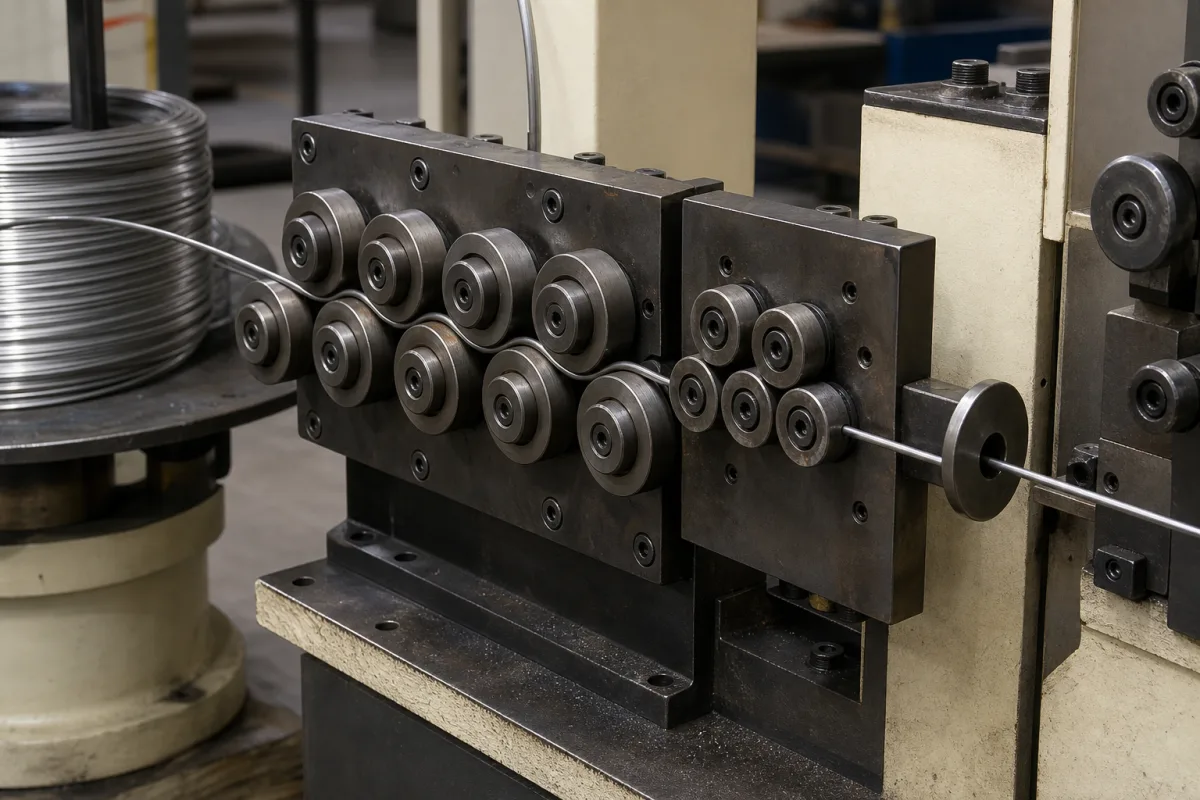
Wire straightener: multi-roller straightening unit for coil-fed wire
Roller wire straighteners · rollers per plane, single or two-plane units at 90°, roller bearing type by wire tensile strength, roller pitch and straightening force
A wire straightener is a set of grooved rollers in one or two rows, offset so that wire pulled or pushed from a coil is bent back and forth with decreasing amplitude until the coil set and cast are removed. It sits in front of spring coilers, screw and nail machines, wire benders and cut-to-length lines, and its settings decide whether the wire feeds straight and consistent. Ask three things first: the wire diameter range and tensile strength, how many rollers per plane and whether a second plane at 90° is needed, and how roller positions will be set and repeated between batches.
Roller-type wire straighteners and straightening units, single-plane and two-plane, for round and flat wire fed from coils, specified by wire diameter and strength, rollers per plane, roller type and adjustment. Automatic wire harness crimping and cut-strip-crimp machines, which may include their own small straightener, are covered on the Automated wire harness crimping machine page. Rotary (spinner) straighteners, bar and tube straightening machines and rolling-mill straighteners are outside this page except where compared.
CNFX editorial research · Sources checked October 12, 2026 · 3 sources
Pick rollers per plane, a second plane and a roller type for the wire's strength
Cometo's ASM/ADM straightener, for spring, screw and wire-bending machines, handles wire from 0.6 to 11.00 mm. It comes as a single-plane unit (ASM) with every roller adjustable on both rows, or a two-plane unit (ADM) with both planes fixed together by a 90° bracket, and with 3, 5, 7, 9, 11 or 13 rollers per plane. Its roller options are rated by wire tensile strength: single-row bearing rollers up to 600 N/mm², double-row 100Cr6 rollers up to 800 N/mm², and double-row rollers with a hardened, removable steel sleeve for 600 to 2200 N/mm². [1]
At the heavy end, Witels-Albert offers nine hydraulically opened straightening machines covering wire from 9 to 40 mm diameter, with 5, 7 or 9 straightening rollers to suit the application and wire properties; it notes that roller choice can also depend on the wire's yield point and speed. [2]
Editorial note: a single plane removes curvature in one direction only; coil-fed wire bent in more than one direction is the case for a second plane at 90°. Give the supplier the wire grade and tensile strength, not only the diameter, because the roller bearing type and sleeve are chosen on strength.
Give the supplier the wire material, diameter or flat-wire section, tensile strength range, coil inner diameter and cast, feed speed and whether the wire is pulled or pushed through, the machine it feeds, required straightness, available space, and whether roller positions must be indicated or recorded.
02
Know the straightening force and roller positions instead of setting by feel
Witels-Albert, writing in umformtechnik.net, explains that the radial straightening force at each roller sets the contact pressure on the wire, and that the pressure depends on roller pitch, roller material and groove geometry. Its calculations show roller spacing indirectly proportional to straightening force; choosing a straightener with optimised spacing can cut the force by about 45%, and large wire can produce more than 100 kN per roller. [2]
Fraunhofer IEM researchers built a straightening machine for high-strength flat wire (1.4310 steel, 3.9 × 0.4 mm) with a force sensor at each roller and absolute position measurement. The rollers, 10.8 mm in radius at a 13 mm pitch, can be set to within 0.01 mm; interchangeable force sensors of 200 N or 500 N nominal force resolve 2 N or 5 N, and the measured noise was about ±0.08 N with the wire stationary and ±0.3 N while feeding. A force model matched measurements with a root mean squared error of 0.62 N. [3] The authors note that adjusting a straightener has so far been manual, lengthy and complex even for an experienced worker. [3]
Cometo offers digital roller position indicators on its units so that settings can be recorded and repeated, and Witels-Albert fits mechanical position indicators on its heavy machines for defined, reproducible roller adjustment. [1][2] Editorial calculation: the Fraunhofer rollers are 21.6 mm in diameter, 54 times the 0.4 mm flat-wire thickness.
03
Roller and machine options published by two makers
Tensile strength and diameter, not diameter alone, separate these options.
Given in the maker's brochure per roller count. [1]
Drawing with wire line height.
05
Send the wire, line and setting data together
Paste it into your enquiry below or into an email to a maker, then replace every bracket.
Wire: [material; diameter or flat section; tensile strength; coil ID and cast]
Line: [machine fed; pull or push; speed]
Straightener: [rollers per plane; one or two planes; roller type]
Setting: [position indicators; recorded settings; force monitoring]
Target: [straightness; surface marking limits]
Documents: [drawing; roller groove profile; test on our wire]
Explore company information and manufacturing capabilities, then discuss the scope of your project with a relevant supplier.
Share this page
Compiled and source-reviewed by the CNFX editorial team.
Each manufacturer above links to the page on that company's own website where the product is listed, with the date we checked it. How we source and review
· Page last updated 13 October 2026
Buyer questions
How many rollers does a wire straightener need?
Makers offer a range: Cometo builds 3 to 13 rollers per plane for 0.6–11 mm wire, and Witels-Albert offers 5, 7 or 9 rollers on machines for 9–40 mm wire. [1][2]
Why does wire tensile strength matter for a straightener?
Roller bearings and sleeves are rated by it; Cometo's options run from 600 N/mm² to 2200 N/mm². [1]
How large are straightening forces?
Witels-Albert reports more than 100 kN per roller on large wire; on 0.4 mm flat wire Fraunhofer researchers used force sensors of 200 N or 500 N nominal. [2][3]
Sources and what still needs a direct check
Sources checked 2026-10-12. Cometo and Witels-Albert describe their own straighteners (Witels-Albert's in the trade journal umformtechnik.net); the Fraunhofer IEM study in Sensors measured straightening forces on a purpose-built machine.