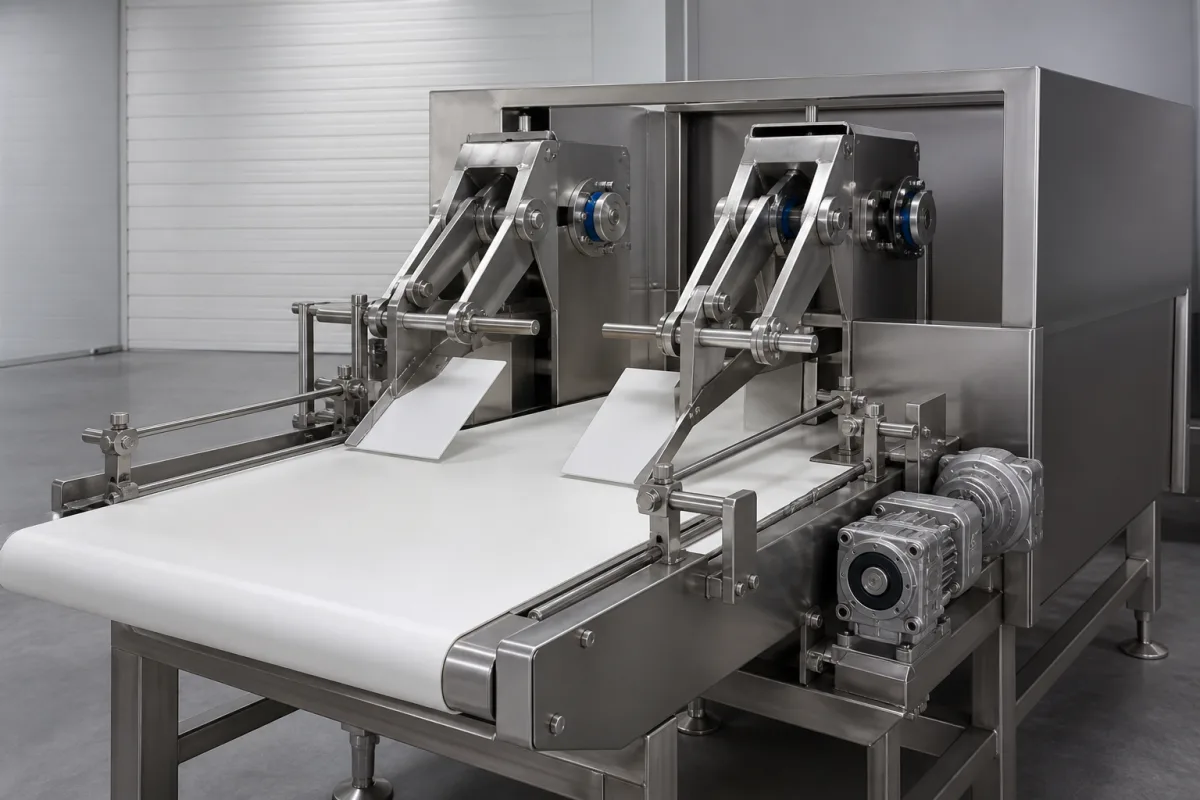
Flap folding station for thin dough sheets: two-flap folds for strudel packs and a turning flap conveyor for calzone
Pivoting flaps and flap conveyors that fold cut sheets of thin dough on a belt · strudel sheets folded in thirds by two flaps on a stopped belt, calzone sheets 18–30 cm wide and 0.5–2 mm thick folded by a conveyor that turns over through 160–180°, and why a plough fails on sheets above about 18 cm
Some dough products leave the line as a folded piece rather than a flat sheet or a laminated block: a packet of strudel or filo sheets folded for packing, or a filled pizza crust folded in half. The folding station has to turn over a sheet that has almost no stiffness of its own, put the fold where it is wanted every time, and not tear, stretch or stick to the sheet while doing it.
Folding stations that fold individual cut sheets of thin dough on a conveyor with pivoting flaps, turning flap conveyors and tucking or rolling devices, for strudel, filo, calzone and similar products, and the swinging lapper that folds a continuous sheet. Laminating lines that fold dough and fat into layers, and how layer counts build up, are covered on the Industrial dough laminator page; gauge-roll pairs and reduction per station on the Dough sheeter roller assembly page.
CNFX editorial research · Sources checked October 13, 2026 · 3 sources
Two flaps on pins parallel to the belt, working one after the other on stacked strudel sheets
The EMO Marietta patent US 5,268,188 was written for machine-pulled strudel dough, which until then had been cut to size by machine and then folded by hand. Its aim is a folded packet whose visible edges are all folds, because exposed cut edges let the dough lose moisture in storage and turn brittle enough to crack when it is unfolded. [1]
A gripper that moves faster than the infeed conveyor lays two or more sheets on top of each other on an intermediate conveyor, whose drive is switched off while folding takes place. In the first folding station two flaps pivot on pins parallel to the conveying direction, worked by lever mechanisms: the first flap folds one margin over, pivots back, and only then does the second flap fold the opposite margin. The flaps are perforated so that a vacuum does not form and make the sheets stick to them, and a pivoting or springy blade, about as wide as the spacing of the flap pins, holds the sheets and fixes the two fold lines. [1]
The patent sets the fold geometry: the first margin folded over can be almost as wide as the base between the pins, while the second must be narrow enough for its cut edge to land inside the base; it describes each of the two folds as turning over about a third of the original sheet width. A further flap, pivoting about an axis across the belt, then tucks one end of the packet; a set of rods rotating about an axis between them rolls the other end over at least twice and is then withdrawn along its axis, and a pusher moves the packet on. Sensors such as photoelectric barriers stop the belt at the tucking flap, and a separation foil of parchment or paper can be folded in to keep the sheets apart. [1]
Editorial calculation: with both margins folded over the base, the middle of the packet holds three thicknesses of each sheet, so the two superposed sheets in the patent's example give six thicknesses of dough there before the end tucks add more.
Ask how the flap folder holds the fold line, whether the flaps are perforated or otherwise kept from sticking, and how many sheets it folds together.
02
Wider than 18 cm and about 1 mm thick: a turning flap conveyor instead of a plough
Frisco-Findus's European application EP 0 558 783 starts from the plough: a plough-shaped guide over the belt lifts half of each piece and turns it over the other half as it passes, which the applicant says works well for small products such as pirogues and suits dough of a certain thickness and a small surface to fold. [2]
With such large thin sheets the half being lifted collapses before it covers the other half, and for some doughs the plough does not work at all. The application instead uses a continuously running retracting conveyor whose belt runs round a reciprocating shuttle board, and a flap conveyor hinged to its end. A photocell above the flap conveyor detects the leading edge of the sheet; the flap conveyor, whose belt runs only while it lies end to end with the first conveyor, is then rotated by eccentric hinges, driven by a cam or pneumatic cylinder, to an inverted position above the first conveyor, laying the leading half onto the rear half, which carries the filling. The folded piece runs on under the inverted flap and can drop straight into a package. [2]
Quantity in the application
Value
Sheet size at which a plough is not satisfactory
Width above about 18 cm, thickness only about 1 mm, as for calzone [2]
2 or 3 on wider conveyors, or separate machines in parallel lanes [2]
Give the supplier the sheet diameter or width, thickness and dough type, and say where the filling sits relative to the fold.
03
Continuous sheets: a swinging lapper that holds the dough between rollers
Where the dough arrives as a continuous sheet rather than cut pieces, it is folded by swinging it back and forth onto a belt running across the infeed. Rheon Automatic Machinery's patent CA 2048738 C explains the weakness of the earlier design, two vertical plates swinging between an upper conveyor and the belt below: the plates do not hold the sheet, so it stretches under its own weight while hanging between them, changing its thickness or width and making the weight per unit area of the folded block vary at random. [3]
Rheon's swinging mechanism instead holds the sheet between a movable arm with three rollers and a fixed arm with two, geared so that adjacent rollers turn in opposite directions at the infeed speed; an air cylinder closes the arms on the sheet, and the dough leaves the lowest roller directly onto the belt. Because a swing at constant angular velocity slows the free end near each end of the stroke and lets slack dough pile up at the folds, the swing is driven through a pair of non-circular gears that speed it up as it moves outward. [3]
Editorial note: this is the folding route of laminating lines; the flap folders in the two sections above handle one cut sheet or stack at a time on a belt that stops.
04
What a flap folding station supplier needs to know
Paste it into your enquiry below or into an email to a maker, then replace every bracket.
Product: [strudel, filo, calzone or other; filled or not]
Sheet: [width or diameter; thickness; moisture or dough condition]
Fold: [halves, thirds, end tucks; separation foil yes/no; sheets folded together]
Rate: [pieces per minute; lanes]
Transfer: [infeed conveyor; outfeed or direct into package]
Hygiene: [flap and belt materials; cleaning access]
Explore company information and manufacturing capabilities, then discuss the scope of your project with a relevant supplier.
Share this page
Compiled and source-reviewed by the CNFX editorial team.
Each manufacturer above links to the page on that company's own website where the product is listed, with the date we checked it. How we source and review
· Page last updated 13 October 2026
Buyer questions
Why fold strudel sheets so that no cut edge is outside?
EMO Marietta's patent says exposed edges lose moisture in storage, which makes the dough brittle and liable to crack when unfolded; folding them inside reduces this. [1]
Why are the folding flaps perforated?
The EMO Marietta patent perforates them so that no vacuum forms between flap and dough sheet to make the sheet stick. [1]
When is a plough folder not enough?
Frisco-Findus says a plough is not satisfactory for dough sheets wider than about 18 cm and only about 1 mm thick, such as calzone, because the lifted half collapses. [2]
How does a swinging lapper avoid stretching the dough?
Rheon's patent holds the sheet between geared rollers down to the belt instead of letting it hang between swinging plates. [3]
Sources and what still needs a direct check
Sources checked 2026-10-13. Three patents from three applicants: a strudel producer's flap folder, a frozen food company's turning flap conveyor for calzone, and a dough machinery maker's swinging lapper.