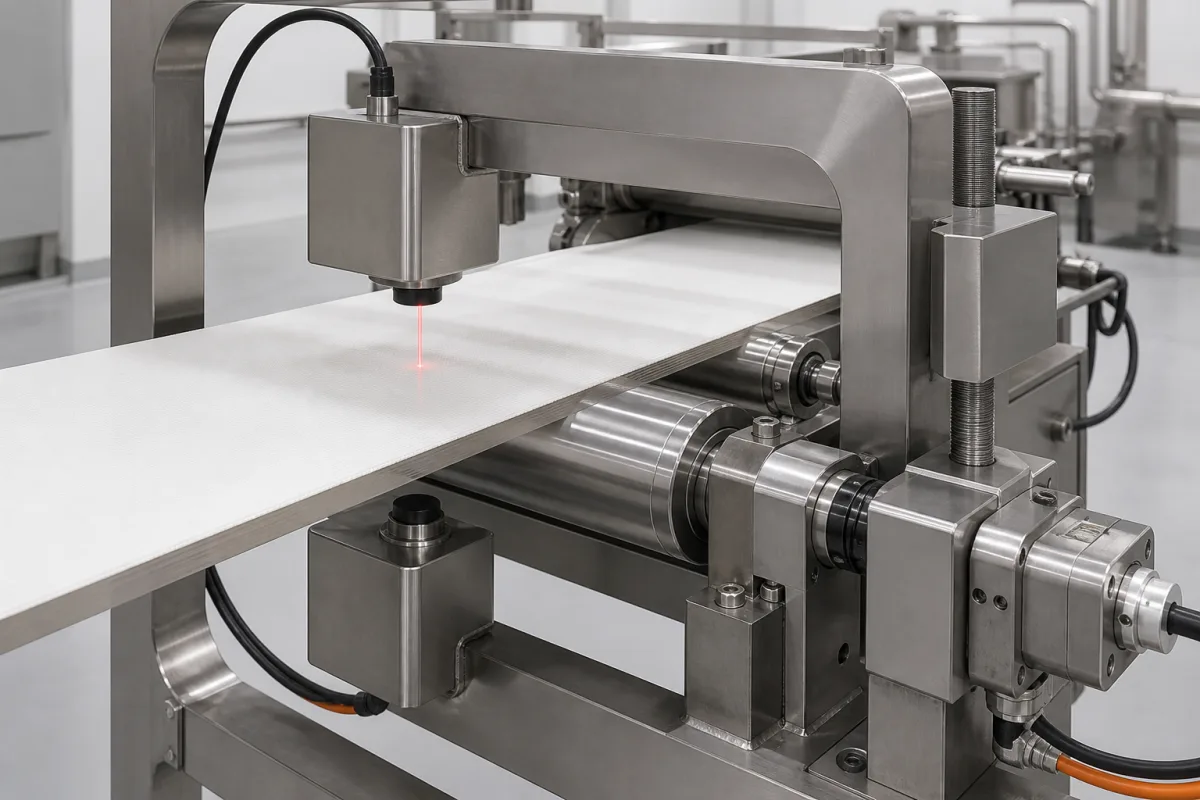
Dough sheet thickness control system: laser gauging with automatic roll-gap correction
Closed-loop dough sheet thickness control · laser displacement sensors that read the sheet, a controller that compares it with the set thickness, and actuators that move the roll
When dough consistency changes, a roll gap set by hand gives a different sheet thickness and piece weight. A thickness control system closes that loop: non-contact displacement sensors read the sheet after the rolls, a controller compares the reading with the set thickness, and motorised jacks or servo drives move one roll until the sheet is back on target. The questions are where the sensors read from, how finely the actuators move, and what the thickness reading is used to correct.
Sensing and feedback systems that hold the thickness of a dough or masa sheet on sheeters, gauging stations and laminating lines: laser and optical displacement sensors, their mounting and zeroing, the controller and set-point logic, and the roll-gap actuators they drive. Complete laminating lines are covered on the Industrial dough laminator page. Roll pairs, roll gap settings and reduction ratios per station are covered on the Dough sheeter roller assembly page, and folding of cut dough sheets on the Flap folding station page. Web edge guide systems, which steer a moving web sideways rather than hold its thickness, are covered on the Web edge guide system page. Checkweighers and vision systems for finished pieces are outside this page.
CNFX editorial research · Sources checked October 13, 2026 · 3 sources
Sensors above and below the sheet, or one sensor reading against the roll
Panasonic's noodle-line example mounts two HG-C micro laser distance sensors above and below the dough, sandwiching the sheet so its thickness is read and displayed in real time; it cites repeatability of 10 µm with the HG-C1030 and analogue outputs that let a PLC adjust the gap between the rollers of the previous process. [3]
JC Ford's patent for a high-speed tortilla sheeter reads the masa sheet from one side only. Before production the controller records each optical displacement sensor's distance to the bare front roller as the zero; once masa covers the roller, the second distance to the sheet surface is subtracted from the zero to give thickness. A left and a right sensor let the operator set a thickness for each end of the rolls. [1]
The same patent explains why a fixed gap is not enough: corn masa consistency varies over time with humidity, temperature and other factors, can vary along the length of the rolls inside the hopper, and occasionally contains hard kernels, while the manual alternative is a worker measuring or weighing the sheet at intervals and turning adjustment screws. [1]
In Nabisco's dough machining patent, sheet thickness measured on-line with a laser position sensor just upstream of the cutter correlated with piece weight, with the data accurate to within 4% of the trend line; the authors describe this as a considerable improvement over a control system based on roller power demand. [2]
Arrangement
How thickness is obtained
Published detail
Two laser sensors, sheet between
Distance from each side, sheet sandwiched
HG-C1030 repeatability 10 µm; analogue output to PLC. [3]
Optical sensors over the exit roll
Empty-roll zero minus distance to sheet surface
Left and right sensors, separate set points per end. [1]
Tell the supplier the dough type and its stickiness, sheet width and thickness range, line speed, whether the sheet runs on a belt or adheres to a roll where it is read, flour dusting and washdown conditions, and whether thickness must be held across the width or only at one track.
02
Stepper jacks, set points and the loop and speed trims around them
JC Ford's actuators couple a stepper motor through a 12:1 right-angle reducer to a five-ton ball screw jack with a 24:1 ratio on each end of the rear roll, configured to move the roll in increments of about 0.001 in; the patent notes that this precision is not necessary for tortilla production and that less accurate actuators may be practical. [1]
Its controller runs in a manual mode, where the operator sets the gap with set-point buttons and thickness is displayed but not acted on, and an automated mode, where a null-and-balance routine compares each sensor reading with the preset thickness and opens or closes the gap. A handwheel version of the jack gives a manual override. [1]
Nabisco's patent adds controls that a thickness gauge alone does not cover: roll speeds are set from a master mass flow rate, the gauge roll speed is trimmed from a sensor that watches the apex of the dough loop between the auxiliary rolls and the gauge rolls, and piece weight from the thickness signal is checked against sampled weights. It reports upper and lower rolls run at about 1.24 : 1.00, with dough leaving the nip at an average relative velocity of 1.7, or about 1.4 for a stiffer dough. [2]
Editorial calculation: 0.001 in = 25.4 µm per actuator step, about 2.5 times the 10 µm repeatability Panasonic cites for the HG-C1030, so in this pairing the gauge resolves finer than the jack moves. The stepper-to-jack reduction is 12 × 24 = 288 : 1. [1][3]
Ask for the sensor model and its repeatability on dough, the actuator step and travel, how the controller avoids hunting around the set point, how zero is re-checked after cleaning, and whether thickness, loop position and line speed are logged together.
03
What to send for a dough thickness control retrofit or new sheeter
Paste it into your enquiry below or into an email to a maker, then replace every bracket.
Dough: [bread, pastry, cracker, masa, noodle; consistency range]
Sheet: [width; target thickness and tolerance; line speed]
Read point: [on belt or on roll; distance after the nip]
Sensors: [two-sided or single-sided; across-width tracks]
Actuators: [stepper or servo jacks; step size; travel; manual override]
Control: [PLC interface; set points; logging; weight feedback]
Explore company information and manufacturing capabilities, then discuss the scope of your project with a relevant supplier.
Share this page
Compiled and source-reviewed by the CNFX editorial team.
Each manufacturer above links to the page on that company's own website where the product is listed, with the date we checked it. How we source and review
· Page last updated 13 October 2026
Buyer questions
How is dough sheet thickness measured without touching it?
Panasonic places two laser distance sensors above and below the sheet; JC Ford's tortilla sheeter patent reads the sheet on the exit roll and subtracts from an empty-roll zero. [3][1]
How finely can the roll gap be corrected?
JC Ford's stepper and ball-screw jack actuators are configured for increments of about 0.001 in, which the patent says is finer than tortilla production needs. [1]
Why measure thickness before the cutter?
Nabisco found laser-measured sheet thickness upstream of the cutter correlated with piece weight within 4%, so thickness can serve as a continuous weight signal. [2]
Sources and what still needs a direct check
Sources checked 2026-10-13. Two US patents describe working thickness and mass-flow control on tortilla and snack dough lines; Panasonic's application note shows its own laser sensors on a noodle sheet.