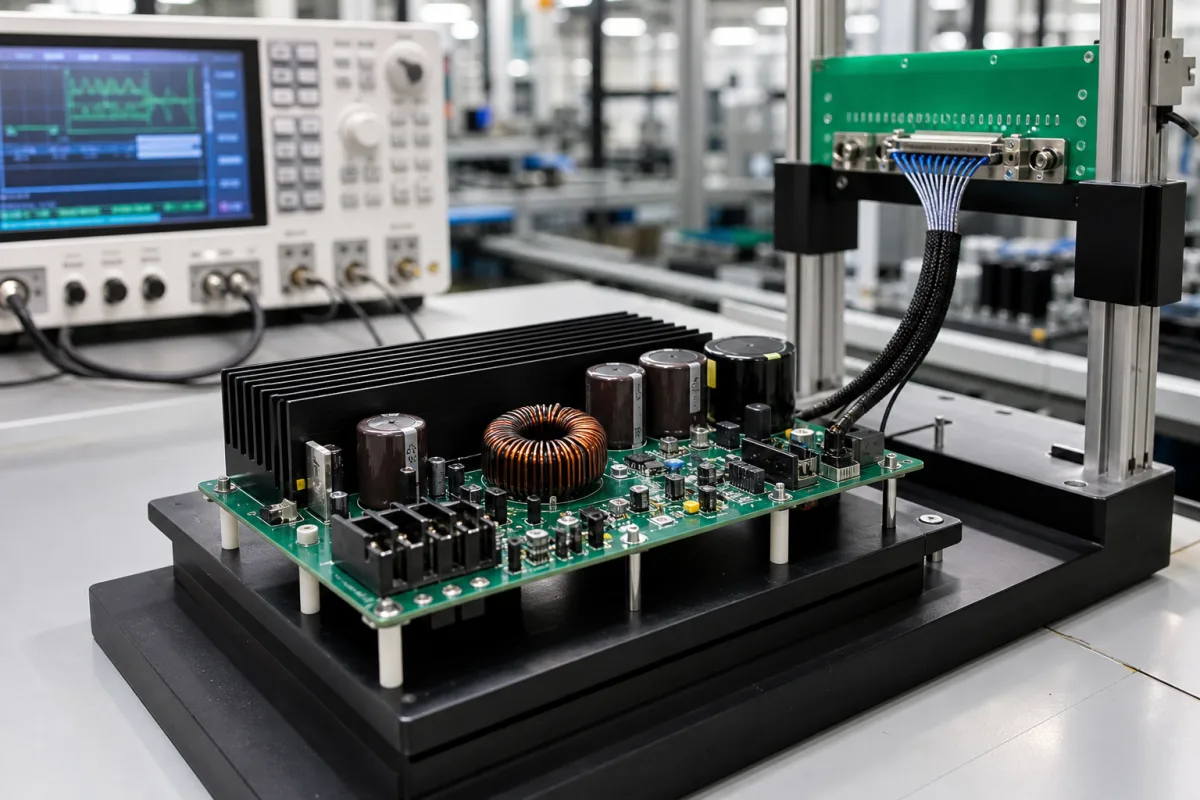
Class-D amplifier modules · Power at 1% versus 10% THD+N, load and supply voltage, AES17 measurement filters, heat sinking and idle loss
An audio amplifier module is a circuit board, such as one built around an integrated Class-D power stage, that amplifies a line-level signal to drive loudspeakers, with power supply filtering, an output filter, protection circuits and a heat sink. Ask three things first: what power per channel it delivers into your speaker impedance at a stated distortion level, which supply voltage it needs, and how it was measured and cooled when rated.
Class-D and other audio power amplifier boards and modules for consumer, professional and active-speaker products. Complete amplifiers in cases, DSP-only modules, preamplifiers and loudspeakers are outside this page.
CNFX editorial research · Sources checked October 12, 2026 · 4 sources
Read power ratings at a stated distortion, load and supply
Texas Instruments' TPA3255 datasheet (a Class-D amplifier IC) lists output power per channel at 51 V supply and a 75 °C case temperature: 315 W into 4 Ω at 10% THD+N but 255 W at 1% THD+N; at 53.5 V, 250 W and 200 W into 6 Ω and 195 W and 155 W into 8 Ω. It quotes 0.006% THD+N at 1 W into 4 Ω, about 112 dB SNR, 85 µV A-weighted output noise, and 2.5 W idle loss with four channels switching. [1]
The datasheet's feature list gives 90% efficient Class-D operation into 4 Ω and a supply range of 18–53.5 V, and describes stereo, mono (bridged) and 2.1 or 4 × single-ended configurations. [1]
Lower-power modules use smaller chips. TI's TPA3116D2 family lists 2 × 50 W into 4 Ω BTL at 21 V (TPA3116D2), 2 × 30 W into 8 Ω at 24 V (TPA3118D2) and 2 × 15 W into 8 Ω at 15 V (TPA3130D2) from a single 4.5–26 V supply, with over 90% efficiency, switching up to 1.2 MHz with AM avoidance, a programmable power limit and stereo or mono modes. TI's TAS5825M, a digital-input closed-loop Class-D amplifier, lists 2 × 30 W into 8 Ω at 24 V at 1% THD+N and 2 × 38 W at 10%, or 1 × 53 W and 1 × 65 W into 4 Ω at 22 V, from 4.5–26.4 V. [2][3]
Editorial calculation: the TAS5825M's stereo rating rises from 30 W to 38 W per channel between 1% and 10% THD+N, about 27% (38 ÷ 30), similar to the TPA3255's 24% step, so compare modules only at the same distortion figure. [3][1]
Editorial calculation: the 10% THD+N figure is about 24% higher than the 1% figure (315 ÷ 255) for the same chip and load; at 90% efficiency, 2 × 200 W of output draws about 444 W from the supply and leaves about 44 W to remove as heat. Ask module suppliers for power at 1% THD+N into your impedance and supply. [1]
Infineon's MA5332MS, a multichip module listed as active and preferred, integrates a dual-channel PWM controller, a high-voltage gate driver and four low-RDS(on) MOSFETs in a 7 × 7 mm 42-pin IQFN package. Infineon lists 2 × 200 W into 4 Ω at 10 % THD+N, 95 % efficiency at 2 × 200 W into 4 Ω, operation without a heat sink at 2 × 100 W, a split ±25 V or single 50 V supply, differential or single-ended inputs, 2 × SE, BTL and parallel-SE output modes, and OCP, OTP and UVLO protection with clip and fault reporting outputs. [4]
Editorial calculation: at Infineon's 95 % efficiency, 2 × 200 W of output draws about 400 ÷ 0.95 ≈ 421 W and leaves about 21 W of heat, against about 44 W for 2 × 200 W at the 90 % TI figure above; both are 10 % THD+N or chip-level figures, so the module's heat sink must still be sized from the supplier's test at your supply, load and enclosure temperature. [4][1]
Give the supplier the number of channels and configuration, speaker impedance, required power at a stated THD+N, supply voltage and source, input type and level, gain, SNR and noise targets, protection features, size and mounting, heat sink and airflow, EMC and safety requirements, and quantities.
02
Check the measurement filters and the cooling behind the rating
TI warns that audio analysers can give incorrect readings of Class-D amplifier performance because of out-of-band noise at the output, and recommends AES17 plus AUX-0025 pre-analyser filters; without them a 30 kHz low-pass filter (10 Ω and 47 nF) can reduce the remaining out-of-band noise. Its electrical characteristics are measured with AES17 plus AUX-0025 filters and a specified LC output filter. [1]
TI also states that thermal performance depends on the heat sink design and the surroundings, such as a closed box without airflow or a fanned system, so the maximum continuous output power is influenced by thermal design; its thermal data assume an 85 °C heat sink with thermal compound. [1]
The TAS5825M lists THD+N of 0.03% at 1 W and 1 kHz at 12 V, 110 dB A-weighted SNR, 35 µV rms idle channel noise and quiescent current under 20 mA at 12 V; it accepts I²S, left- or right-justified or TDM audio at 32–192 kHz and adds DRC, EQ, bass enhancement and speaker thermal and excursion protection. Both TI families integrate over-current, over-temperature and under- or over-voltage protection with fault reporting. [3][2]
Editorial note: ask module suppliers which filter and analyser they used, the case or heat-sink temperature during the power test, and how long full power can be held in your enclosure.
03
High-power, mid-power and digital-input Class-D boards
The reviewed data sheets cover high-power analogue-input Class-D stages for hundreds of watts per channel (TPA3255), mid-power analogue-input stereo amplifiers for 15–50 W per channel (TPA3116D2 family), and digital-input amplifiers with built-in audio processing for smart and wireless speakers (TAS5825M). [1][2][3]
Listings include 2.1-channel digital amplifier boards built on Class-D amplifier ICs, alongside power supply modules.
The heat sink decides how much of the IC's rating the module can hold: TI ties maximum continuous output power to heat-sink design and enclosure airflow, and Infineon states heat-sink-less operation only up to 2 × 100 W on its 2 × 200 W part. [1][4]
Power at 1% THD+N, distortion, SNR, supply range and load for a module quotation
Ask for the power row at 1% THD+N: the reviewed datasheets put their 10% figures 24–27% higher for the same chip and load. [1][3]
Field
What it means and published values
Ask the supplier for
Output power per channel (watts)
255 W at 1%, 315 W at 10% THD+N, 4 Ω, in one IC. [1] Mid-power examples: 2 × 15–50 W; 2 × 30 W at 1%. [2][3] Infineon MA5332MS: 2 × 200 W into 4 Ω at 10 % THD+N. [4]
1 company lists this product among what they make. Company figures are quoted from each
company's own website; every card states where the relationship came from.
Shenzhen Creatall Electronics Co., Ltd.
Manufacturing site to be confirmed for the order
Lists a 100 W 2.1-channel 12–24 V amplifier board based on a TPA3116D2 Class-D IC, among amplifier and power supply modules.
Explore company information and manufacturing capabilities, then discuss the scope of your project with a relevant supplier.
Share this page
Compiled and source-reviewed by the CNFX editorial team.
Each manufacturer above links to the page on that company's own website where the product is listed, with the date we checked it. How we source and review
· Page last updated 13 October 2026
Buyer questions
Why do amplifier power ratings differ between suppliers?
They may quote different distortion levels; TI's TPA3255 gives 315 W at 10% THD+N but 255 W at 1% into 4 Ω. [1]
Why are special filters needed to measure Class-D amplifiers?
TI says audio analysers without suitable filters misread Class-D output because of out-of-band noise and recommends AES17 plus AUX-0025 filters. [1]
Does the heat sink limit output power?
Yes; TI states maximum continuous output power depends on the heat sink and enclosure airflow. [1]
Do audio amplifier modules accept digital audio directly?
Some do: digital-input Class-D amplifiers such as the TAS5825M take I²S or TDM audio at up to 192 kHz and include DSP functions. [3]
Can a 200 W per channel Class-D amplifier run without a heat sink?
Infineon lists its MA5332MS at 2 × 200 W into 4 Ω (10 % THD+N) with heat-sink-less operation stated only up to 2 × 100 W. [4]
Sources and what still needs a direct check
Sources checked 2026-10-12. Texas Instruments' datasheets and Infineon's MA5332MS product page each cover one maker's Class-D ICs under its own test conditions; module performance depends on the board, supply and cooling.