Industry-Verified Manufacturing Data (2026)

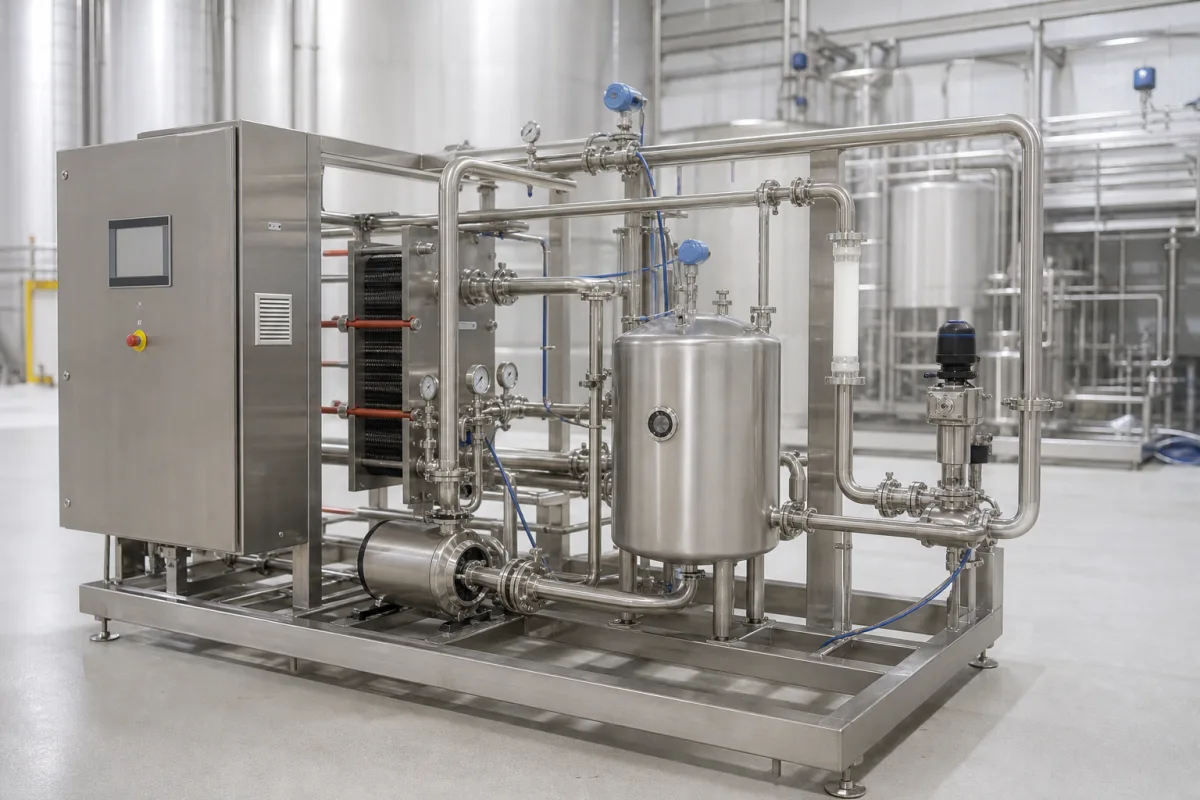
Continuous Flow Pasteurization System

Based on aggregated insights from multiple verified factory profiles within the CNFX directory, the standard Continuous Flow Pasteurization System used in the Manufacture of Dairy Products sector typically supports operational capacities ranging from standard industrial configurations to heavy-duty production requirements.

Technical Definition & Core Assembly

A canonical Continuous Flow Pasteurization System is characterized by the integration of Plate Heat Exchanger and Temperature Control System. In industrial production environments, manufacturers listed on CNFX commonly emphasize Stainless Steel 316L construction to support stable, high-cycle operation across diverse manufacturing scenarios.

Industrial thermal processing equipment for dairy product safety and shelf-life extension.
Product Specifications

Technical details and manufacturing context for Continuous Flow Pasteurization System

Definition
A continuous flow pasteurization system is an industrial machine designed for the precise thermal treatment of liquid dairy products to eliminate pathogenic microorganisms while preserving nutritional and sensory qualities. It operates as a critical processing stage in dairy manufacturing plants, ensuring product safety compliance and extending shelf life for commercial distribution. The system integrates heating, holding, and cooling sections with precise temperature control to meet regulatory requirements for various dairy products including milk, cream, and dairy-based beverages. As a standalone industrial equipment, it serves as essential infrastructure in B2B dairy processing supply chains, connecting raw milk reception to downstream packaging operations.
Working Principle
Utilizes plate heat exchangers to rapidly heat dairy products to specific temperatures (typically 72-85°C), maintains precise holding times, then rapidly cools the product through regenerative heat recovery.
Common Materials
Stainless Steel 316L, Food-Grade Elastomers, Thermal Insulation Materials
Technical Parameters
  • Maximum continuous processing capacity (L/h) Standard Spec
  • Temperature control accuracy (°C) Standard Spec
Components / BOM
  • Plate Heat Exchanger
    Transfers heat between product and heating/cooling media
    Material: Stainless Steel 316L
  • Temperature Control System
    Monitors and regulates heating and cooling processes
    Material: Stainless Steel Housing with Electronic Components
  • Holding Tube
    Maintains product at pasteurization temperature for required time
    Material: Stainless Steel 316L
  • Regenerative Section Optional
    Recovers heat from pasteurized product to preheat incoming product
    Material: Stainless Steel 316L
  • Flow Diversion Valve
    Automatically diverts under-processed product from main flow
    Material: Stainless Steel with Food-Grade Seals
Engineering Reasoning
2.5-4.0 MPa (25-40 bar) at 72-75°C for 15-30 seconds
Pressure drop below 2.0 MPa or temperature deviation beyond ±0.5°C from setpoint for >5 seconds
Design Rationale: Insufficient lethality (F0<3.0) due to inadequate thermal processing, allowing microbial survival (particularly Listeria monocytogenes D72=0.3 min, z=6°C)
Risk Mitigation (FMEA)
Trigger Plate heat exchanger fouling exceeding 0.5 mm calcium phosphate scale thickness
Mode: Reduced heat transfer coefficient (U<2000 W/m²·K) causing temperature drop below 71.5°C
Strategy: CIP system with 2% nitric acid at 70°C for 20 minutes every 8 hours
Trigger Centrifugal pump cavitation at NPSHa<2.5 m
Mode: Flow instability (pulsation >±10% of 5000 L/h design flow) leading to residence time variation
Strategy: Positive displacement pump with 0.1 m³/h recirculation loop maintaining 3.0 m NPSH margin

Industry Taxonomies & Aliases

Commonly used trade names and technical identifiers for Continuous Flow Pasteurization System.

Industrial Ecosystem & Supply Chain DNA

Complementary Systems
Downstream Applications
Specialized Tooling

Application Fit & Sizing Matrix

Operational Limits
pressure: Up to 6 bar (87 psi) to prevent boiling at high temperatures
flow rate: 5,000-50,000 L/hr typical, customizable based on heat exchanger configuration
temperature: 72-95°C (161-203°F) typical pasteurization range, up to 120°C (248°F) for UHT applications
slurry concentration: Up to 40% total solids for dairy slurries, viscosity-dependent
Media Compatibility
✓ Milk and cream ✓ Dairy-based beverages ✓ Yogurt and cultured products
Unsuitable: Highly abrasive slurries with particulate >2mm (e.g., fruit pulps with seeds, nut pastes)
Sizing Data Required
  • Required volumetric throughput (L/hr)
  • Product viscosity and solids content
  • Target temperature-time profile (e.g., 72°C for 15s)

Reliability & Engineering Risk Analysis

Failure Mode & Root Cause
Thermal stress cracking
Cause: Rapid temperature cycling between pasteurization and cleaning cycles causing differential expansion in heat exchanger plates and seals
Biological fouling and scaling
Cause: Mineral deposition and microbial growth in heat exchanger channels due to inadequate water treatment and insufficient cleaning protocols
Maintenance Indicators
  • Abnormal pressure drop across heat exchanger sections (indicates fouling or blockage)
  • Unusual vibration or knocking sounds from pumps and valves (suggests cavitation or mechanical wear)
Engineering Tips
  • Implement predictive maintenance with infrared thermography to detect early thermal anomalies and fouling patterns before failure occurs
  • Establish optimized CIP (Clean-in-Place) procedures with validated temperature, chemical concentration, and flow rate parameters to prevent both under-cleaning and over-stressing of components

Compliance & Manufacturing Standards

Reference Standards
ISO 14159:2002 Safety of machinery - Hygiene requirements for the design of machinery ANSI/NSF 51-2017 Food Equipment Materials DIN 11850-3:2009 Food processing equipment - Stainless steel tubes - Part 3: Tubes for the food, chemical and pharmaceutical industries
Manufacturing Precision
  • Tube wall thickness: +/-0.1mm
  • Temperature control accuracy: +/-0.5°C
Quality Inspection
  • Pressure test at 1.5x operating pressure for 30 minutes
  • Microbiological validation test with thermocouple mapping

Factories Producing Continuous Flow Pasteurization System

Verified manufacturers with capability to produce this product in China

✓ 94% Supplier Capability Match Found

P Procurement Specialist from United Arab Emirates Feb 16, 2026
★★★★★
"The technical documentation for this Continuous Flow Pasteurization System is very thorough, especially regarding Processing Capacity (L/h)."
Technical Specifications Verified
T Technical Director from Australia Feb 13, 2026
★★★★★
"Reliable performance in harsh Manufacture of Dairy Products environments. No issues with the Continuous Flow Pasteurization System so far."
Technical Specifications Verified
P Project Engineer from Singapore Feb 10, 2026
★★★★★
"Testing the Continuous Flow Pasteurization System now; the Processing Capacity (L/h) results are within 1% of the laboratory datasheet."
Technical Specifications Verified
Verification Protocol

“Feedback is collected from verified sourcing managers during RFQ (Request for Quote) and factory evaluation processes on CNFX. These reports represent historical performance data and technical audit summaries from our B2B manufacturing network.”

6 sourcing managers are analyzing this specification now. Last inquiry for Continuous Flow Pasteurization System from UAE (59m ago).

Frequently Asked Questions

What is the heat recovery efficiency of this pasteurization system?

Our continuous flow pasteurization system achieves up to 90-95% heat recovery efficiency through its regenerative section, significantly reducing energy consumption and operating costs in dairy processing.

How does this system ensure dairy product safety and shelf life?

The system precisely controls heating temperature (typically 72-85°C) and holding time (15-30 seconds) to eliminate pathogens while preserving product quality. This thermal processing extends shelf life while maintaining nutritional value and taste.

What maintenance is required for stainless steel 316L components?

Stainless steel 316L offers excellent corrosion resistance in dairy environments. Regular cleaning with food-grade detergents and periodic inspection of seals and gaskets is recommended. The material withstands CIP (Clean-in-Place) procedures common in dairy manufacturing.

Can I contact factories directly on CNFX?

CNFX is an open directory, not a transaction platform. Each factory profile provides direct contact information and production details to help you initiate direct inquiries with Chinese suppliers.

Get Quote for Continuous Flow Pasteurization System

Request technical pricing, lead times, or customized specifications for Continuous Flow Pasteurization System directly from verified manufacturing units.

Your business information is encrypted and only shared with verified Continuous Flow Pasteurization System suppliers.

Thank you! Your message has been sent. We'll respond within 1–3 business days.

Need to Manufacture Continuous Flow Pasteurization System?

Connect with verified factories specializing in this product category

Add Your Factory Contact Us
Previous Product
Automated Ultra-High Temperature Sterilization Line
Next Product
Dairy Flow Control Diaphragm Valve