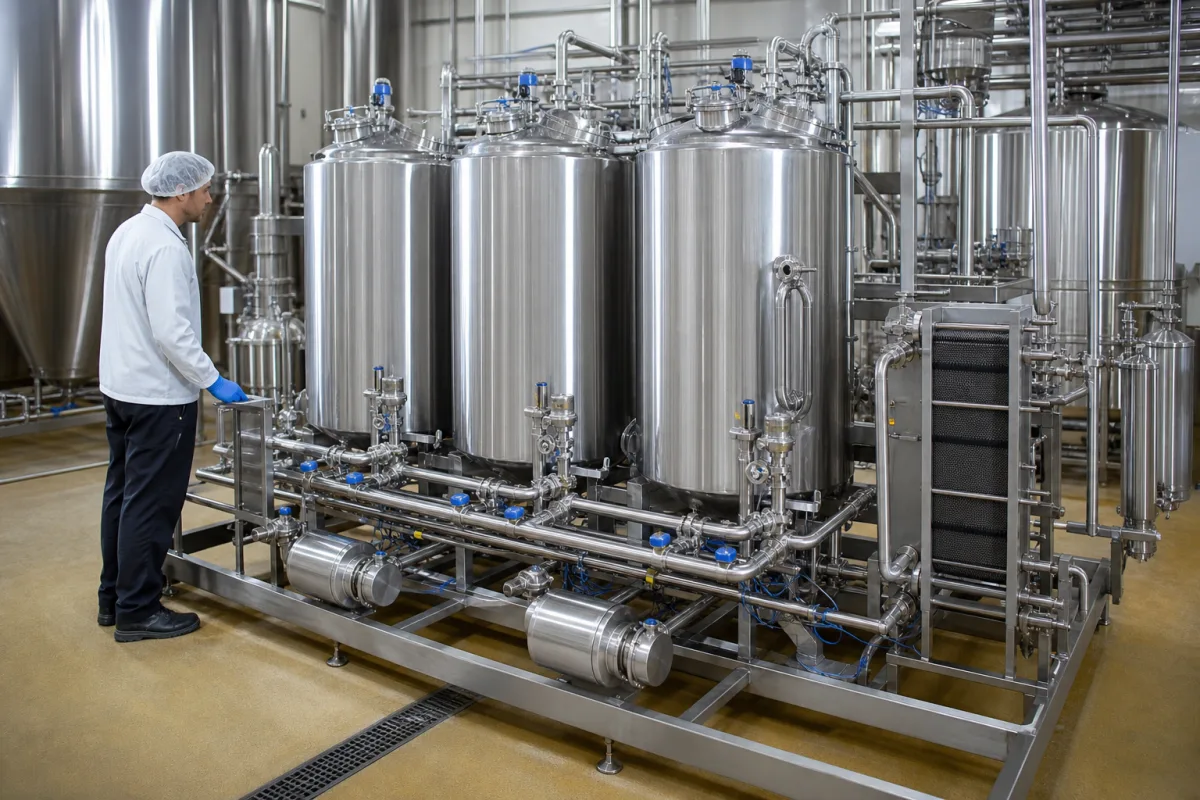
Hygienic processing · Time, temperature, chemistry and mechanical action
A CIP system heats and pumps rinse water, caustic and acid through pipes and spray devices so equipment is cleaned without dismantling. Whether it cleans depends less on the skid than on flow velocity in each line, spray coverage in each tank, and the time, temperature and chemistry of each step.
Fixed and mobile CIP units for food, dairy, beverage, brewing, distilling, cosmetic and pharmaceutical plants, with tanks, heating, supply and return pumps, and controls. Tank cleaning heads sold alone and cleaning chemicals are covered only where they affect the system.
CNFX editorial research · Sources checked October 12, 2026 · 4 sources
Balance time, temperature, chemistry and mechanical action
A Brewer Magazine article describes cleaning as four ingredients: time, temperature, chemical action and mechanical action. Heated cleaning media improve results; the chemical dose needed depends on the temperature and the mechanical method; and mechanical action, how the fluid is delivered to the wall, is in its words "the most important ingredient to the recipe", from hand brushing through static spray balls to impingement devices that scrub with jets. [2]
Tech-Long describes the CIP sequence as alternating cleaning water and detergent, heated through a heat exchanger to the required temperature and concentration and pumped through tanks and pipelines under the joint action of acid, alkali and heat. [3]
Give the supplier a list of circuits (lines with diameters and lengths, tanks with sizes and spray devices), the soils (product, fat, protein, sugar, scale), the cleaning chemicals and temperatures you intend, and the time available between batches.
02
Size flow for pipelines
Alfa Laval recommends a minimum velocity of 1.5 m/s to clean pipes, to reach turbulent flow and sufficient wall shear stress; below it, cleaning may be insufficient. It gives about 1,000 hl/h (100 m³/h) for DN 150 and 1,700 hl/h for DN 200 pipelines. [1]
Where a line changes diameter, the larger section after a restriction may not reach 1.5 m/s; Alfa Laval suggests routing CIP in reverse so each section gets enough velocity. Alfa Laval says "normally, the CIP of pipes is done separately from the CIP of the tank", pipes with hot caustic and tanks with cold caustic, so the CIP supply flow is set by the largest circuit rather than their sum. [1]
03
Choose tank spray devices and pump pressure
Alfa Laval says its rotary spray heads clean vessels up to about 5 m diameter and its rotary jet heads 15 m or more; a jet head on a small tank may be oversized and needs a flange of about 200 mm. To deliver 5 bar at a jet head at the top of a tank, it estimates about 7.5 bar at the CIP supply pump, allowing at least 1–2 bar for height and friction. [1]
It notes that jet pressure at the tank wall is only a few tenths of a bar, so inlet pressures of 5–7 bar do not damage the tank. Rotation of jet heads can be verified with a sensor, and jet heads have service intervals while it recommends replacing gaskets and O-rings (EPDM or FKM, occasionally PTFE) "at the same time as the machines themselves are being serviced, or about every two years". [1]
For rinse water, Alfa Laval notes 304 stainless steel tolerates up to about 2 ppm chlorine and 316 up to about 5 ppm. [1]
04
Brewhouse carts, beverage-line CIP and multi-tank stations on supplier sites
ACE's brewhouse cart and Tech-Long's beverage-line CIP mark the two ends of the range reviewed: a portable unit with its own caustic and acid tanks, and a steam- or electric-heated system built into a treatment line. [4][3]
ACE lists portable CIP carts with caustic tank and electric heater, acid tank, sanitary pump and control panel in SUS304, and says "we usually offer 100 litre and 200 litre per tank" for brewhouses; Tech-Long lists CIP systems with steam or electric heating within beverage treatment lines; Chenma lists CIP washing machines, semi-automatic and mobile CIP units; Zhengjiu and Boben list CIP systems with brewing and distilling equipment; SinoPAK lists CIP for beverage tanks and lines; HJchem lists CIP with reactors and filtration; ChenFei lists CIP within juice and food processing equipment. [4][3]
05
Solution tanks, heating, supply and return pumps, spray devices and controls
The supply pump and spray device rows are sized from Alfa Laval's figures above (1.5 m/s in the largest line, about 7.5 bar at the pump for 5 bar at a jet head); the return pump and control rows carry no published values. [1]
Circuit flow, pump head, step temperatures and tank volumes for a CIP quotation
Flow rate and pump pressure follow from the circuit list: Alfa Laval sizes the supply flow to the largest single circuit because pipes and tanks are cleaned in separate runs. [1]
Field
What it means and published values
Ask the supplier for
Flow rate (m³/h)
1.5 m/s minimum in pipes, e.g. ~100 m³/h for DN 150. [1]
Flow per circuit.
Operating pressure (MPa)
E.g. ~0.75 MPa at pump for 0.5 MPa at a jet head. [1]
Pump head per circuit.
Operating temperature (°C)
Alfa Laval: pipes cleaned with hot caustic, tanks with cold caustic. [1]
12 companies list this product among what they make. Company figures are quoted from each
company's own website; every card states where the relationship came from.
Wenzhou Ace Machinery Co., LTD
Manufacturing site to be confirmed for the order
Lists portable CIP carts and automatic CIP units in stainless steel.
Explore company information and manufacturing capabilities, then discuss the scope of your project with a relevant supplier.
Share this page
Compiled and source-reviewed by the CNFX editorial team.
Each manufacturer above links to the page on that company's own website where the product is listed, with the date we checked it. How we source and review
· Page last updated 13 October 2026
Buyer questions
What flow velocity does CIP need in pipes?
Alfa Laval recommends at least 1.5 m/s to reach turbulent flow and enough wall shear; about 100 m³/h in DN 150 pipe. [1]
What are the four factors of CIP cleaning?
Time, temperature, chemical action and mechanical action; Brewer Magazine calls mechanical action "the most important ingredient to the recipe". [2]
Can tanks and pipes be cleaned together?
Alfa Laval says "normally, the CIP of pipes is done separately from the CIP of the tank", pipes with hot caustic and tanks with cold caustic, so size the CIP flow to the largest circuit. [1]
Sources and what still needs a direct check
Sources checked 2026-10-12. Alfa Laval is a hygienic equipment maker; its brewery CIP webinar Q&A gives flow, spray device and pressure guidance. Brewer Magazine is a brewing trade publication. Supplier pages describe their own offers.