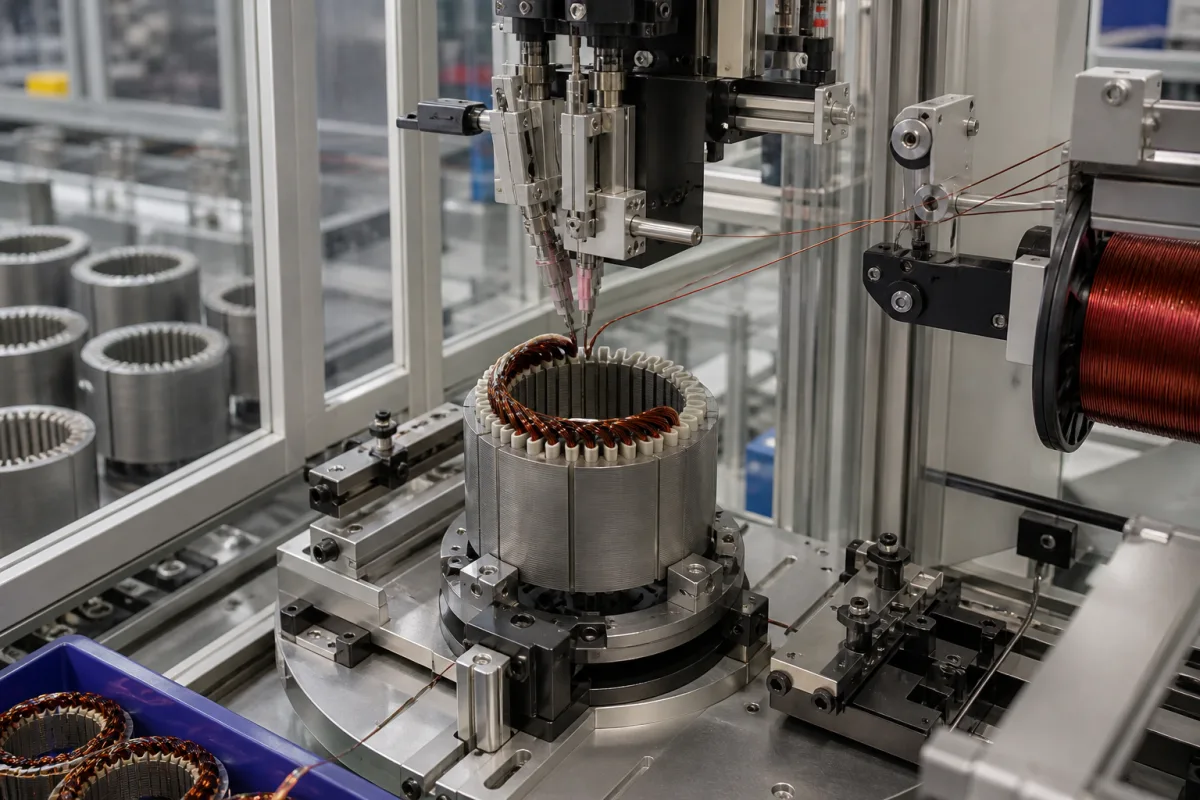
Concentrated-winding stator winding machine for brushless (BLDC) and PM motor stators
Tooth-coil stators for brushless and PM motors · Needle versus flyer direct winding, stator size windows, multi-strand wire and fill factor
A concentrated-winding stator winding machine winds enamelled copper wire directly around each tooth of a stator, producing tooth coils for brushless DC (BLDC), permanent-magnet and stepper motors in fans, appliances, power tools, drones and drives. A needle machine feeds wire through a nozzle that moves inside the slots of an inner-slot stator; a flyer machine throws wire around the teeth of an outer-wound stator from outside. Ask three things first: which method suits your stator's geometry, what stator diameters, stack heights and wire sizes the machine accepts, and whether it can wind parallel strands to reach your slot fill.
Machines that wind concentrated (tooth) coils directly onto stator cores of BLDC, permanent-magnet and stepper motors, including needle (in-slot nozzle) and flyer (outer) winders and multi-station versions. Winding and coil-insertion machines for distributed windings of three-phase induction motors are covered on the Three-phase motor stator winding machine page. Hairpin lines, transformer and toroid winders, and magnet wire are outside this page.
CNFX editorial research · Sources checked October 12, 2026 · 6 sources
Match the direct-winding method to the stator and winding type
Nittoku Engineering's European patent application EP 1 343 244 describes two direct winding methods for inner-rotor stators: a nozzle that supplies the wire is inserted into the interior of each slot, or the nozzle moves outside each slot. It states that both are applied to concentrated winding, where wire is wound onto each tooth, and that they cannot be applied to distributed winding, where a coil spans more than one tooth, because the wire of the first phase wound across a slot obstructs the following phases. [1]
The same document contrasts the inserter method, where coils are pre-wound and inserted into slots: it raises the wire space factor in distributed windings but lengthens the coil ends, which then need shaping and add copper-loss heat. [1] The Technische Hochschule Ingolstadt describes insertion as the industry standard for rotating-field stators with round copper wire and names its limited copper fill factor as a drawback; its research develops needle winding, which places enamelled round wire precisely in the laminated-core slots without end plates. [2]
Xingte's machines show the two machine families. Its XT-02D dual-station machine uses needle winding for multi-pole BLDC stators, winds two stators per cycle, and changes tooling in about 20 minutes; its XT-BL06 is a six-station flyer ("flying fork") outer winder with an angular accuracy of ±0.5°. [4][5] Editorial note: send the stator drawing with slot opening, tooth count and whether the core is inner-slot or outer-wound, since that decides the method before any speed figure matters.
Give the supplier the stator drawing (outer and inner diameter, stack height, slot count, slot opening, insulation end caps), the winding diagram, turns per tooth, wire diameter and number of parallel strands, wire-end termination, target cycle time per stator, and the motor type (BLDC, PM, stepper).
02
Plan parallel strands and the fill factor you can reach
Wärtsilä's encyclopedia defines orthocyclic winding as a structure in which the upper layer sits in the grooves of the lower layer and gives the optimal fill factor of 90.7% for round wires. [3] The THI research group names maximum copper fill factors as the potential of precise needle-wound wire placement. [2]
Xingte's XT-DGRXJ single-station machine is built for multi-strand, parallel winding to improve fill factor and efficiency: it lists stators up to Ø250 mm and 150 mm stack height, wire up to Ø0.8 mm, up to 32 wires and up to 32 slots, with a multi-strand wire tension system and storage for 50 parameter programs. [6]
Editorial calculation: a Ø0.5 mm wire has a copper cross-section of π × 0.25² = 0.196 mm²; ten parallel Ø0.5 mm strands carry 1.96 mm², the same as one wire of about Ø1.58 mm. Splitting a heavy conductor into strands keeps each wire within a machine's wire-size limit, such as the Ø0.8 mm maximum of the XT-DGRXJ. [6]
Editorial note: 90.7% is a geometric ceiling for perfectly layered round wire, not a slot fill to expect in production; ask the supplier for the copper fill it has achieved on a stator similar to yours, measured the same way.
03
Compare published machine windows
Each figure is a reference value published by the maker; confirm it for your stator.
Editorial calculation, assuming one turn per revolution: at 1,000 rpm, a tooth coil of 60 turns takes 60 / 1,000 × 60 = 3.6 s of winding time before indexing, wire hooking and cutting; with two stations winding together the XT-02D completes two stators per cycle. [4]
Explore company information and manufacturing capabilities, then discuss the scope of your project with a relevant supplier.
Share this page
Compiled and source-reviewed by the CNFX editorial team.
Each manufacturer above links to the page on that company's own website where the product is listed, with the date we checked it. How we source and review
· Page last updated 13 October 2026
Buyer questions
Why can't needle winding make distributed windings?
Nittoku's patent states that direct nozzle winding applies to concentrated windings; in distributed windings the first phase's wire obstructs the following phases. [1]
What is the maximum fill factor for round wire?
Wärtsilä gives 90.7% for orthocyclic winding of round wires, a geometric ceiling. [3]
How many parallel strands can a machine wind?
Xingte's XT-DGRXJ lists up to 32 wires of up to Ø0.8 mm. [6]
Sources and what still needs a direct check
Sources checked 2026-10-12. Nittoku Engineering's patent application and the THI research page describe winding methods; Wärtsilä's encyclopedia defines orthocyclic winding; Xingte publishes its own machine parameters.