Editorial Technical Reference

Electrical Grade Epoxy Resin Compound

This page explains how Electrical Grade Epoxy Resin Compound is classified within Manufacture of Electricity Distribution and Control Apparatus. Technical values and manufacturer relationships are research references; confirm the current specification and supplier evidence for each order.

Technical Definition & Core Assembly

Thermosetting polymer compound for electrical insulation and encapsulation in distribution equipment.
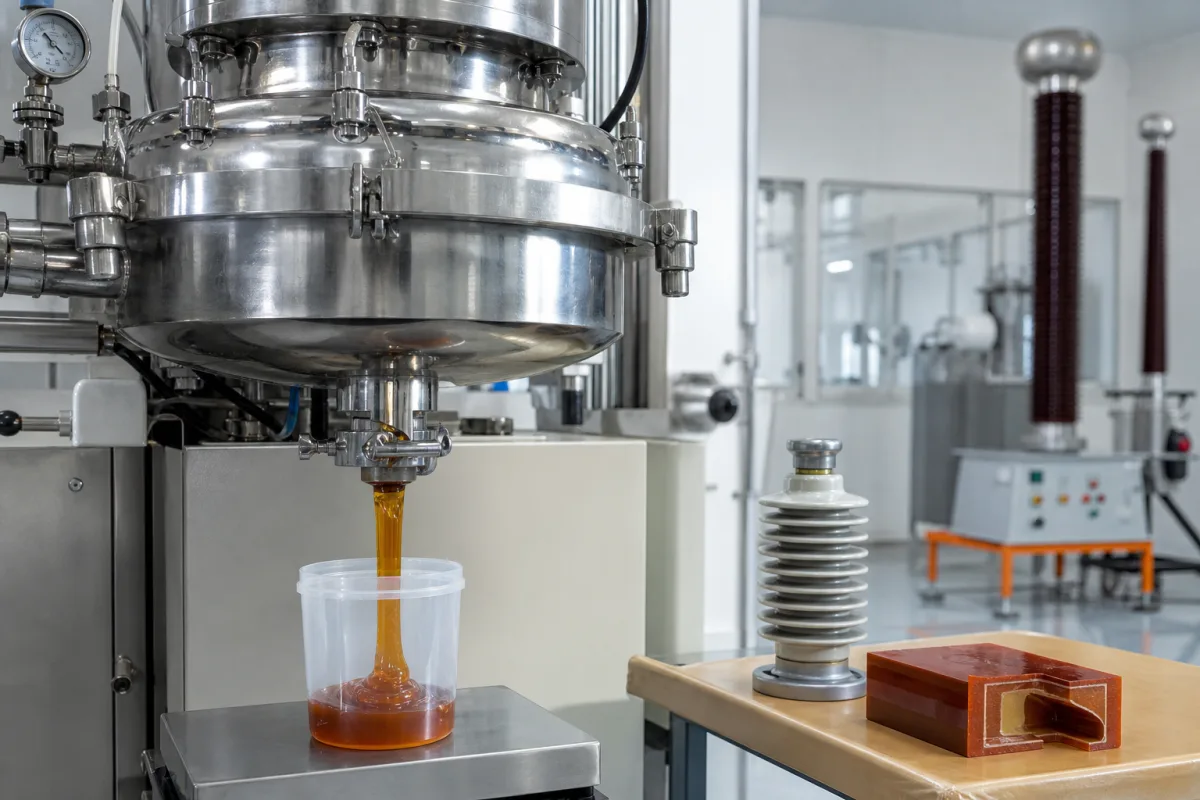
Representative product image. Confirm appearance and specifications with the manufacturer.

Product Specifications

Technical details and manufacturing context for Electrical Grade Epoxy Resin Compound

Definition
Electrical grade epoxy resin compound is a specialized thermosetting polymer formulation engineered for high-voltage insulation applications in electricity distribution and control apparatus. This material serves as a critical insulating medium in switchgear, circuit breakers, busbar systems, and transformer components where dielectric strength and thermal stability are paramount. It provides reliable electrical isolation, mechanical protection, and environmental sealing for conductive elements in medium to high voltage systems. Manufacturers utilize this compound for potting, casting, and encapsulation processes to ensure long-term operational safety and reliability in harsh industrial environments. The compound is based on bisphenol-A epoxy resin, cured with anhydride hardeners, and filled with silica to enhance mechanical and thermal properties. Flame retardant additives are included to meet fire safety requirements. Key performance parameters include dielectric strength of 16–20 kV/mm (IEC 60243), volume resistivity of 1×10^14–1×10^15 Ω·cm (IEC 60093), thermal conductivity of 0.6–0.8 W/m·K (ASTM E1530), glass transition temperature of 120–150 °C (ISO 11357), and comparative tracking index (CTI) of 600–800 V (IEC 60112). The material exhibits flexural strength of 80–120 MPa (ISO 178), water absorption of 0.1–0.3% (ISO 62), and density of 1.1–1.3 g/cm³ (ISO 1183). Pot life is 30–60 minutes, viscosity is 2000–4000 mPa·s (ISO 2555), and curing time at 80 °C is 4–8 hours. The operating temperature range is -40 to 130 °C. These values are typical ranges; actual performance must be verified with the manufacturer for specific applications. The compound is supplied as a two-part system requiring proper mixing and curing procedures. It is essential to follow the manufacturer's instructions for handling, mixing, and curing to achieve optimal insulation properties. Users should confirm that the selected grade meets the required standards and specifications for their intended use.
Working Principle
The compound cures through chemical cross-linking when mixed with hardener, forming a rigid, non-conductive polymer matrix that physically encapsulates electrical components while providing dielectric insulation between conductive elements. The cross-linked network restricts molecular mobility, contributing to high dielectric strength and thermal stability. The silica filler enhances mechanical strength and reduces thermal expansion, while flame retardant additives inhibit combustion. The cured material acts as a barrier against moisture and contaminants, ensuring long-term insulation integrity.
Common Materials
Bisphenol-A Epoxy Resin, Anhydride Hardener, Silica Filler, Flame Retardant Additives
Technical Parameters
ParameterTypical rangeNotes & selection driver
Dielectric StrengthRequired16–20 kV/mmElectrical breakdown voltage at standard thicknessIEC 60243
Volume ResistivityRequired1×10^14–1×10^15 Ω·cmElectrical resistance through material volumeIEC 60093
Thermal ConductivityRequired0.6–0.8 W/m·KHeat transfer capability of cured materialASTM E1530
Glass Transition TemperatureRequired120–150 °CTemperature at which polymer transitions from glassy to rubbery stateISO 11357
CTI (Comparative Tracking Index)600–800 VResistance to surface electrical trackingIEC 60112
Pot Life30–60 minutesWorking time after mixing before viscosity increases
Viscosity2000–4000 mPa·sAffects impregnation and flowISO 2555
Flexural Strength80–120 MPaMechanical robustnessISO 178
Water Absorption0.1–0.3 %Low moisture uptakeISO 62
Operating Temperature-40–130 °CContinuous service range
Curing Time4–8 hAt 80°C
Density1.1–1.3 g/cm³Affects weight and costISO 1183

Ranges are indicative industry figures for RFQ preparation, not a supplier commitment. Confirm every value and standard with the legal manufacturer before ordering.

Components / BOM
  • Epoxy Base Resin Part
    Primary polymer matrix providing mechanical and electrical properties
    Material: Bisphenol-A or Novolac epoxy
  • Hardener System Part
    Catalyzes cross-linking reaction for curing
    Material: Anhydride or amine-based compound
  • Mineral Filler Part
    Improves thermal conductivity and reduces shrinkage
    Material: Silica, alumina, or quartz powder
  • Flame Retardant Optional Part
    Enhances fire resistance properties
    Material: Phosphorus or halogen-based additives

Industry Taxonomies & Aliases

Commonly used trade names and technical identifiers for Electrical Grade Epoxy Resin Compound.

Industrial Ecosystem & Supply Chain Structure

Complementary Systems
Downstream Applications
Specialized Tooling

Application Fit & Sizing Matrix

Operational Limits
pressure: Atmospheric to 0.5 MPa during curing, negligible post-cure
other spec: Viscosity: 500-2000 cP at 25°C (mix-dependent), Pot life: 30-90 minutes, Cure time: 2-8 hours at elevated temperature
temperature: -40°C to +155°C continuous, up to +180°C short-term
Media Compatibility
✓ Copper windings and busbars ✓ Fiberglass reinforced plastics (FRP) ✓ Ceramic insulators
Unsuitable: Continuous exposure to strong acids or alkalis (pH <2 or >12)
Sizing Data Required
  • Volume of encapsulation cavity (cm³ or in³)
  • Required dielectric strength (kV/mm)
  • Thermal cycling profile (temperature range and cycles)

Reliability & Engineering Risk Analysis

Failure Mode & Root Cause
Delamination
Cause: Thermal cycling stress exceeding adhesion limits, improper surface preparation, or moisture ingress at the interface.
Electrical tracking/arcing
Cause: Surface contamination (dust, moisture, oils), partial discharge due to voids or cracks, or voltage stress exceeding dielectric strength.
Maintenance Indicators
  • Visible cracks, crazing, or discoloration (yellowing/browning) on the epoxy surface
  • Audible corona discharge (hissing or crackling sounds) or unusual odor indicating thermal degradation
Engineering Tips
  • Ensure meticulous surface preparation (cleaning, degreasing, roughening) and controlled curing per manufacturer specifications to minimize internal stresses and voids.
  • Implement regular infrared thermography inspections to detect hotspots from partial discharge or poor thermal dissipation before catastrophic failure.

Indicative industry ranges for design and RFQ preparation. Confirm the exact figures and applicable standard with the manufacturer before specifying.

Compliance & Manufacturing Standards

Applicable Standards
ASTM D1763-00(2020) Standard Specification for Epoxy Resins IEC 60243-1 Electrical strength of insulating materials - Test methods ISO 527-2 Plastics - Determination of tensile properties - Part 2: Test conditions for moulding and extrusion plastics

Quoted from the published standard.

Manufacturing Precision
  • Viscosity: +/- 5% of specified value at 25°C
  • Dielectric Strength: Minimum 15 kV/mm per ASTM D149
Quality Inspection
  • Thermogravimetric Analysis (TGA) for thermal stability
  • Dielectric Constant and Dissipation Factor test per ASTM D150

Manufacturers of Electrical Grade Epoxy Resin Compound

Manufacturer profiles associated with Electrical Grade Epoxy Resin Compound.

Sourcing Electrical Grade Epoxy Resin Compound from China?
Tell us your specification and target quantity — we will match it against manufacturer records and come back with the factories that fit.
Request manufacturers We manufacture this

Manufacturer listings support early research and capability understanding. They are not certification, ranking, or transaction guarantees.

Technical documentation
Request current drawings, revision history, and a signed specification sheet.
Manufacturing capability
Verify equipment lists, process limits, capacity, and representative production evidence.
Inspection readiness
Confirm test methods, calibrated equipment, sampling plans, and traceable reports.
Supplier transparency
Check the legal entity, factory address, ownership, certifications, and direct contacts.

CNFX does not score or rank suppliers. Buyers must verify all claims and documents with the legal manufacturer before ordering.

Frequently Asked Questions

What is the typical dielectric strength of this epoxy resin compound?

The dielectric strength is typically in the range of 16–20 kV/mm when tested according to IEC 60243. This value is a reference range; the actual dielectric strength may vary depending on the specific formulation and test conditions. Always verify the exact value with the manufacturer for your intended application.

How is the compound cured?

The compound is a two-part system consisting of epoxy resin and hardener. When mixed in the correct ratio, a chemical cross-linking reaction occurs, forming a rigid thermoset polymer. The curing time at 80 °C is typically 4–8 hours, but this can vary based on the mass and geometry of the part. Follow the manufacturer's instructions for mixing and curing to achieve optimal properties.

What is the operating temperature range?

The continuous operating temperature range is -40 to 130 °C. This range indicates the temperatures at which the cured material can be used without significant degradation of its insulating properties. For applications outside this range, consult the manufacturer for suitability.

What standards are relevant for verifying the performance of this material?

Key standards include IEC 60243 for dielectric strength, IEC 60093 for volume resistivity, ASTM E1530 for thermal conductivity, ISO 11357 for glass transition temperature, IEC 60112 for comparative tracking index, ISO 2555 for viscosity, ISO 178 for flexural strength, ISO 62 for water absorption, and ISO 1183 for density. These standards are used for testing and verification; they do not imply certification of a specific product. Always confirm compliance with the manufacturer.

Data Basis

Editorial classification, named public sources where available, and source-reviewed manufacturer records.

Preliminary Technical Classification
This page supports structured research, RFQ preparation, and supplier evaluation. It does not replace buyer-led supplier qualification, standards review, or technical approval.
Buyer enquiry

Request manufacturing insight for Electrical Grade Epoxy Resin Compound

Ask for use case, specification boundaries, supplier type, and RFQ preparation information for this product.

Where it goes
Straight to the CNFX editorial desk, and to the manufacturer if this product is linked to a claimed profile. Nothing is broadcast to a supplier list.
Your details stay here
We do not sell or rent enquiry data, and we do not add you to a mailing list. Used only to answer this request.
No commission, no middleman
CNFX is a directory. We take no cut of any order and never negotiate on a supplier's behalf.
What we don't claim
A listing is not an endorsement. Qualify every supplier and verify every figure yourself before ordering.

Your business information is used only to process this request.

Thank you! Your message has been sent. We'll respond within 1–3 business days.
Sorry, we couldn't send your message. Please try again, or email us at contact@cnfx.com.

Need to Manufacture Electrical Grade Epoxy Resin Compound?

Compare manufacturer profiles with relevant product and process capability.

Previous Product
Medium Voltage Vacuum Interrupter Module
Last Product
Get QuotesChat