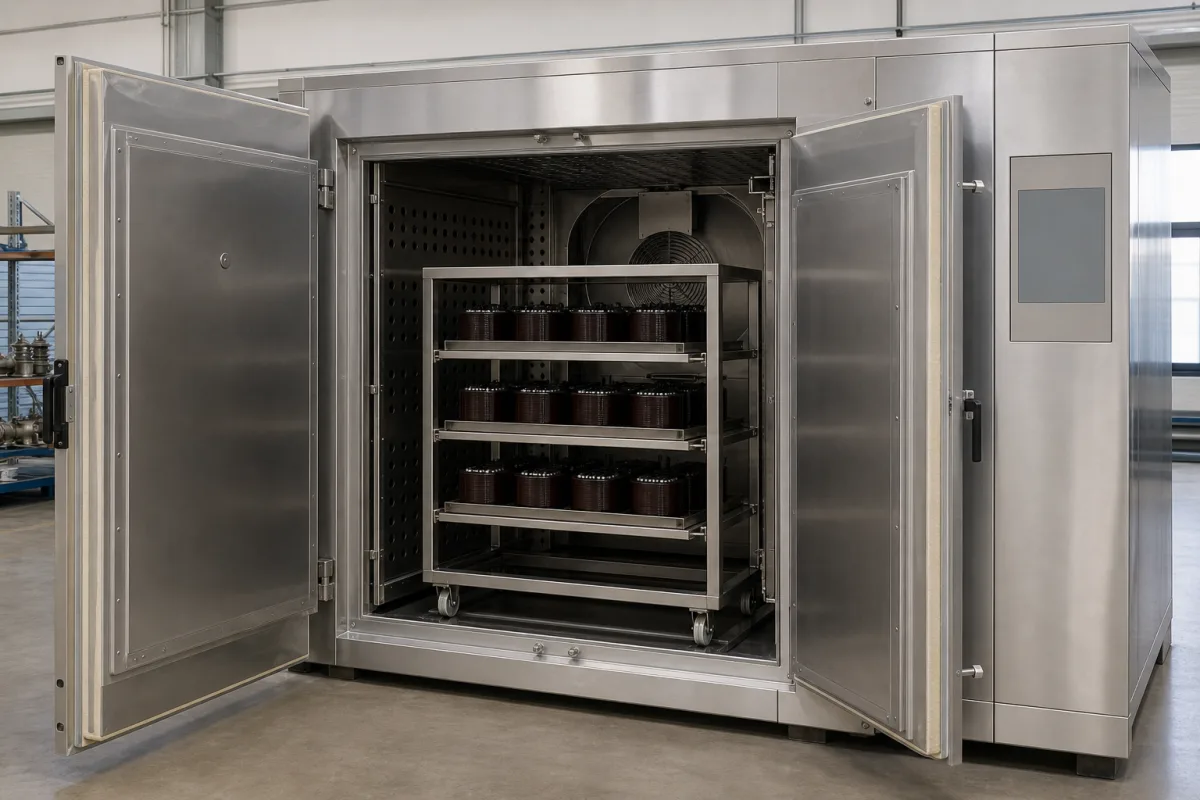
Batch curing oven for varnish-impregnated windings and transformer coils
Winding varnish curing ovens · Cure schedule by thermal class, solvent load and ventilation below 25% LFL, fan interlocks, trolley loading
A curing oven for impregnated windings is a batch forced-air oven, loaded on trolleys or racks, that evaporates any solvent and cures the varnish or resin on motor stators, rotors, transformer coils and cores after dipping or impregnation. Ask three things first: what time and temperature your varnish needs for the thermal class you claim, how much solvent the load releases and how the oven ventilates it, and how heaters are interlocked with the exhaust fan.
Batch and trolley-loaded forced-air ovens for drying and curing insulating varnishes and impregnating resins on electrical windings, coils and cores, including their heaters, circulation and exhaust fans, interlocks and controls. General-purpose hot-air ovens and their uniformity testing are covered on the Industrial hot air oven page, and silicone post-cure ovens on their own page. Powder-coating cure ovens, vacuum pressure impregnation vessels and UV or infrared curing equipment are outside this page.
CNFX editorial research · Sources checked October 12, 2026 · 3 sources
SynFlex's data for Voltatex 2100, a heat-curing polyester-imide/phenolic impregnating varnish for insulation systems up to thermal class H under IEC 60085, gives hardening schedules by thermal class: 4–6 h at 120 °C for class E, 4–6 h at 130 °C for class B, and 6 h at 150 °C for classes F–H. It lists a temperature index of 155–165 °C (IEC 60216, weight loss), a UL thermal class of 200, and storage of up to 6 months at a maximum of 25 °C. [1]
Editorial calculation: a 6 h soak at 150 °C plus an assumed 2 h heat-up and 1 h cool-down gives a 9 h cycle, so a single oven completes two full cycles in 24 hours; a 4 h class E soak with the same heat-up and cool-down allows three. Heat-up and cool-down depend on load mass and oven power, so ask the supplier for a thermocouple trace in the heaviest coil. [1]
Test temperature
Bond strength of twisted coils (IEC 60455-2, method A)
Give the supplier the largest stator or coil (dimensions and mass), load per batch, varnish or resin name with its cure schedule, solvent content, thermal class required, maximum oven temperature, trolley or rack arrangement, available power and the ventilation and exhaust route.
02
Ventilate for the solvent the load releases
Glyptal's data sheet for its 9620 insulating varnish, suggested for form- and random-wound coils, stators and armatures, gives 40% solids by weight in a xylene solvent system, a specific gravity of 0.98, a Pensky-Martens flash point of 66 °F, and a tack-free air-dry time of about ½ hour; it states that baking improves oil, moisture, acid and salt-water resistance. [2]
OSHA's dip-tank rules require ventilation that keeps airborne concentration in vapour areas below 25% of the lower flammable limit (LFL), forbid recirculating exhaust air above 25% of the LFL, and require that a heating system used in a drying operation is installed to NFPA 86A, has mechanical ventilation running before and during drying, and shuts down automatically if any ventilating fan fails to maintain ventilation. [3]
Editorial calculation: a batch of windings retaining 20 kg of wet varnish at 40% solids releases 20 × 0.60 = 12 kg of xylene during flash-off and bake; the exhaust has to be sized for the rate at which that solvent leaves at the start of the bake, not the average over the cycle. Varnish pick-up is an assumed example. [2][3]
Cure temperature, uniformity, exhaust flow and interlocks for a winding varnish oven
Exhaust flow is set by the solvent in the load, not the chamber size: OSHA requires vapour to stay below 25% of the lower flammable limit, so give the varnish and wet load per batch. [3]
Explore company information and manufacturing capabilities, then discuss the scope of your project with a relevant supplier.
Share this page
Compiled and source-reviewed by the CNFX editorial team.
Each manufacturer above links to the page on that company's own website where the product is listed, with the date we checked it. How we source and review
· Page last updated 13 October 2026
Buyer questions
What cure does an impregnating varnish need?
SynFlex's Voltatex 2100 data gives 6 h at 150 °C for thermal class F–H, 4–6 h at 130 °C for class B and 4–6 h at 120 °C for class E; follow your own varnish's data. [1]
How much ventilation does a solvent varnish oven need?
OSHA's dip-tank rules require vapour to be kept below 25% of the LFL and heaters in drying operations to shut down if a ventilating fan fails. [3]
How much solvent does a varnished load release?
Glyptal's 9620 varnish is 40% solids by weight in xylene, so 60% of the wet varnish retained evaporates. [2]
Sources and what still needs a direct check
Sources checked 2026-10-12. SynFlex and Glyptal publish data for their own varnishes. OSHA's regulation sets ventilation and interlock requirements for dipping and coating with flammable liquids.