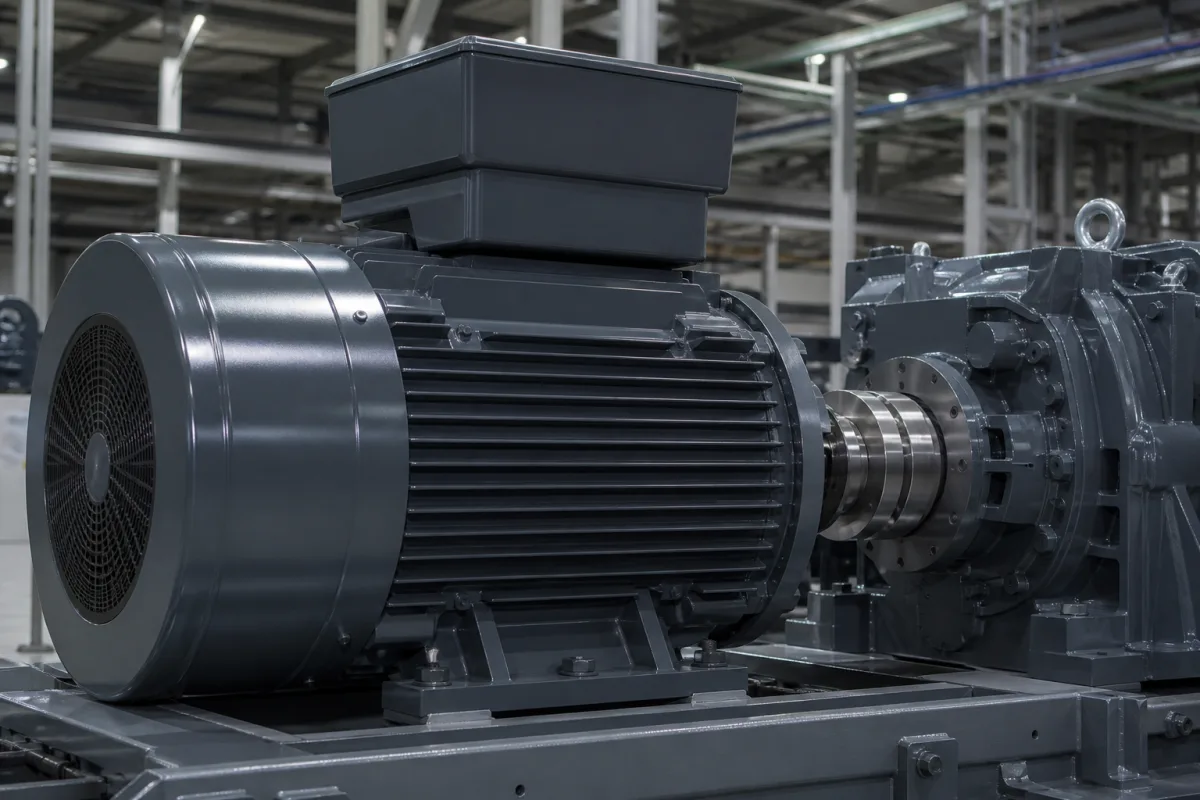
Pellet mill main drive motor: matching motor speed and power to the die through the drive train, and the trips that stop it
The motor that turns a pellet mill's die · direct coupling, V-belts, double reduction or a stand-alone gearbox between a 1,200–1,800 rpm motor and a die turning at roughly 95–250 rpm, plus the shear-pin and slip trips wired into its starter
A pellet mill's main drive motor does one job: turn the die and its main shaft against the rollers hard enough to force conditioned meal or wood through the die holes. What makes it a distinct purchase from an ordinary foot-mounted motor is everything around it. The pole count and supply frequency have to land the die at the surface speed the mill builder designed for, through whatever sits in between — a direct coupling, V-belts on a jackshaft, a double-reduction drive or a separate gearbox. The power rating depends on whether the mill makes animal feed or wood pellets. And the starter has to accept a trip signal from the mill's shear-pin or shear-key protection.
Main electric motors of ring-die pellet mills for animal feed and for wood and biomass pellets, specified together with the transmission they drive (direct coupling, single-reduction V-belt, double reduction, or stand-alone gearbox), the die speed that results, installed power against throughput, and the shear-pin, shear-key and belt-slip trips interlocked with the motor starter. General-purpose AC induction, permanent-magnet and DC motors are covered on the Electric motor page; cast-iron TEFC IEC-frame motor construction (enclosure, cooling and mounting codes) on the Cast-iron TEFC IEC-frame three-phase motor page; the pellet mill as a whole machine, its ring-die sizes, capacities, conditioning and durability on the High-capacity pellet mill for animal feed page; the die itself on the Feed pellet mill die (ring die) page; steam conditioning on the Feed conditioning and retention chamber page. Geared motors for powder blenders are on the Blender drive motor page, drum granulator final drives on the Main drive system of a fertilizer drum granulator page, motors coupled to fan shafts on the Direct-coupled fan motor assembly page, main motors of woodworking machines and their braking on the Main motor page, rotors on the Motor rotor assembly page and terminal boxes on the Terminal Box page.
CNFX editorial research · Sources checked October 13, 2026 · 6 sources
Direct coupling, V-belts, double reduction or a separate gearbox: what each does to the motor's speed and pole count
The motor's synchronous speed is only half of the specification; the other half is the ratio between motor and die. Four Andritz datasheets for different mill frames show four different answers, and Bühler adds a fifth with no transmission at all.
Editorial calculation from the datasheet figures: the PM615's 6.6 m/s on a 600 mm die is about 210 die rpm, so its helical stage reduces the 1,480 rpm motor by roughly 7:1, and the same gearing at 60 Hz (1,780 rpm, 7.9 m/s) gives about 251 die rpm. [1] The BioMax die at 6 m/s on 1,200 mm turns about 95 rpm, roughly 15.5:1 below a 1,480 rpm motor. [4] On the 32LM, 150 and 174 die rpm from an 1,800 rpm motor are reductions of 12:1 and about 10.3:1, and put the 813 mm die surface at about 6.4 and 7.4 m/s. [3]
Two consequences for the motor order follow from the table. First, a die speed is quoted for one supply frequency; Andritz lists separate die velocities for 50 Hz and 60 Hz on the PM615, so a motor bought for a 60 Hz site runs the die about 20 % faster unless the gearing changes. [1] Second, where the transmission is a belt drive, the motor speed itself is a design choice: the 26LM-II is listed with a 1,200 rpm motor and the 32LM with an 1,800 rpm motor. [2][3] Bühler states that leaving out the transmission lowers energy consumption by up to 10 %, and that circumferential die speed can be adjusted without changing the die. [5] Editorial note: with no gearing in between, that adjustment has to come from the motor's own speed, so ask how it is set.
Mill (maker)
Drive between motor and die
Main motor as published
Die as published
PM615W / PM615XW (Andritz)
Single-reduction precision helical gearing; motor direct-coupled, 4-pole [1]
Max. 160 kW (200 HP), 1,480 rpm at 50 Hz; 1,780 rpm at 60 Hz [1]
Ø600 mm inside; 6.6 m/s at 50 Hz, 7.9 m/s at 60 Hz [1]
Sprout 26LM-II (Andritz)
Single-reduction V-belt drive with jackshaft assembly [2]
320 or 410 kW (900 mm die); 470 or 585 kW (1,200 mm die) [5]
Circumferential die speed adjustable without changing the die [5]
Give the motor supplier the die speed the mill builder specifies at your supply frequency, the reduction ratio and type of the transmission, the shaft and coupling interface on the gearbox or jackshaft side, and whether speed is fixed or set by a drive.
02
Installed kW per tonne an hour: feed pellets against wood pellets
Editorial calculation from the ratings below: the two Kahl wood mills carry between about 4 and 11 times the installed kW per t/h of the two feed mills.
Amandus Kahl's presentation to the World Bioenergy Association gives about 50–55 kWh/t for its flat-die pellet mill on wood, or 40–45 with steam (the slide prints the unit as kWh/h), and 74–81 kWh/t for grinding plus pelleting. [6] Editorial calculation: the 65-1500's 630 kW spread over 10–12 t/h is 52.5–63 kW per t/h, the same order as the 50–55 kWh/t Kahl quotes for the pelleting step, so on that mill the energy figure and the nameplate rating describe a motor loaded close to its rating.
Do not carry a feed-mill kW figure over to a wood or biomass line, or the reverse; ask the mill builder for the motor rating it guarantees for your material and throughput.
03
Shear pins, shear keys and belt-slip sensors wired into the motor starter
Tramp metal or an overload jammed between roller and die is stopped mechanically first, by a part designed to break, and the motor has to be cut off when it does.
On the Sprout 26LM-II and 32LM, a shear key system protects the mill against foreign material in the die cavity, and a proximity switch interlocked with the motor starter cuts power to the mill when the shear keys break; a V-belt slip sensor is standard to protect the belts and drive. [2][3] The PM615 uses a shear pin hub array to protect the shaft. [1] On the BioMax, the hydraulic system opens all roll-adjusting cylinders automatically on any shear pin failure. [4]
Andritz describes the 26LM-II's rotating assembly as approximately 1.5 tons, giving a flywheel effect. [2] Editorial note: that inertia sits on the motor shaft through the belts when the mill starts and keeps the die turning after a trip, so give the motor supplier the rotating mass and the starting method (direct-on-line, soft starter or variable-speed drive) so that starting time and thermal capacity can be checked.
Paste it into your enquiry below or into an email to a maker, then replace every bracket.
Mill: [maker, model, ring-die inside diameter and width; material: feed or wood/biomass]
Drive train: [direct, V-belt single reduction, double reduction or gearbox; ratio; coupling or sheave]
Motor: [kW; poles and rpm; 50 or 60 Hz; voltage; duty; enclosure; mounting]
Die speed: [rpm or m/s at the site frequency; fixed or variable]
Starting: [DOL, soft starter or VFD; rotating mass of the mill]
Protection: [shear pin or key trip contact; belt-slip sensor; interlock to starter]
Explore company information and manufacturing capabilities, then discuss the scope of your project with a relevant supplier.
Share this page
Compiled and source-reviewed by the CNFX editorial team.
Each manufacturer above links to the page on that company's own website where the product is listed, with the date we checked it. How we source and review
· Page last updated 13 October 2026
Buyer questions
Why do pellet mill main motors run at different speeds?
Because the transmission differs. Andritz lists a 4-pole 1,480 rpm motor direct-coupled to helical gearing on the PM615, 1,200 rpm with a V-belt drive on the 26LM-II and 1,800 rpm with a double-reduction drive on the 32LM. [1][2][3]
How large is the main motor on a big pellet mill?
Andritz lists up to 800 kW for the BioMax, Kahl builds 630 kW and 800 kW wood pellet mills, and Bühler offers 320–585 kW on the Kubex T. [4][6][5]
What stops the motor when metal gets into the die?
On the Sprout 26LM-II, broken shear keys are detected by a proximity switch interlocked with the motor starter, which cuts power to the mill. [2]
Does a pellet mill need a gearbox or belts?
Not always. Bühler's Kubex T uses a direct drive with no transmission system, which it says lowers energy consumption by up to 10 %. [5]
Sources and what still needs a direct check
Sources checked 2026-10-13. Four Andritz Feed & Biofuel datasheets cover four drive arrangements; Bühler's product page covers a gearless direct drive; Amandus Kahl's presentation to the World Bioenergy Association gives motor ratings and energy figures for wood pellet mills.