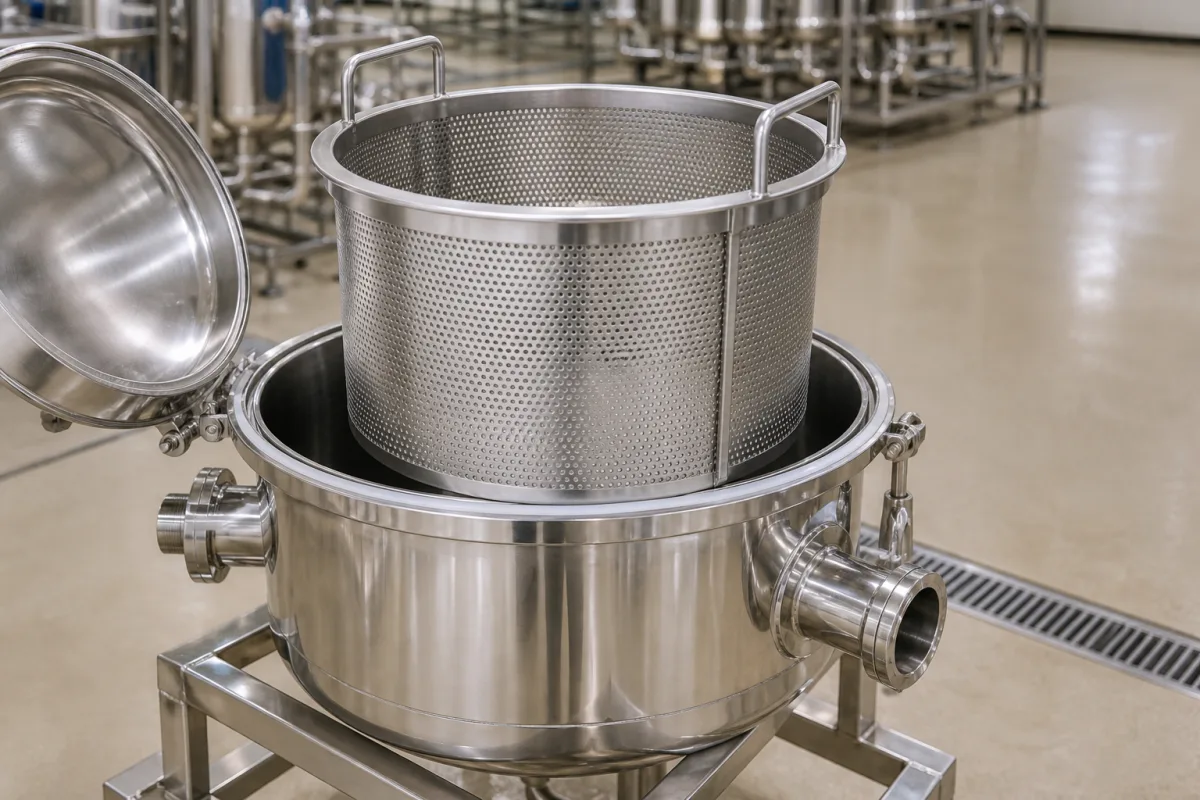
Sieve basket for hygienic process-line strainers: hole diameter and pitch, open area, and when to change to mesh or wedge-wire
The removable perforated, mesh-lined or wedge-wire element of a hygienic strainer in dairy, food, beverage and brewery lines · hole size against hole pitch, screen area against pipe bore, and slot sizes from 53 µm to 4 mm
A hygienic strainer in a milk, juice, beer or sauce line is only as good as the basket inside it. The housing, clamps and seals keep the product in; the basket decides which particles stop, how much screen the flow has to pass through, and how quickly the element fills and has to come out for cleaning. A buyer specifying a replacement or a new basket has to fix three things: the opening (hole diameter, mesh or slot width), the open area that follows from the opening and its spacing, and the total screen area relative to the pipe it sits in.
Removable straining elements — perforated tubes and baskets, mesh-overlaid baskets and wedge-wire slot elements — for hygienic inline, coarse, basket and slot strainers in dairy, food, beverage and brewery process lines, specified by opening size, hole pitch and open area, screen area against pipe bore, pressure and temperature limits, and cleaning access. Rotating conical centrisieves and paddle-type centrifugal screeners for starch slurries, with their sieve cones, are covered on the Industrial starch centrifugal sieving machine page. Y-type, basket and duplex strainers for steam, condensate, water and process liquids are on the Pipeline strainer (Y-type and basket) page; in-tank hydraulic suction strainers on the In-tank hydraulic suction strainer page; cartridge filter housings on the Filter housing page; solvent filter skids on the Solvent filtration skid page; relief valves on the same hygienic lines on the Sanitary pressure relief valve page.
CNFX editorial research · Sources checked October 13, 2026 · 5 sources
Hole diameter, hole pitch and the open area they give on a perforated strainer tube
Open area is not chosen separately from the holes; it follows from the hole diameter and the distance between hole centres. McNichols gives the percentage open area of round holes on 60° staggered centres as D² × 90.69 / C², and on straight centres as D² × 78.54 / C². [5] Alfa Laval's published element data fit the staggered formula.
The LKIF leaflet shows 1.5 and 2.25 mm on its element drawing without labelling which is the hole and which the pitch; the editorial check above reads them as hole diameter and pitch because that pairing reproduces the stated 40.2 %. [2][5] Alfa Laval states that the LKVF is meant to remove coarse particles of 1 to 3 mm, that its perforated tube is welded to a flange with a handle and clamped to a ferrule on the housing, and that the tube is designed to take the pressure drop in either flow direction; with the side connection as inlet, the maximum product pressure falls from 10 bar to 7 bar. [1]
Editorial note from the table: a finer hole at a proportionally finer pitch keeps the open area, but Alfa Laval's 1 mm element sits at 23 % against 33 % for the 3 mm element, so the finest of the three coarse elements gives the flow about 30 % less open screen.
When ordering a replacement basket, state the hole diameter and the pitch or the open area, the pattern (staggered or straight), the sheet thickness and alloy, and the flow direction through the element; a hole size alone does not define the element.
02
Screen area against pipe bore: an inline insert compared with a coarse-strainer basket
The second number that sets how long a basket runs before it blocks is its total screen area compared with the bore of the line. Alfa Laval publishes approximate strainer areas for each size of the LKIF inline element and for the LKVF coarse strainer. [2][1]
Editorial calculation: the LKVF coarse strainer's 430 cm² of screen in the 25–51 mm sizes and 840 cm² in the 63.5–76.1 mm sizes [1] is about 23 times the bore of a 51 mm line and about 21 times that of a 76.1 mm line, or about 4.7–7.6 times the bore once its 23–33 % perforation is applied. The inline insert keeps to the pipe's own envelope and so offers about 3–4.5 times the bore as open screen, falling to 2.7 times at 101.6 mm; the separate housing of the coarse strainer is what buys the extra area.
Alfa Laval rates the LKIF from full vacuum to 10 bar and, with EPDM seals, from −10 °C to 140 °C, with wetted parts in AISI 316 and a semi-bright finish; its pressure-drop diagram is measured on water at 20 °C to VDI 2173. [2]
Line size
LKIF strainer area (approx.)
Editorial calculation: bore area
Editorial calculation: screen ÷ bore, gross / at 40.2 % open
Ask for the screen area of the basket, not only the connection size, and for a pressure-drop curve on water or, better, on your product.
03
Below 1 mm: wedge-wire slot elements from 53 µm and mesh overlays on a perforated basket
For openings below the 1 mm of the finest coarse element, the choice is a slot element or wire mesh. Alfa Laval's LKSF slot strainer element is made of surface wire on vertical rods, welded at every intersection, and is offered from 53 µm to 4 mm. [3]
Sure Flow's tri-clamp basket strainers are built in 316 stainless steel polished to 25 Ra with PTFE cover gaskets, are intended for duties where frequent, thorough cleaning is needed between every batch, and take perforated, mesh or wedge-wire screening elements; an example order is a 2 in strainer with a 1/8 in perforated basket. [4] Alfa Laval's LKSF-CL collects impurities at the bottom of its housing, where they can be drained during operation through a manual valve or two remote-controlled valves, and the LKSF-BL can be backflushed by reversing the flow. [3]
Editorial calculation from Sure Flow's table: going from 20 mesh to 100 mesh cuts the opening from about 0.031 in to 0.005 in, roughly six-fold, while open area only falls from 46 % to 30 %. [4]
For a mesh-lined basket, state the mesh count or opening, the wire alloy, how the mesh is fixed to the perforated backing, and whether the combination still has to meet the hygienic certification you buy the housing under.
04
Data for a hygienic strainer basket
Paste it into your enquiry below or into an email to a maker, then replace every bracket.
Strainer: [maker and model, line size, connection type]
Opening: [hole diameter and pitch, or mesh count, or slot width]
Open area: [% and pattern; screen area in mm² or cm²]
Material: [alloy; surface finish Ra; seal material]
Duty: [product, flow, temperature, max. pressure drop; flow direction]
Cleaning: [CIP or manual removal; backflush; draining of debris]
Explore company information and manufacturing capabilities, then discuss the scope of your project with a relevant supplier.
Share this page
Compiled and source-reviewed by the CNFX editorial team.
Each manufacturer above links to the page on that company's own website where the product is listed, with the date we checked it. How we source and review
· Page last updated 13 October 2026
Buyer questions
How is the open area of a perforated strainer basket worked out?
For round holes on 60° staggered centres McNichols gives D² × 90.69 / C². Alfa Laval's LKVF elements of 1 mm holes at 2.0 mm pitch, 2 mm at 3.5 mm and 3 mm at 5.0 mm are published at 23, 30 and 33 % perforation, which the formula reproduces. [5][1]
How fine can a hygienic strainer element go?
Alfa Laval offers its LKSF wedge-wire slot elements from 53 µm to 4 mm. [3]
What open area does a mesh overlay give?
Sure Flow lists 46 % for 20 mesh, 36 % for 40 mesh and 30 % for 100 mesh. [4]
How much screen area does an inline strainer insert have?
Alfa Laval gives about 4,400 mm² for its 25 mm LKIF element, rising to about 50,600 mm² at 101.6 mm. [2]
Sources and what still needs a direct check
Sources checked 2026-10-13. Three Alfa Laval leaflets give element perforation, slot sizes, screen areas and ratings; Sure Flow Equipment's sanitary strainer catalogue gives basket construction and mesh open areas; McNichols gives the open-area formulas for perforated metal.