Editorial Technical Reference

Smart Industrial Power Factor Correction System

This page explains how Smart Industrial Power Factor Correction System is classified within Manufacture of Other Electrical Equipment. Technical values and manufacturer relationships are research references; confirm the current specification and supplier evidence for each order.

Technical Definition & Core Assembly

Automated industrial power quality management system for reactive power compensation.
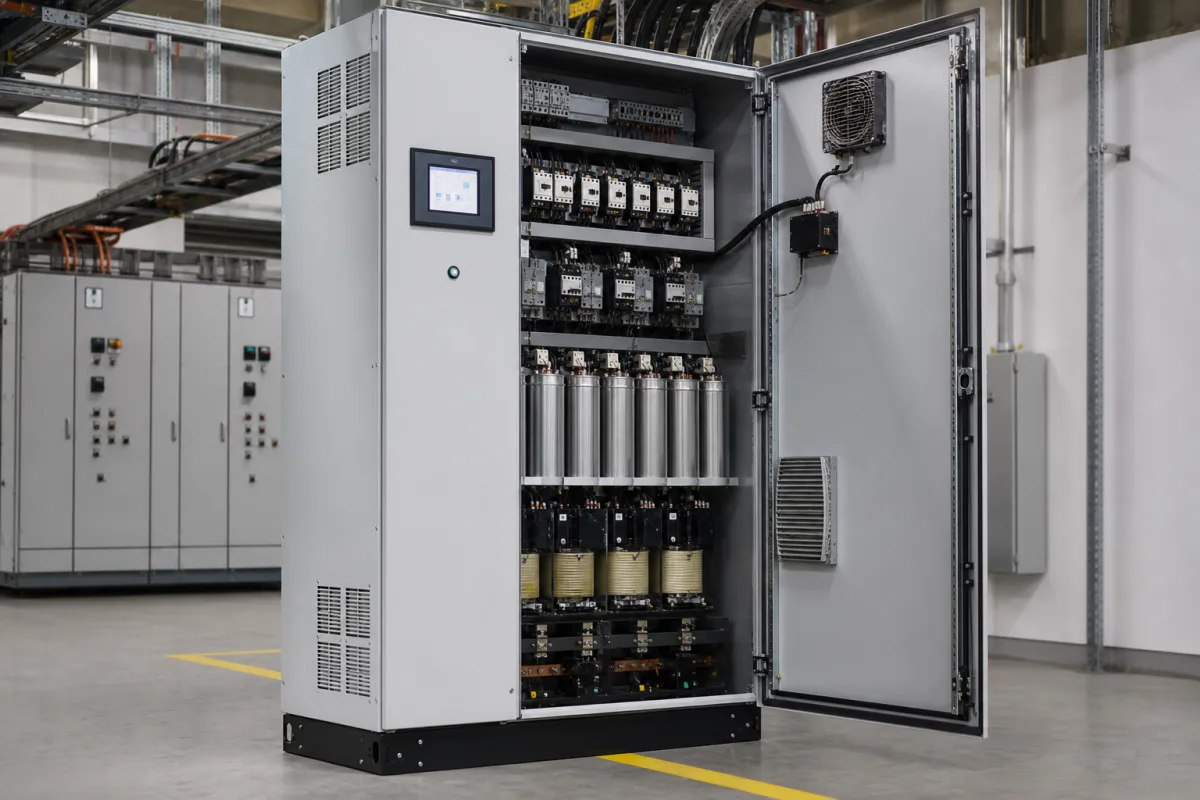
Representative product image. Confirm appearance and specifications with the manufacturer.

Product Specifications

Technical details and manufacturing context for Smart Industrial Power Factor Correction System

Definition
The Smart Industrial Power Factor Correction System is a fully integrated solution designed for medium to large-scale manufacturing facilities. It automatically monitors and compensates for reactive power in electrical networks to improve energy efficiency and reduce utility penalties. The system integrates capacitor banks, switching devices, monitoring sensors, and control logic into a coordinated unit that maintains an optimal power factor across variable industrial loads. It is intended for B2B industrial clients seeking to optimize electrical infrastructure and comply with utility power factor requirements while reducing operational costs.

The system operates by continuously monitoring the power factor via current and voltage sensors. When the power factor deviates from the target setpoint, the control logic automatically switches capacitor banks in or out to minimize reactive power flow. This dynamic response ensures that the power factor remains within the specified accuracy of ±1.5%.

Key technical parameters include a total compensation capacity ranging from 100 to 600 kvar, operating voltage from 380 to 690 V (per IEC 60038), and a response time of 20 to 40 ms. The system offers 4 to 12 switching steps for granular control, and harmonic filtering capabilities for the 5th, 7th, 11th, and 13th harmonics (per IEC 61000-2-4). It is designed for ambient temperatures from -25°C to 55°C (per IEC 60721-3-3) and provides a degree of protection from IP54 to IP65 (per IEC 60529). Communication interfaces include RS485 and Modbus for SCADA integration. The system is available in a floor-standing cabinet with dimensions of 800×1800×600 mm and weighs between 150 and 450 kg, depending on configuration.

Materials used include aluminum capacitor casings, copper busbars, a steel enclosure, and polypropylene film dielectric. These components are selected for durability and performance in industrial environments.

For procurement, it is essential to verify model-specific values and standards with the legal manufacturer or supplier, as the listed parameters are reference ranges. The system is not a certified product unless explicitly stated by the manufacturer. Always confirm that the selected model meets your specific load requirements and site conditions.
Working Principle
The system continuously monitors the power factor using current and voltage sensors. When the power factor falls below the target setpoint, the control logic activates capacitor banks in stages to inject reactive power, reducing the phase angle between voltage and current. When the power factor exceeds the setpoint, capacitors are switched off. This automatic switching maintains the power factor within ±1.5% of the setpoint, minimizing reactive power flow and improving energy efficiency. The system uses a stepwise switching approach with 4 to 12 stages to provide granular control and avoid overcompensation. The response time is 20 to 40 ms, ensuring rapid correction under varying load conditions.
Common Materials
Aluminum capacitor casings, Copper busbars, Steel enclosure, Polypropylene film dielectric
Technical Parameters
ParameterTypical rangeNotes & selection driver
Total Compensation CapacityRequired100–600 kvarMaximum reactive power compensation capability
Operating VoltageRequired380–690 VRated system voltage (typically 400V, 480V, or 600V)IEC 60038
Response TimeRequired20–40 msTime to detect and apply compensation
Number of StepsRequired4–12 stepsNumber of capacitor switching stages for granular control
Harmonic Filtering5, 7, 11, 13 %Total harmonic distortion reduction capabilityIEC 61000-2-4
Ambient Temperature RangeRequired-25–55 °COperating temperature range for industrial environmentsIEC 60721-3-3
Control Accuracy±1.5 %Power factor maintained within setpoint
Switching Frequency≤10 operations/hMax capacitor switching rate
Degree of ProtectionIP54–IP65Indoor/outdoor installationIEC 60529
Communication InterfaceRS485, ModbusFor SCADA integration
Weight150–450 kgDepends on capacity and enclosure
Dimensions (W×H×D)800×1800×600 mmTypical floor-standing cabinet

Ranges are indicative industry figures for RFQ preparation, not a supplier commitment. Confirm every value and standard with the legal manufacturer before ordering.

Components / BOM
  • Capacitor Bank Array
    Provides reactive power compensation through multiple capacitor units
    Material: Aluminum casing with polypropylene dielectric
  • Intelligent Controller
    Monitors power factor and controls capacitor switching
    Material: Electronic components in steel enclosure
  • Power Quality Analyzer
    Continuously measures voltage, current, power factor, and harmonics
    Material: Electronic sensors and processing unit
  • Thyristor Switching Modules
    Provides zero-crossing switching of capacitor banks
    Material: Semiconductor components with heat sinks
  • Protection Circuitry Part
    Includes overcurrent, overvoltage, and temperature protection
    Material: Relays, fuses, and thermal sensors

Industry Taxonomies & Aliases

Commonly used trade names and technical identifiers for Smart Industrial Power Factor Correction System.

Industrial Ecosystem & Supply Chain Structure

Complementary Systems
Downstream Applications
Specialized Tooling

Application Fit & Sizing Matrix

Operational Limits
pressure: Up to 1.5 bar (atmospheric pressure systems), 0.8 to 1.2 bar typical
other spec: Voltage range: 200-690V AC, 50/60Hz, Humidity: 5-95% non-condensing, IP54 enclosure rating
temperature: -20°C to +55°C (operating), -40°C to +70°C (storage)
Media Compatibility
✓ Industrial manufacturing facilities ✓ Commercial buildings with heavy HVAC loads ✓ Data centers with high power density
Unsuitable: Hazardous locations with explosive atmospheres (Class I, Division 1)
Sizing Data Required
  • Total connected load (kVA)
  • Existing power factor measurement
  • Target power factor requirement

Reliability & Engineering Risk Analysis

Failure Mode & Root Cause
Capacitor Bank Degradation
Cause: Thermal stress from harmonic currents and voltage spikes, leading to dielectric breakdown and reduced capacitance over time.
Control System Malfunction
Cause: Electromagnetic interference (EMI) from adjacent industrial equipment corrupting sensor signals and microcontroller operations.
Maintenance Indicators
  • Audible humming or buzzing from capacitor banks indicating internal arcing or imminent failure.
  • Visual warning lights or error codes on the control panel signaling power factor instability or communication loss.
Engineering Tips
  • Install harmonic filters and surge protection devices upstream to minimize electrical stress on capacitor banks.
  • Implement regular infrared thermography scans to detect abnormal heating in capacitors and connections before catastrophic failure.

Indicative industry ranges for design and RFQ preparation. Confirm the exact figures and applicable standard with the manufacturer before specifying.

Compliance & Manufacturing Standards

Applicable Standards
IEC 61000-3-2 (CE marking for harmonic current emissions) ANSI C84.1 (Voltage ratings for electrical power systems)

Quoted from the published standard.

Manufacturing Precision
  • Capacitance tolerance: +/-5% of rated value
  • Voltage measurement accuracy: +/-0.5% of full scale
Quality Inspection
  • Dielectric withstand test (hipot test) per IEC 60255
  • Harmonic distortion analysis per IEEE 519

Manufacturers of Smart Industrial Power Factor Correction System

Manufacturer profiles associated with Smart Industrial Power Factor Correction System.

Sourcing Smart Industrial Power Factor Correction System from China?
Tell us your specification and target quantity — we will match it against manufacturer records and come back with the factories that fit.
Request manufacturers We manufacture this

Manufacturer listings support early research and capability understanding. They are not certification, ranking, or transaction guarantees.

Technical documentation
Request current drawings, revision history, and a signed specification sheet.
Manufacturing capability
Verify equipment lists, process limits, capacity, and representative production evidence.
Inspection readiness
Confirm test methods, calibrated equipment, sampling plans, and traceable reports.
Supplier transparency
Check the legal entity, factory address, ownership, certifications, and direct contacts.

CNFX does not score or rank suppliers. Buyers must verify all claims and documents with the legal manufacturer before ordering.

Frequently Asked Questions

What is the typical response time of the system?

The response time is typically between 20 and 40 ms, depending on the load conditions and the number of switching steps required. This allows for rapid correction of power factor deviations.

Can the system be integrated with existing SCADA systems?

Yes, the system provides RS485 and Modbus communication interfaces, which are commonly used for SCADA integration. This allows remote monitoring and control of the power factor correction process.

What harmonic filtering capabilities does the system offer?

The system is designed to filter the 5th, 7th, 11th, and 13th harmonics, as referenced in IEC 61000-2-4. This helps reduce total harmonic distortion in the electrical network.

What is the operating temperature range?

The system is designed to operate in ambient temperatures from -25°C to 55°C, as per IEC 60721-3-3. This makes it suitable for a wide range of industrial environments.

Data Basis

Editorial classification, named public sources where available, and source-reviewed manufacturer records.

Preliminary Technical Classification
This page supports structured research, RFQ preparation, and supplier evaluation. It does not replace buyer-led supplier qualification, standards review, or technical approval.
Buyer enquiry

Request manufacturing insight for Smart Industrial Power Factor Correction System

Ask for use case, specification boundaries, supplier type, and RFQ preparation information for this product.

Where it goes
Straight to the CNFX editorial desk, and to the manufacturer if this product is linked to a claimed profile. Nothing is broadcast to a supplier list.
Your details stay here
We do not sell or rent enquiry data, and we do not add you to a mailing list. Used only to answer this request.
No commission, no middleman
CNFX is a directory. We take no cut of any order and never negotiate on a supplier's behalf.
What we don't claim
A listing is not an endorsement. Qualify every supplier and verify every figure yourself before ordering.

Your business information is used only to process this request.

Thank you! Your message has been sent. We'll respond within 1–3 business days.
Sorry, we couldn't send your message. Please try again, or email us at contact@cnfx.com.

Need to Manufacture Smart Industrial Power Factor Correction System?

Compare manufacturer profiles with relevant product and process capability.

Previous Product
Precision Current Shunt Resistor
Last Product
Get QuotesChat