Industry-Verified Manufacturing Data (2026)

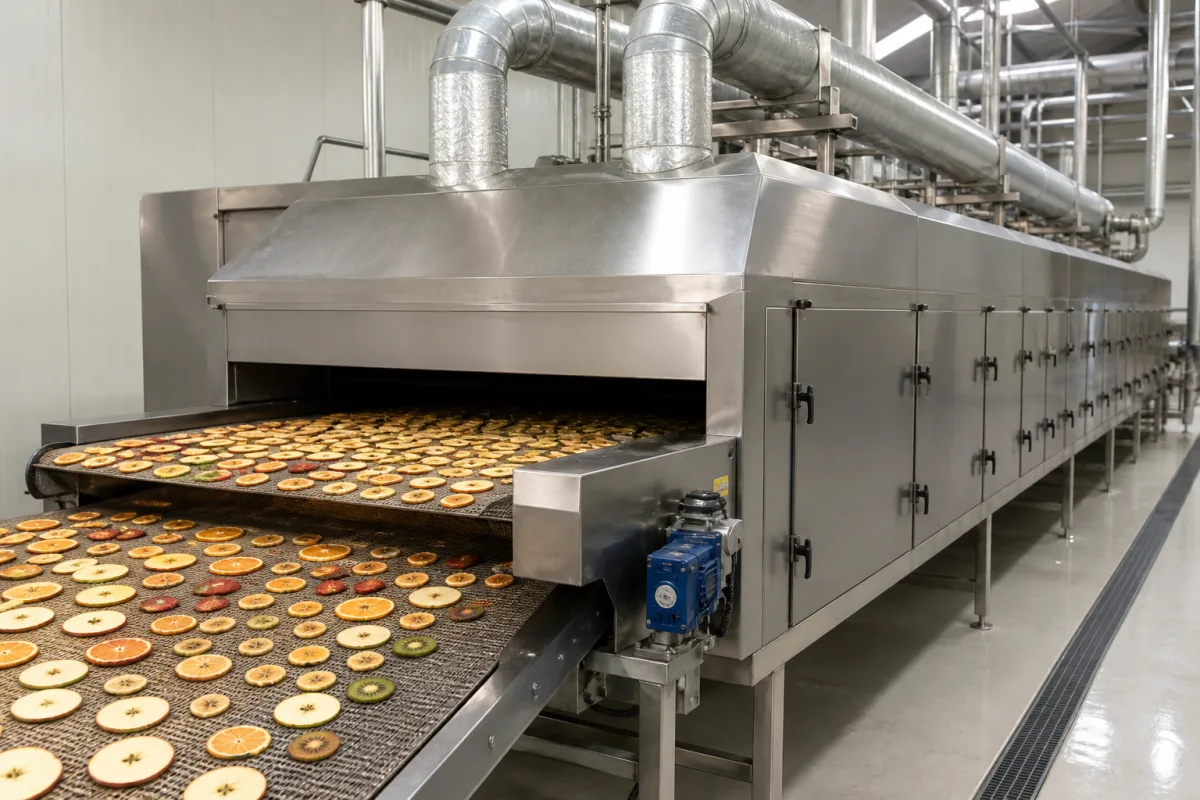
Industrial-Scale Food Dehydrator

Based on aggregated insights from multiple verified factory profiles within the CNFX directory, the standard Industrial-Scale Food Dehydrator used in the Manufacture of Other Food Products sector typically supports operational capacities ranging from standard industrial configurations to heavy-duty production requirements.

Technical Definition & Core Assembly

A canonical Industrial-Scale Food Dehydrator is characterized by the integration of Heating Element Assembly and Air Circulation System. In industrial production environments, manufacturers listed on CNFX commonly emphasize Food-grade stainless steel construction to support stable, high-cycle operation across diverse manufacturing scenarios.

Industrial-scale equipment for controlled moisture removal from food products.

Product Specifications

Technical details and manufacturing context for Industrial-Scale Food Dehydrator

Definition
An industrial food dehydrator is a specialized processing device designed for large-scale moisture removal from various food products through controlled heat and airflow. It enables food manufacturers to extend shelf life, reduce packaging costs, and create value-added products like dried fruits, vegetables, herbs, and jerky. This equipment plays a critical role in B2B supply chains by providing consistent, high-volume dehydration for ingredient suppliers, snack manufacturers, and prepared food producers. Industrial dehydrators help reduce food waste by preserving seasonal produce and creating shelf-stable ingredients for downstream food processing.
Working Principle
Utilizes forced hot air circulation through multiple trays or conveyor systems to evaporate moisture from food products while maintaining temperature and humidity control.
Common Materials
Food-grade stainless steel, Heat-resistant polymers, Aluminum heating elements
Technical Parameters
  • Maximum throughput of fresh product (kg/hour) Customizable
  • Operational temperature control range (°C) Customizable
Components / BOM
Engineering Reasoning
0.1-1.5 bar absolute pressure, 40-85°C air temperature, 0.2-2.0 m/s air velocity
Material yield strength of 304 stainless steel at 150°C: 205 MPa, Polycarbonate viewing window glass transition temperature: 147°C, Belt tensile strength: 50 N/mm
Design Rationale: Thermal expansion mismatch between stainless steel frame (coefficient 17.3 μm/m·K) and polycarbonate components (70 μm/m·K) causing stress concentrations exceeding material yield points at temperature differentials >60°C
Risk Mitigation (FMEA)
Trigger Moisture sensor calibration drift exceeding ±3% RH due to hygroscopic contamination
Mode: Over-dehydration below 3% moisture content causing product embrittlement and conveyor belt product adhesion
Strategy: Dual redundant capacitive humidity sensors with automated monthly calibration against NIST-traceable standards
Trigger Heating element uneven thermal distribution creating >15°C temperature gradient across 2m belt width
Mode: Differential product shrinkage causing belt tracking misalignment exceeding 5mm tolerance
Strategy: Zoned PID temperature control with 12 independently regulated heating zones and infrared thermal imaging feedback

Industry Taxonomies & Aliases

Commonly used trade names and technical identifiers for Industrial-Scale Food Dehydrator.

Industrial Ecosystem & Supply Chain DNA

Complementary Systems
Downstream Applications
Specialized Tooling

Application Fit & Sizing Matrix

Operational Limits
pressure: Atmospheric to 0.5 bar vacuum
temperature: 40-85°C (104-185°F)
air flow rate: 500-5000 m³/h
slurry concentration: Up to 40% solids by weight
Media Compatibility
✓ Fruit slices (apples, bananas) ✓ Vegetable powders (carrot, spinach) ✓ Meat jerky (beef, poultry)
Unsuitable: High-oil content products (nuts, seeds) due to oxidation risk
Sizing Data Required
  • Initial moisture content (%)
  • Target final moisture content (%)
  • Required production capacity (kg/h dry product)

Reliability & Engineering Risk Analysis

Failure Mode & Root Cause
Heating element degradation
Cause: Cyclic thermal stress from repeated heating/cooling cycles leading to material fatigue, oxidation, and eventual burnout, exacerbated by moisture ingress and food particle accumulation.
Fan bearing failure
Cause: Continuous high-temperature operation causing lubricant breakdown, combined with particulate contamination from food debris leading to abrasive wear and eventual seizure or imbalance.
Maintenance Indicators
  • Inconsistent product moisture content or extended drying times indicating airflow or heating irregularities
  • Unusual grinding/vibration noises from fan assembly or overheating odors from electrical compartments
Engineering Tips
  • Implement predictive maintenance using infrared thermography to monitor heating element temperature profiles and vibration analysis on fan bearings to detect early degradation
  • Establish rigorous cleaning protocols with HEPA-filtered compressed air systems to remove food particulates from heat exchangers and airflow passages, combined with scheduled lubrication using high-temperature food-grade lubricants

Compliance & Manufacturing Standards

Reference Standards
ISO 22000:2018 - Food safety management systems ANSI/UL 197 - Commercial Electric Cooking Appliances CE Marking - Machinery Directive 2006/42/EC
Manufacturing Precision
  • Temperature uniformity: +/- 2.5°C across all trays
  • Airflow velocity: +/- 0.5 m/s at specified fan settings
Quality Inspection
  • HACCP validation testing for microbial reduction
  • Material safety verification for food contact surfaces

Factories Producing Industrial-Scale Food Dehydrator

Verified manufacturers with capability to produce this product in China

✓ 94% Supplier Capability Match Found

P Procurement Specialist from United Arab Emirates Feb 20, 2026
★★★★★
"Reliable performance in harsh Manufacture of Other Food Products environments. No issues with the Industrial-Scale Food Dehydrator so far."
Technical Specifications Verified
T Technical Director from Australia Feb 17, 2026
★★★★★
"Testing the Industrial-Scale Food Dehydrator now; the Processing Capacity (kg/hour) results are within 1% of the laboratory datasheet."
Technical Specifications Verified
P Project Engineer from Singapore Feb 14, 2026
★★★★★
"Impressive build quality. Especially the Processing Capacity (kg/hour) is very stable during long-term operation."
Technical Specifications Verified
Verification Protocol

“Feedback is collected from verified sourcing managers during RFQ (Request for Quote) and factory evaluation processes on CNFX. These reports represent historical performance data and technical audit summaries from our B2B manufacturing network.”

17 sourcing managers are analyzing this specification now. Last inquiry for Industrial-Scale Food Dehydrator from Thailand (17m ago).

Frequently Asked Questions

What is the typical energy consumption of this industrial dehydrator?

Energy consumption varies by model and load, typically ranging from 0.8-1.2 kWh per kg of product processed, with precise figures available in detailed specifications.

How does the humidity exhaust system improve food drying efficiency?

The humidity exhaust system continuously removes moist air from the chamber, maintaining optimal drying conditions and preventing moisture re-absorption, which reduces processing time by 15-25% compared to passive systems.

What maintenance is required for the food-grade stainless steel components?

Regular cleaning with food-safe sanitizers and periodic inspection of seals and joints is recommended. Stainless steel surfaces require minimal maintenance beyond standard hygiene protocols for food manufacturing equipment.

Can I contact factories directly on CNFX?

CNFX is an open directory, not a transaction platform. Each factory profile provides direct contact information and production details to help you initiate direct inquiries with Chinese suppliers.

Get Quote for Industrial-Scale Food Dehydrator

Request technical pricing, lead times, or customized specifications for Industrial-Scale Food Dehydrator directly from verified manufacturing units.

Your business information is encrypted and only shared with verified Industrial-Scale Food Dehydrator suppliers.

Thank you! Your message has been sent. We'll respond within 1–3 business days.

Need to Manufacture Industrial-Scale Food Dehydrator?

Connect with verified factories specializing in this product category

Add Your Factory Contact Us
Previous Product
Industrial Food Extrusion and Forming Machine
Last Product