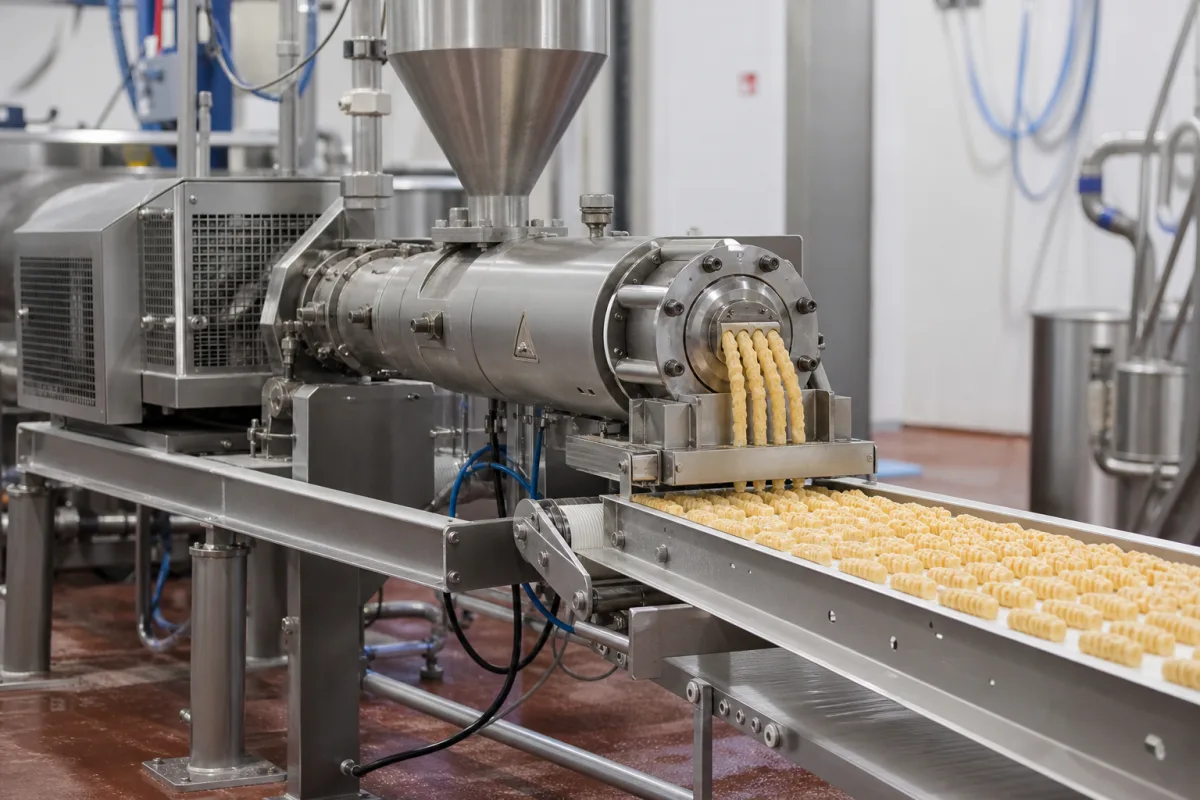
Extrusion cooking · Feed moisture, screw speed and barrel temperature; specific mechanical energy; expansion and texture
An industrial food extrusion and forming machine is a cooking extruder in which one or two screws convey, knead and heat a moistened starch or protein mix under pressure, then force it through a die where it expands and is cut into snacks, cereals, pasta-type shapes or pet food. Ask three things first: the moisture, screw-speed and temperature window your product needs, the specific mechanical energy the extruder can deliver and measure, and the die and cutter arrangement for your shapes.
Cooking extruders for foods and pet foods, single- and twin-screw, with dies and cutters for direct-expanded snacks, cereals, pellets and kibble. Cold pasta presses, plastic extruders, extruder spare parts and gearboxes alone, and fryers or dryers are outside this page.
CNFX editorial research · Sources checked October 12, 2026 · 4 sources
Set the moisture, screw speed and temperature window
Kantrong and co-authors (Journal of Food Science and Technology, 2018) made rice snacks with 15% oyster mushroom powder on a twin-screw extruder, varying feed moisture from 12 to 18% (wet basis), screw speed from 275 to 425 rpm and barrel temperature from 130 to 150 °C. Bulk density changed significantly with all three, higher barrel temperature raised the expansion ratio, and hardness rose with more moisture and lower screw speed. [1]
Using response surface methodology, they chose 13.5% feed moisture, 425 rpm and a maximum barrel temperature of 130 °C as giving good snack quality at low energy. [1] Editorial note: these settings are for one rice-based formulation on one machine; use them as an example of the window an extruder supplier should demonstrate with your own recipe.
Give the supplier the products and formulations, target throughput, moisture range, temperature profile, desired expansion, density and texture, die shapes and cut lengths, downstream drying or frying, cleaning and food-contact requirements, and utilities.
02
Measure specific mechanical energy and residence time
The same study measured specific mechanical energy (SME) from the extruder's current and voltage with and without load, divided by the feed rate, and found that feed moisture had the largest influence on SME: between 12 and 15% moisture SME fell as moisture fell, while between 15 and 18% it fell as moisture rose. It reports SME values of about 260–350 kJ/kg. [1]
A 2024 review in Frontiers in Sustainable Food Systems on extruded instant flours describes SME and mean residence time as essential process parameters, alongside pressure and torque, and reviews how temperature, screw speed and moisture affect properties such as water absorption and solubility, pasting, colour and bulk density. [2]
Editorial calculation: at 300 kJ/kg and a feed rate of 100 kg/h, the net mechanical power going into the product is 300 × 100 / 3600 ≈ 8.3 kW; ask suppliers to quote motor power with margin above the SME your products need at full throughput.
03
Size the extruder from a maker's model range
ANDRITZ's brochure Advanced extrusion technology for pet food production lists its extruder range by screw diameter, main motor and capacity, and describes its co-rotating twin-screw extruders as suited to recipes with high inclusion of meat slurries or fresh meat, with complete discharge and no residue in the barrel for rapid recipe changeover. [3]
The brochure's feature table lists belt drive on the three smaller single-screw models and gear drive on the others, pinned screws on the single-screw models and splined screws on the twin-screw models, screw push-out and high-moisture meat slurry handling only on the twin-screw models, and water cooling or heating jackets and liquid injection points on all. It describes adjusting pressure at the die plate to raise or lower SME without changing screws, and a microfeed system for pellets down to 2 mm. [3]
Editorial calculation: installed motor power per tonne of rated capacity is 500 / 12 ≈ 42 to 500 / 8 ≈ 63 kW per t/h for the EXTS616 and 315 / 11 ≈ 29 to 315 / 4 ≈ 79 kW per t/h for the EX1021; this is an upper bound, not the specific mechanical energy actually used. [3][1]
For direct-expanded snacks and breakfast cereals rather than pet food, Baker Perkins gives the nominal throughput of its SBX Master 125 twin-screw extruder as 2,300 kg/h of direct expanded products, against a previous maximum of 1,500 kg/h in its range. It attributes the gain to a motor and gearbox combination with twice the torque capacity of its previous generation, which it says also lets the extruder handle denser materials, and to a high free-volume agitator geometry that sustains output on low-density materials such as bran and fine milled flours. The barrel is modular so its length can be matched to the process and extended later; screws run on splined shafts; the drive is AC; and control is by PLC touch screen with automatic start and stop sequences. Baker Perkins names corn curls, chipsticks, maize rings, whole-grain and multigrain snacks and filled pillows among the products of its Snack Master lines. [4] Editorial calculation: 2,300 ÷ 1,500 ≈ 1.53, about 53% more nominal output; at the 260–350 kJ/kg SME measured for one rice-based snack, 2,300 kg/h would take about 166–224 kW of net mechanical power (SME × rate ÷ 3,600), so check motor rating against your own recipe's SME. [4][1]
Model
Type
Screw diameter
Motor
Capacity
EX0618
Single-screw
177 mm
200 kW
1–4 t/h
EX0621
Single-screw
210 mm
315 kW
3–7 t/h
EX1021
Single-screw
210 mm
315 kW
4–11 t/h
EX1250
Single-screw
250 mm
710 kW
10–20 t/h
EXMAX S1021
Single-screw
210 mm
315 kW
3–9 t/h
EXTS616
Twin-screw
2 × 158 mm
500 kW
8–12 t/h
EXTS718
Twin-screw
2 × 176 mm
710 kW
10–18 t/h
Give the product (kibble, aquafeed, snacks), meat or slurry inclusion, target output and pellet size, and ask for the model, motor power, screw type and the SME range the drive can deliver.
04
Twin-screw snack extruders, puffed-snack lines and pet food extruders on the listed pages
Listings include twin-screw food and snack extruders, puffed-snack production lines and pet food extruders.
05
Feeder, screws, heated barrel, die, cutter and drive on a cooking extruder
The feeder, screw and barrel-zone rows correspond to the three variables Kantrong and co-authors varied (feed moisture, screw speed, barrel temperature); the cutter row has no published value in these sources. [1]
Throughput, screw speed, barrel temperature, motor power and die pressure for a food extruder
Published values here come from the rice-snack study (275–425 rpm, 130–150 °C), ANDRITZ's pet food range and Baker Perkins' 2,300 kg/h snack extruder; screw diameter, L/D, heating zones and machine weight are left for the supplier to quote. [1][3][4]
Field
What it means and published values
Ask the supplier for
Maximum throughput (kg/h)
Product rate; e.g. 2,300 kg/h nominal for direct expanded products on one twin-screw snack extruder. [4]
3 companies list this product among what they make. Company figures are quoted from each
company's own website; every card states where the relationship came from.
Jinan Arrow Machinery Co., Ltd.
Manufacturing site to be confirmed for the order
Lists twin-screw food extruders and puffed snack production lines.
Explore company information and manufacturing capabilities, then discuss the scope of your project with a relevant supplier.
Share this page
Compiled and source-reviewed by the CNFX editorial team.
Each manufacturer above links to the page on that company's own website where the product is listed, with the date we checked it. How we source and review
· Page last updated 13 October 2026
Buyer questions
Which process variable has the largest effect on extruder energy?
In a twin-screw rice-snack study, feed moisture had the largest influence on specific mechanical energy. [1]
How does barrel temperature affect expansion?
In that study, raising barrel temperature from 130 toward 150 °C increased the expansion ratio. [1]
What is specific mechanical energy?
The mechanical energy input per kilogram of product, measured there from loaded minus no-load electrical power divided by feed rate. [1]
How much motor power does a pet food extruder need?
One maker's range runs from a 200 kW single-screw extruder for 1–4 t/h to 710 kW twin-screw for 10–18 t/h. [3]
How much can a large snack and cereal extruder produce?
Baker Perkins gives a nominal 2,300 kg/h of direct expanded products for its SBX Master 125 twin-screw extruder, up from a previous maximum of 1,500 kg/h in its range; actual output depends on the product and recipe. [4]
Sources and what still needs a direct check
Sources checked 2026-10-12. Kantrong et al. is a peer-reviewed study of one rice-based snack; the Frontiers review covers extruded instant flours; ANDRITZ and Baker Perkins publish data for their own extruders. Settings for your products must come from trials.