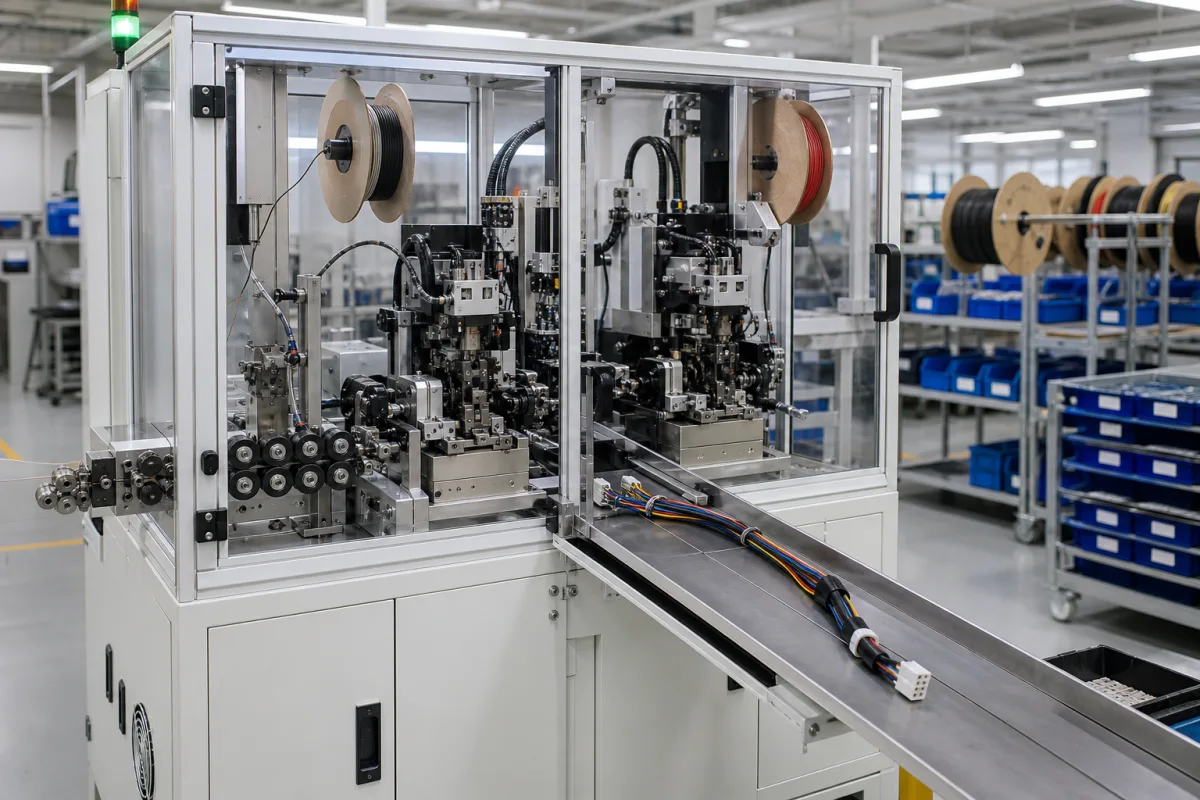
Wire processing · Wire range and press force, cycle rate, length tolerance, error detection and crimp pull testing
An automated wire harness crimping machine feeds wire from a reel, cuts it to length, strips the ends and crimps terminals; some models add seal insertion or a second crimp station. Ask three things first: the wire sizes and terminals it handles, the press force, cycle rate and length tolerance, and the error detection and pull testing that prove each crimp.
Fully automatic and semi-automatic terminal crimping machines and cut-strip-crimp machines for wire harness production. Hand crimp tools, hose crimping machines, crimp applicators sold alone and harness test benches are outside this page.
CNFX editorial research · Sources checked October 11, 2026 · 4 sources
Hechang's HC-10 fully automatic machine cuts and strips wire and crimps one end. Its specification table lists wire sizes of 0.03–2.5 mm² (AWG 30–13), a 1.5-ton crimping capacity, cutting length 40 mm to 99,999.99 mm with a tolerance of ±0.002 × L, stripping length 0.1–10 mm, compressed air at 6–6.5 kg, 165 kg weight and 4,000 pieces per hour, with detectors for wire presence, wire overload, strip error, terminal presence and crimp error. [2]
The same page's feature list describes a 2-ton servo press and wire range of 0.1–3 mm² (AWG 32–13), which differs from the specification table; ask the supplier to confirm force and wire range in the quotation. [2]
Editorial calculation: 4,000 pieces per hour is 3,600 ÷ 4,000 = 0.9 s per piece; at 500 mm cut length the ±0.002 × L tolerance is ±1.0 mm. [2] Ask for rate at your lengths and terminal type, not the maximum.
Give the supplier the wire types and cross-sections, terminals and seals with part numbers, cut and strip lengths, one- or two-end crimping, required output per shift, crimp monitoring and traceability, applicator compatibility, air and power supply, and acceptance samples.
02
Prove crimp quality with pull testing
NASA-STD-8739.4A, the agency's crimping and harness workmanship standard, sets minimum crimp tensile strengths for copper stranded conductors: for example 36 N for 24 AWG, 57 N for 22 AWG, 92 N for 20 AWG, 142 N for 18 AWG, 183 N for 16 AWG and 290 N for 14 AWG. Combinations not in the table must reach at least 60% of the wire's tensile strength. The test pulls at 25.4 ± 6.3 mm per minute. [1]
For production control, the standard requires pull tests of each tool and contact-conductor combination at the start and end of each shift or production run, with zero failures out of three samples before production proceeds, records traceable to the contact, wire, tool, setting and run, and hardware made before a failed test treated as suspect. Adjustable crimp tools must be set, sealed or locked and verified before use. [1]
Editorial calculation: testing at both the start and end of a shift uses 2 × 3 = 6 destructive samples per tool and combination per shift, unless the standard's rule for skipping a test between consecutive shifts applies. [1] Hechang also lists pull force testers and crimp micrograph analysis equipment. [2]
03
Cut-strip-crimp, double-head, ferrule and crimp-and-tin machines from eight listed makers
The listed makers range from fully automatic cut-strip-crimp machines (Hechang, Wirepro) and double-head terminal machines (Kunshan Bolun) to ring-lug and ferrule crimpers (Kunshan Yuanhan, Qingdao Jingchengwang) and crimp-and-tin machines (Bettertech).
Hechang, Kingsing, Bozwang, Bolun and Wirepro list fully automatic cut-strip-crimp machines; Yuanhan lists stripping-crimping and ring-lug crimping machines; JCW lists stripping and crimping machines including ferrule crimpers; Bettertech lists terminal crimping and crimp-and-tin machines.
04
Check a double-ended machine's stations, limits and sample rule
Schleuniger's datasheet for the CrimpCenter 36 S, a fully automatic machine that processes both wire ends, shows what a two-sided specification adds to the single-ended example above. It lists up to 6 processing stations with a maximum of 3 crimping stations, wire lengths of 55 mm to 65 m (optionally from 35 mm), stripping length of 0.1 to 18 mm on each side, wire cross sections of 0.13 to 6 mm² (26 to 10 AWG) and a maximum wire feed rate of 8 m/s. It needs a 400/230 V, 50/60 Hz, 16 A supply and 6 bar non-oiled, dried and filtered compressed air. [3]
Its crimping stations come with integrated crimp force monitoring, and one version adds electronic crimp height control; other stations load seals, twist and tin, or strip coaxial cable. The datasheet warns that wires with hard or tightly bonded insulation might not process even inside the stated range, and requires sample processing for cross sections smaller than 0.22 mm² (24 AWG) or larger than 4 mm² (12 AWG). The machine weighs about 440 kg without stations and about 750 kg fully equipped. [3]
Editorial note: send wire samples at the smallest and largest sizes on your wire list, including any hard or bonded insulation, with the quotation request. Ask whether crimp force monitoring and crimp height control are included on every crimping station quoted, and for the rate at your shortest cut length rather than the maximum feed rate.
Check what crimp force monitoring will and will not catch
Crimp force monitoring compares each press stroke's force curve with a recorded good reference. Researchers at Friedrich-Alexander-Universität Erlangen-Nürnberg published 2,439 labelled force curves from a semi-automatic bench crimper fitted with a strain sensor on the press connecting rod, recorded at 3,566 points per curve, crimping 0.50 mm² 16-strand and 0.35 mm² 12-strand FLRY-B copper wire into MLK 1.2 terminals with quick-change tooling. Good samples were stripped to 4 mm; defects were made by removing one, two or three strands or by stripping to 3 mm so insulation was crimped. [4]
The authors note that certain standards permit up to 10% of strands to be missing, so a monitor may legitimately pass a crimp with one strand gone. [4] Editorial calculation: one strand of 12 is 8.3% and one of 16 is 6.25%, both inside that 10% allowance, which fits the single-missing-strand class accounting for 123 of the 200 disagreements; and 20 kN is about 2.0 tonnes-force, against the 1.5-ton capacity in the cut-strip-crimp example above. [4][2] Ask a machine supplier which defect classes its monitor was validated on, at which wire sizes, and to show the reject rate on deliberately faulty samples, then confirm with NASA-style pull tests. [1]
Item (FAU study)
Value
Press
Eccentric, 20 kN pressing force, 40 mm stroke, 135.78 mm closing height, up to 6 mm² wire, 112 kg
Curves recorded
2,439; for 0.5 mm²: 790 OK, 76 one missing strand, 188 two, 51 three
Monitor vs expert labels
200 curves (about 8%) disagreed on OK/NOK
Disagreements by class
123 one missing strand, 43 two missing strands, 33 crimped insulation, 1 three missing strands
06
Wire feed, stripper, crimp press, error detectors and pull tester
Each machine part below maps to a line of the HC-10 example: ±0.002 × L cutting, 0.1–10 mm stripping, a 1.5-ton press and five error detectors. [2]
Crimp force, cycle rate, wire range and air supply for a harness crimper
Values here come from the HC-10 table, with two editorial conversions: 1.5 t is about 14.7 kN, and 4,000 pieces per hour is about 67 per minute. Pull-test strength is set by NASA-STD-8739.4A, not by the machine. [2][1]
Field
What it means and published values
Ask the supplier for
Crimping force (kN)
E.g. 1.5 t in the example table; about 14.7 kN (editorial conversion). [2]
Force and press type.
Cycle speed (cycles/min)
E.g. 4,000 pcs/h; about 67 per minute (editorial calculation). [2]
8 companies list this product among what they make. Company figures are quoted from each
company's own website; every card states where the relationship came from.
Explore company information and manufacturing capabilities, then discuss the scope of your project with a relevant supplier.
Share this page
Compiled and source-reviewed by the CNFX editorial team.
Each manufacturer above links to the page on that company's own website where the product is listed, with the date we checked it. How we source and review
· Page last updated 13 October 2026
Buyer questions
How strong must a crimp be?
NASA-STD-8739.4A gives minimums such as 57 N for 22 AWG and 142 N for 18 AWG copper; other combinations need at least 60% of the wire's tensile strength. [1]
How often should crimps be pull-tested in production?
The NASA standard requires tests at the start and end of each shift or run, with zero failures out of three samples. [1]
Is the maximum output rate realistic?
Treat it as a maximum: the example machine lists 4,000 pieces per hour; ask for the rate at your cut lengths and terminals. [2]
Does a wire inside a machine's stated range always process?
No: Schleuniger's CrimpCenter 36 S datasheet says wires with hard or tightly bonded insulation might not process even within range, and requires sample processing below 0.22 mm² or above 4 mm². [3]
Does crimp force monitoring catch every bad crimp?
Not in one published test: in an Erlangen-Nürnberg dataset of 2,439 crimps, the machine's monitor and expert labels disagreed on about 8% (200 curves), 123 of them crimps with one missing strand. [4]
Sources and what still needs a direct check
Sources checked 2026-10-11. NASA-STD-8739.4A is NASA's workmanship standard for crimping and harnesses. Hechang is a supplier listed on this page; its specification is used as a worked example, not a recommendation. Schleuniger's datasheet describes its own machine; an open dataset from Friedrich-Alexander-Universität Erlangen-Nürnberg tests crimp force monitoring.