Engine ignition coils (ignition transformers) for spark-ignition vehicle engines · system voltage, maximum secondary voltage, spark energy and current, primary and secondary resistance, turns ratio, dwell time, oil-filled or epoxy-potted construction, canister, multi-tower and coil-on-plug types
An ignition coil is a step-up transformer in a spark-ignition engine: the ignition system switches battery current through its primary winding during a dwell interval, and interrupting that current makes the secondary winding produce the high voltage that fires the spark plug. Coils come as remote-mounted canister coils feeding a distributor, multi-tower coil packs for distributorless systems, and single-fire coils mounted directly in the cylinder head on the plug. Ask three things first: what ignition system and driver will switch the coil, what secondary voltage and spark energy the engine needs, and how and where the coil is mounted.
Ignition coils for spark-ignition vehicle and machine engines — canister, coil-pack and coil-on-plug types, oil-filled or epoxy-potted. Ignition transformers and electronic igniters for oil and gas burners, boilers and parking heaters, spark plugs, distributors, ignition modules, magnetos and high-tension leads are outside this page except where compared.
CNFX editorial research · Sources checked October 11, 2026 · 4 sources
Match secondary voltage, spark energy and the driving system
A Delphi patent for a remote-mounted ignition coil describes the operating cycle: the coil transforms a low voltage, such as 12 V from the vehicle battery, into a voltage high enough to spark across the plug gap. An electronic spark timing signal starts a dwell interval in which primary current builds up, and interrupting the primary current makes the coil produce the high voltage that fires the plug. In its example the primary winding has 166 turns for a nominal 10 A peak primary current and the secondary 15,272 turns, with a secondary resistance of about 4,200–5,200 Ω at 25 °C. [3]
Bosch Motorsport's C90i-E8 single-fire coil lists spark energy of at least 90 mJ, primary current up to 16 A, primary resistance 185 mOhm, a maximum high voltage of 40 kV into 1 MOhm || 10 pF, a high-voltage rise time up to 5.0 kV/µs, spark current up to 160 mA and spark duration up to 1.1 ms. Its measured table runs from 41.4 mJ, 100 mA and 31.6 kV at 10 A primary current to 92.6 mJ and 46 kV at 16 A; Bosch notes that use above 16 A or 40 kV may reduce lifetime. The coil is only for engine control units with an integrated ignition power stage such as IGBT IRG4BC40S. [1]
Dwell time depends on battery voltage and target current: at 12 V Bosch lists 1.06 ms for 10 A and 1.89 ms for 16 A, falling to 0.87 ms and 1.52 ms at 14 V. Bosch states that loom resistance must be less than the primary resistance and that the needed dwell time is to be verified by current measurement. [1]
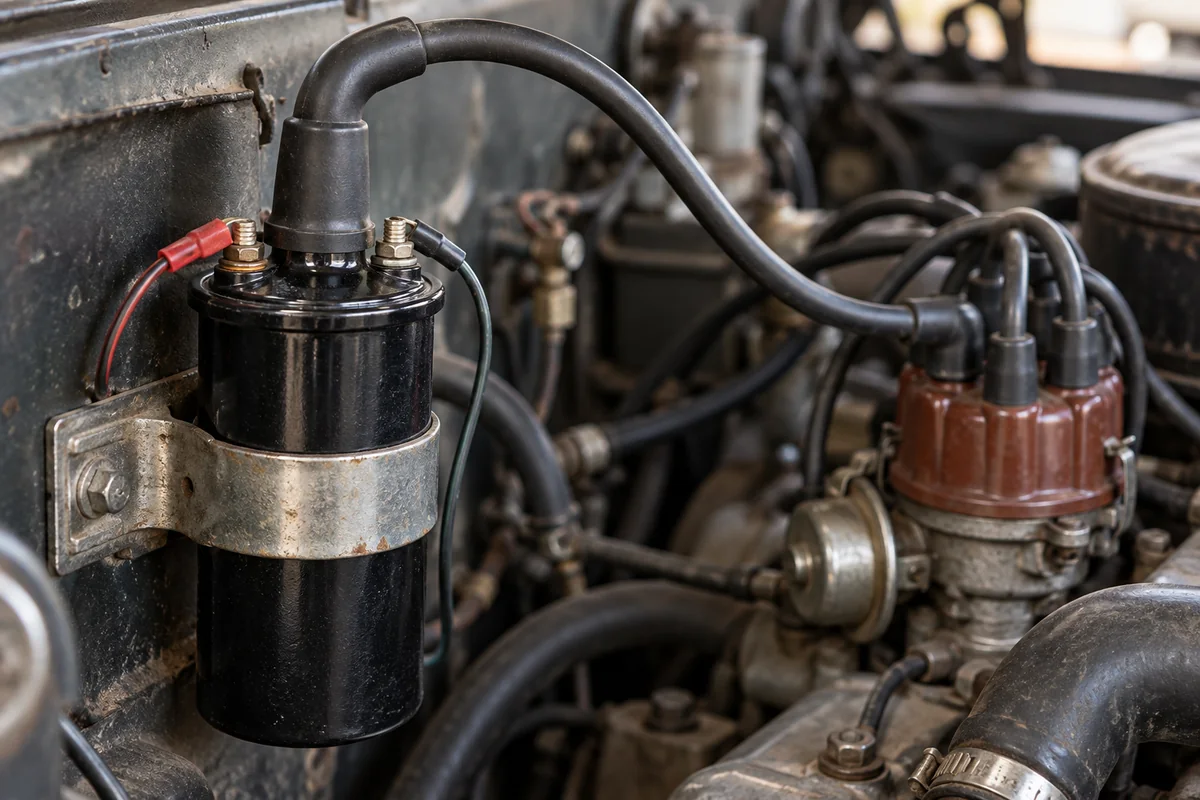
PerTronix's Flame-Thrower II canister coil lists 12 V system voltage, 45,000 V maximum, 0.6 Ohm primary resistance, 9,000 Ohm secondary resistance and a 100:1 turns ratio, for inductive or CD ignition systems, with no external ballast resistor required. [2]
Editorial calculation: the Delphi example's turns ratio is 15,272 ÷ 166 ≈ 92:1, close to PerTronix's listed 100:1. At 12 V a 0.6 Ω primary would draw up to 12 ÷ 0.6 = 20 A if nothing limited it, which is why the dwell time set by the ignition module has to match the coil. [3][2][1]
Give the supplier the engine (cylinders, maximum speed), ignition system (distributor, waste-spark, coil-on-plug), driver (breaker points, ignition module, ECU power stage and its current limit), system voltage range, required secondary voltage and spark energy, spark-plug type and gap, connector and terminal style, mounting, operating temperature and vibration, and quantity.
02
Choose the coil type and construction
The PerTronix canister coil is a remote-mount design; PerTronix says oil-filled coils give better heat control for street vehicles, while epoxy-filled coils give more winding support in high-vibration use such as off-road vehicles and boats. [2] The Delphi patent describes a remote-mounted coil for a six-cylinder distributorless (waste-spark) system, in which each secondary winding feeds two spark plugs through ignition cables; its core is silicon steel laminations or compression-moulded plastic-coated iron particles, the windings are potted in epoxy inside an insulating case, and a magnetically permeable shield surrounds the case. [3]
The Bosch C90i-E8 is a single-fire coil designed for direct cylinder-head mounting, for example in turbocharged direct-injection engines. It weighs under 270 g without wire, is 90 to 225 mm long to suit the customer's spark-plug shaft, fits plugs with an 8 mm ceramic diameter, and is rated 0 to 160 °C at the outer core, −40 to 100 °C storage and up to 480 m/s² vibration at 50 to 2,000 Hz. Noise suppression is inductive with a 1 kOhm resistance, and a suppression diode is internal. [1]
Editorial note: canister coils of the kind in the photograph feed a distributor through one high-tension lead, so the coil must suit the distributor's switching (points or electronic module); coil-on-plug units need the ECU power stage the maker specifies.
03
Compare what suppliers offer
The companies in the manufacturer list below show this product on their own websites. Confirm the legal seller, factory and scope for your order.
When requesting quotations, ask each supplier for secondary voltage and spark energy measured with a stated load and primary current, primary and secondary resistance, the dwell table, temperature and vibration ratings, connector drawings and samples.
04
Ask for spark energy out, not only energy in, at your dwell time
Researchers at Poznan University of Technology, in a 2024 paper in the journal Energies, measured energy flow with an ignition coil energy test stand and a constant-volume chamber that records the spark discharge at high speed. Lengthening the coil charging time from 0.5 ms to 5.0 ms raised the energy delivered to the coil from 9.5 mJ to 330 mJ, while the energy the coil generated rose from 4.2 mJ to 70 mJ; coil efficiency fell from 45% to 20.5% as charging time increased. The authors report further losses in the spark discharge itself. [4]
Editorial calculation: at 5.0 ms charging time, 330 − 70 = 260 mJ per firing is delivered to the coil but not generated as output, so a longer dwell buys more spark energy at a falling efficiency. [4]
Editorial note: Bosch publishes spark energy against primary current together with a dwell table, for example 1.06 ms for 10 A at 12 V. [1] Ask each supplier to state spark energy with the dwell time, primary current and supply voltage used for the measurement, and the energy drawn at that dwell, so quotes compare output per firing on the same basis.
05
Trace the coil
This is a functional reference built from the sources cited; it is not one maker's design.
Fill the specification fields with values for your engine
An ignition coil quotation needs values for your engine. The table explains each field, gives published values where a reviewed source states them, and says what to obtain from the supplier.
Explore company information and manufacturing capabilities, then discuss the scope of your project with a relevant supplier.
Share this page
Compiled and source-reviewed by the CNFX editorial team.
Published product pages show what a company offers, not tested performance. Confirm the legal seller, factory and scope for your order. How we source and review
· Page last updated 13 October 2026
Buyer questions
How does an ignition coil produce the spark voltage?
Primary current builds during the dwell interval; interrupting it makes the secondary produce the high voltage that fires the plug. [3]
What spark energy does a high-performance coil deliver?
Bosch's C90i-E8 lists at least 90 mJ, measured from 41.4 mJ at 10 A to 115 mJ at 20 A primary current. [1]
Oil-filled or epoxy-filled coil?
PerTronix says oil-filled coils control heat better for street use, epoxy-filled coils support windings better under high vibration. [2]
Does a longer dwell time give a stronger spark?
It gives more output energy at lower efficiency: Poznan University of Technology researchers (Energies, 2024) measured coil output rising from 4.2 mJ to 70 mJ as charging time went from 0.5 ms to 5.0 ms, while efficiency fell from 45% to 20.5%. [4]
Sources and what still needs a direct check
Sources checked 2026-10-11. Bosch Motorsport and PerTronix publish their own coil specifications; the Delphi patent explains coil operation and construction. Values for your coil must come from the supplier's data and tests.