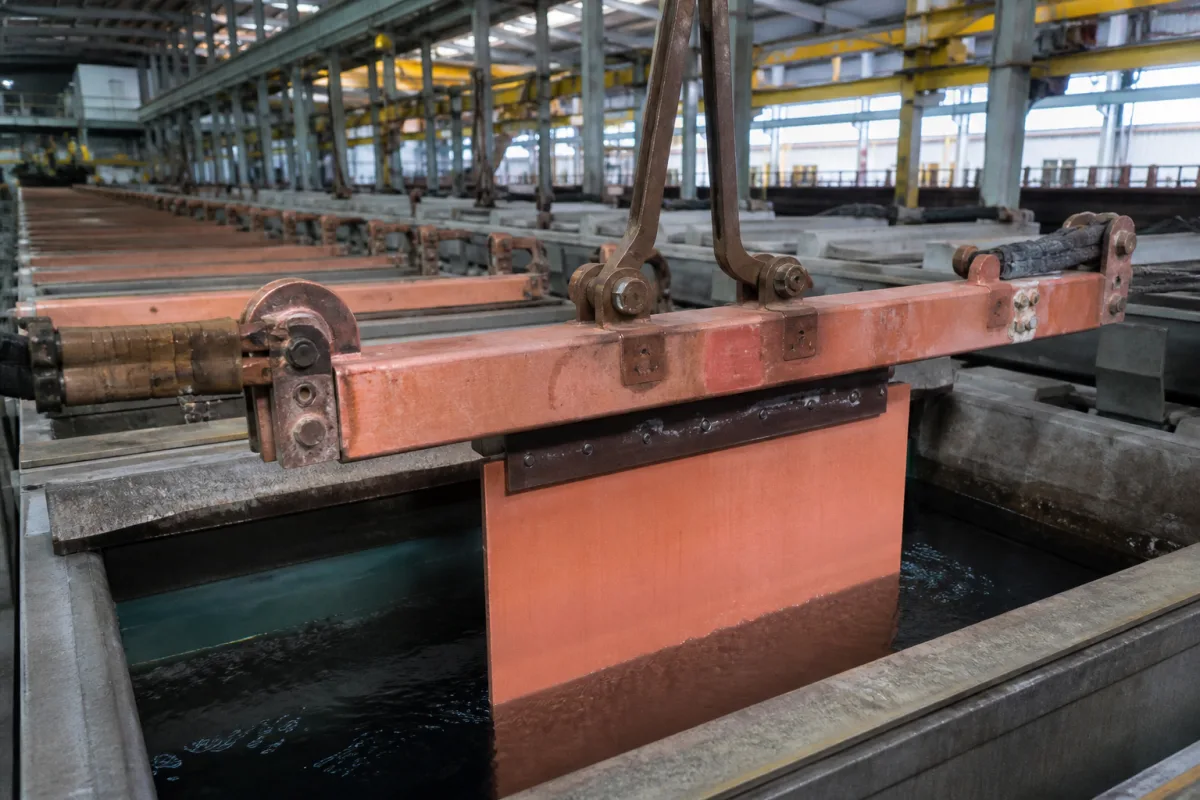
Cathode hanger bars for copper and other metal electrorefining and electrowinning · Solid copper versus copper-clad or copper-plated stainless bars, hollow sections and internal supports, cladding thickness, blade attachment, current density and straightness for cell alignment
An electrolytic cell cathode bar, or hanger bar, is the horizontal conductor at the top of a cathode that hangs the cathode plate (blade) in the electrolytic cell, rests on the busbar and insulator at the cell edges, and carries the current from the busbar into the plate on which copper, zinc, nickel or another metal is deposited. Ask three things first: which bar construction and material suit the refinery's current, stripping machine and electrolyte, how the bar is joined to the blade and how its conductivity is kept over service, and what dimensions, straightness and contact geometry the cells and handling equipment need.
Hanger bars (header bars) for permanent stainless steel cathode plates and starter-sheet cathodes in electrorefining and electrowinning of copper and other non-ferrous metals, supplied alone or welded to blades. Copper cathode product (see high purity copper cathode), anodes, cell busbars, insulators and stripping machines are outside this page except where compared.
CNFX editorial research · Sources checked October 12, 2026 · 5 sources
Mount Isa Mines' US patent 7,332,064 (2008) describes the ISA PROCESS cathode as a stainless steel blade with a hanger bar on its top edge holding the cathode in the bath, the deposited copper being stripped by flexing the plate and then wedge or gas stripping. Early solid copper hanger bars conducted well and carried the load but bent or were damaged in the bath and stripping machinery, and joining the blade to copper needed complex welding; iron or steel bars were stronger but conducted poorly, and electroplated copper coatings on them were limited in tolerance, thickness and adhesion. The patent instead affixes copper cladding around a stainless steel (preferably hollow) bar, around 2 to 4 mm thick, welded along its edges to the plate and bar. [1]
Xstrata Queensland's US patent 7,807,028 (2010) states that in the ISA PROCESS a 2B-finished 316L blade 3.25 mm thick is welded to a hollow stainless steel hanger bar encapsulated in 2.5 mm of electroplated copper, and claims 304 stainless steel blades of 3.0–3.25 mm for copper electrowinning. [2]
EPCM Services' US patent 9,388,501 (2016) describes a different build: a hollow hanger bar formed substantially of copper with stainless steel supporting elements inside it, near or along the bar ends, end caps sealing the bar, and supporting elements of carbon steel or 304 stainless at 16-gauge or more where they are not exposed to the electrolyte or wash. It summarises the hanger bar's two jobs as supporting the deposition plate in the bath and carrying current between the power source and the plate. [3]
An independent historical record confirms the original build. The Australian Academy of Technological Sciences and Engineering's Technology in Australia 1788–1988 states that the ISA process was first implemented by Copper Refineries Pty Ltd, Townsville, in 1979, using permanent cathode plates of 3.25 mm thick 316L stainless steel welded to a 304 stainless steel hanger bar that is copper plated to carry the current. It names the side-edge masking as an acrylic PVC extrusion with a sacrificial seal of high melting-point wax, with wax dipping masking the bottom edge, so that the deposit stays on the plate in handling but strips in the stripping machine, and records that the process had been licensed in Australia, Austria, Canada, Mexico and the USA. [5]
Editorial note: these constructions are patented; ask the supplier which design is offered, whether it is licensed, and how the bar and its joint to the blade resist the electrolyte and wash water.
Give the supplier the metal and process (electrorefining or electrowinning), plate type (permanent stainless or starter sheet), blade material and thickness, bar construction and materials, cladding or plating thickness, overall length and cross-section, contact geometry at the busbar and insulator ends, lifting-lug or hook positions, straightness and twist tolerances, current per cathode, and quantities and spares.
02
Set cladding, tolerances and current duty
US 7,807,028 explains that permanent stainless cathodes allowed a smaller inter-electrode gap and more active area per cell length, so that ISA PROCESS refineries operate at around 330 A/m² against around 240 A/m² for conventional starter-sheet refineries. [2]
US 7,332,064 states that the cladding approach allows a tighter specification on cladding thickness, which helps keep cathodes vertically aligned in the cells, and that the tolerances needed for operation at high current density cannot easily be achieved by electroplating the stainless bar. [1]
Editorial calculation: a cathode with an assumed 1.0 m × 1.0 m immersed area plated on both faces has 2.0 m² of active area; at 330 A/m² it carries about 660 A through its hanger bar, against about 480 A at 240 A/m². Use your actual plate size and current density, and ask the supplier for the bar's voltage drop and temperature rise at that current. [2]
03
Choose among hanger bar designs and blade grades
Glencore Technology's ISAKIDD cathode plate page, which counts 43 electrorefining and 78 electrowinning installations over 43 years, lists three hanger bar designs: the ISA bar, a copper-plated hollow stainless steel bar; the KIDD bar, a solid copper bar with or without sheathing; and the ISAKIDD bar, a stainless steel tube with a high-conductivity copper core and a patented weld sealing the copper contacts to the stainless bar, which it recommends above all for electrowinning cells with aggressive corrosion, such as hooded cells. Each bar can be paired with 316L, 316 Plus or Duplex blades. Duplex blades, used in electrowinning since 2006, are described as cheaper than 316L with higher strength and corrosion resistance, so they strip without permanent deformation. The ISA BR plate, introduced in 2003, can carry copper plating about 55 mm down the blade, which the page says saves 10 mV per cell compared with standard designs. [4]
Editorial calculation: at an assumed 60 cathodes per cell and the 660 A per cathode estimated above, a cell carries about 39,600 A, so 10 mV saves about 396 W per cell, or roughly 3.5 MWh per cell per year of continuous operation. Ask a supplier which bar design and blade grade it offers, whether it is licensed, and the measured contact resistance and plating depth. [4][2]
Makers listing stainless permanent cathode plates for copper
Both listed makers show stainless steel permanent cathode plates for copper electrorefining or electrowinning; ask each which hanger bar construction (clad, plated or solid copper) comes with the plate and who holds the design licence.
05
Core bar, copper layer, supports and blade joint
The copper layer and the blade joint form the current path from busbar to plate; Mount Isa Mines moved from solid copper to a clad stainless core because solid copper bars bent in the bath and in stripping machinery. [1]
Copper thickness, blade grade, current density and edge masking
Two figures anchor the order: 2–4 mm of copper cladding (or 2.5 mm of plating) on the bar, and a 3.25 mm 316L blade for cells run at about 330 A/m². [1][2]
Field
What it means and published values
Ask the supplier for
Construction
Clad stainless, plated stainless or hollow copper with supports. [1][2][3]
Design and licence.
Copper thickness (mm)
2–4 mm cladding; 2.5 mm plating in one process. [1][2]
Thickness and tolerance.
Blade
316L 3.25 mm, 2B finish; 304 3.0–3.25 mm; 316 Plus or Duplex options. [2][4] 316L 3.25 mm on a copper-plated 304 bar, Townsville 1979. [5]
Grade and thickness.
Current density (A/m²)
About 330 (permanent cathode) vs 240 (starter sheet). [2]
Find cathode hanger bars and permanent cathode plates manufacturers
2 companies list this product among what they make. Company figures are quoted from each
company's own website; every card states where the relationship came from.
Explore company information and manufacturing capabilities, then discuss the scope of your project with a relevant supplier.
Share this page
Compiled and source-reviewed by the CNFX editorial team.
Each manufacturer above links to the page on that company's own website where the product is listed, with the date we checked it. How we source and review
· Page last updated 13 October 2026
Buyer questions
Why are cathode hanger bars clad with copper rather than solid copper?
Solid copper bars bent or were damaged in the bath and stripping machines; a stainless core gives strength and copper cladding conducts the current. [1]
How thick is the copper on a stainless hanger bar?
One patent gives cladding of around 2 to 4 mm; another describes 2.5 mm electroplated copper in the ISA PROCESS. [1][2]
What current density do permanent cathode refineries run at?
About 330 A/m² for ISA PROCESS refineries against about 240 A/m² for starter-sheet refineries, according to one patent. [2]
What hanger bar designs are used on permanent copper cathodes?
One technology supplier offers a copper-plated hollow stainless bar, a solid copper bar, and a stainless tube with a copper core, each with 316L, 316 Plus or Duplex blades. [4]
What was the original ISA permanent cathode made of?
Technology in Australia 1788–1988 (Australian Academy of Technological Sciences and Engineering) records 3.25 mm thick 316L stainless steel plates welded to a copper-plated 304 stainless steel hanger bar, first used at Copper Refineries, Townsville, in 1979. [5]
Sources and what still needs a direct check
Sources checked 2026-10-12. The three patents describe their applicants' designs and the problems they address; they are not design standards. Dimensions and ratings for your cells must come from your refinery data and the supplier.