Editorial Technical Reference

Heavy-Duty Molten Aluminum Pouring Nozzle

This page explains how Heavy-Duty Molten Aluminum Pouring Nozzle is classified within Non-Ferrous Metal Production. Technical values and manufacturer relationships are research references; confirm the current specification and supplier evidence for each order.

Technical Definition & Core Assembly

High-temperature refractory nozzle for controlled pouring of molten aluminum in casting operations
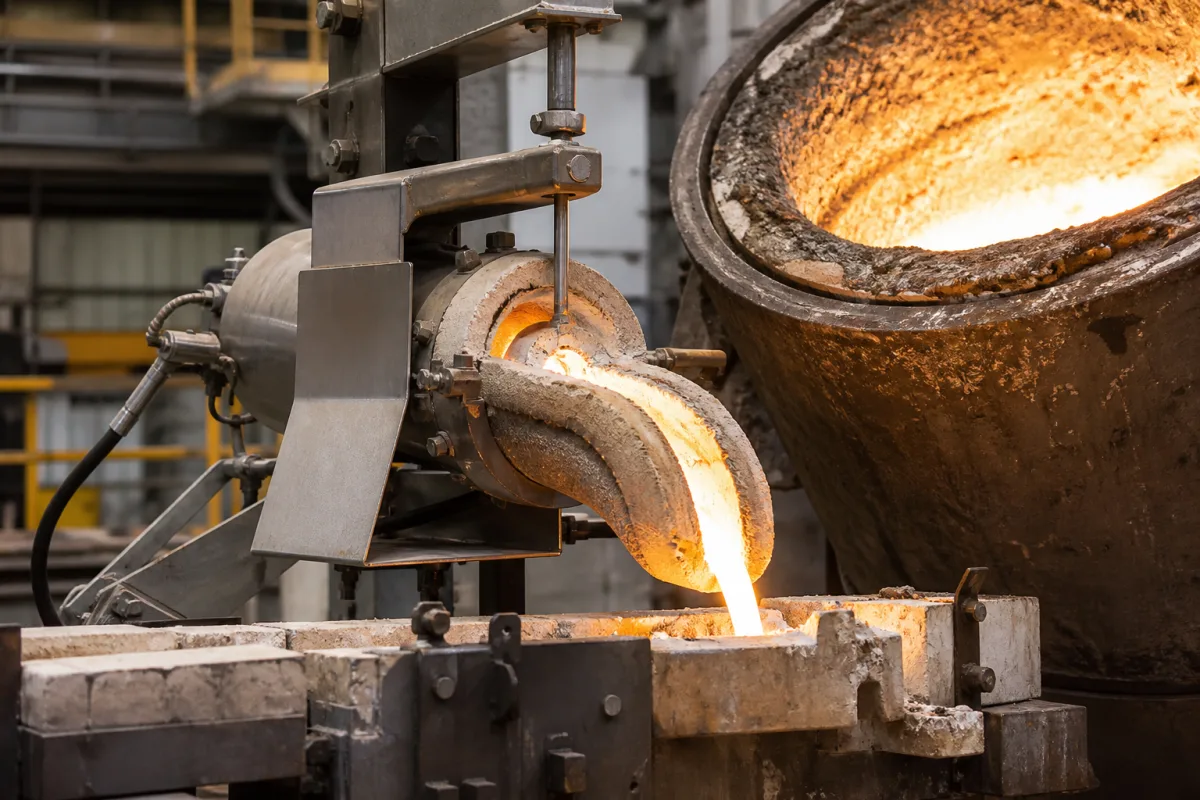
Representative product image. Confirm appearance and specifications with the manufacturer.

Product Specifications

Technical details and manufacturing context for Heavy-Duty Molten Aluminum Pouring Nozzle

Definition
This heavy-duty pouring nozzle is a precision-engineered refractory component designed for the controlled transfer of molten aluminum from holding furnaces to casting molds or launder systems. It is used in non-ferrous metal production, specifically in aluminum casting operations where consistent flow and thermal stability are critical. The nozzle features advanced thermal shock resistance and erosion protection, enabling it to withstand prolonged exposure to temperatures exceeding 700°C. Its calibrated bore ensures consistent flow rates and minimizes turbulence during pouring, which helps reduce oxide formation and gas entrapment in the cast metal. The robust construction, including a stainless steel reinforcement ring, prevents metal contamination and maintains dimensional stability throughout extended production cycles. The nozzle is manufactured from high-alumina refractory ceramic and silicon carbide composite, offering a balance of thermal insulation, mechanical strength, and corrosion resistance. Key parameters include an operating temperature range of 800–1200°C, a bore diameter tolerance of ±0.5 mm (ISO 2768-m), and a thermal shock resistance of at least 50 cycles. The alumina content is at least 75% (GB/T 2988), and the bulk density ranges from 2.8 to 3.2 g/cm³ (GB/T 2997). The nozzle can handle a maximum flow rate of 15 kg/min and has a service life of 300–500 hours under typical operating conditions. It is designed to operate at pressures between 1.0 and 1.6 MPa, with an overall length of 300–500 mm and an outer diameter of 80–120 mm, fitting standard ladle openings. The weight per unit is 5–8 kg, depending on size. The apparent porosity is ≤18% (GB/T 2997), and the cold crushing strength is ≥60 MPa (GB/T 5072). These specifications are reference values; always verify model-specific data with the manufacturer or supplier before procurement.
Working Principle
The nozzle operates on the principle of gravity-driven flow through a tapered refractory bore. The taper helps regulate the flow rate of molten aluminum, ensuring a consistent stream. Thermal insulation layers within the nozzle maintain the metal temperature, preventing premature solidification during transfer. The refractory materials, including high-alumina ceramic and silicon carbide, provide thermal shock resistance and erosion protection, allowing the nozzle to withstand repeated heating and cooling cycles. The stainless steel reinforcement ring adds structural integrity, preventing cracking or deformation under mechanical stress. The calibrated bore minimizes turbulence, reducing the risk of oxide inclusion and gas entrapment in the cast product.
Common Materials
High-Alumina Refractory Ceramic, Silicon Carbide Composite, Stainless Steel Reinforcement Ring
Technical Parameters
ParameterTypical rangeNotes & selection driver
Operating Temperature RangeRequired800–1200 °CContinuous service temperature limits
Bore Diameter ToleranceRequired±0.5 mmManufacturing precision of flow channelISO 2768-m
Thermal Shock Resistance CyclesRequired≥50 cyclesNumber of heating-cooling cycles before failure
Alumina ContentRequired≥75 %Refractory material purity affecting corrosion resistanceGB/T 2988
Maximum Flow RateRequired15 kg/minPeak molten aluminum throughput capacity
Service Life300–500 hoursExpected operational duration before replacement
Overall Length300–500 mmCustomizable per customer drawing
Outer Diameter80–120 mmFits standard ladle openings
Weight5–8 kgPer unit, depending on size
Bulk Density2.8–3.2 g/cm³Higher density improves strengthGB/T 2997
Apparent Porosity≤18 %Lower porosity reduces slag penetrationGB/T 2997
Cold Crushing Strength≥60 MPaEnsures structural integrity during handlingGB/T 5072

Ranges are indicative industry figures for RFQ preparation, not a supplier commitment. Confirm every value and standard with the legal manufacturer before ordering.

Components / BOM
  • Refractory Nozzle Body
    Primary flow channel and thermal barrier
    Material: High-Alumina Ceramic
  • Thermal Expansion Joint
    Accommodates thermal expansion during heating cycles
    Material: Compressed Ceramic Fiber
  • Mounting Flange Part
    Secures nozzle to furnace or launder system
    Material: 310 Stainless Steel
  • Bore Liner Insert Optional Part
    Replaceable wear surface for extended service life
    Material: Silicon Carbide
  • Steel Reinforcement Ring
    Bands the refractory body to stop it cracking under mechanical stress.
    Material: Stainless steel
  • Thermal Insulation Layer
    Holds the melt temperature through the nozzle so the aluminum does not freeze in the bore.

Industry Taxonomies & Aliases

Commonly used trade names and technical identifiers for Heavy-Duty Molten Aluminum Pouring Nozzle.

Industrial Ecosystem & Supply Chain Structure

Complementary Systems
Downstream Applications
Specialized Tooling

Application Fit & Sizing Matrix

Operational Limits
pressure: 0.1 to 0.5 bar (gravity-fed pouring systems)
flow rate: 5 to 50 kg/min (depending on nozzle diameter)
temperature: 700°C to 900°C (typical aluminum pouring range)
slurry concentration: Not applicable - designed for pure molten aluminum alloys
Media Compatibility
✓ Molten aluminum alloys (A356, 6061, etc.) ✓ Molten aluminum-silicon alloys ✓ Molten aluminum-magnesium alloys
Unsuitable: Ferrous metals (steel, iron) or copper-based alloys - incompatible temperature ranges and chemical reactions
Sizing Data Required
  • Required flow rate (kg/min)
  • Pouring temperature (°C)
  • Nozzle-to-mold distance (mm)

Reliability & Engineering Risk Analysis

Failure Mode & Root Cause
Thermal fatigue cracking
Cause: Repeated thermal cycling from molten aluminum contact (approx. 660-750°C) and cooling cycles, causing differential expansion stresses in nozzle material, particularly at joints or thickness transitions.
Aluminum buildup and clogging
Cause: Oxidation and solidification of aluminum on nozzle interior surfaces due to temperature fluctuations, improper preheating, or contamination, leading to flow restriction and increased backpressure.
Maintenance Indicators
  • Visible hairline cracks or discoloration (blue/gray oxidation) on nozzle exterior surface
  • Irregular or pulsating molten metal flow during pouring, indicating partial blockage or erosion
Engineering Tips
  • Implement controlled preheating protocol to gradually bring nozzle to operating temperature (200-300°C) before contact with molten aluminum, minimizing thermal shock.
  • Apply non-wetting ceramic coating (e.g., boron nitride-based) to interior surfaces to reduce aluminum adhesion and facilitate easier cleaning between cycles.

Indicative industry ranges for design and RFQ preparation. Confirm the exact figures and applicable standard with the manufacturer before specifying.

Compliance & Manufacturing Standards

Applicable Standards
ASTM B26/B26M-18 - Standard Specification for Aluminum-Alloy Sand Castings CE Marking - Directive 2014/68/EU (Pressure Equipment Directive)

Quoted from the published standard.

Manufacturing Precision
  • Bore Diameter: +/-0.05mm
  • Surface Flatness: 0.15mm per 100mm length
Quality Inspection
  • Dye Penetrant Testing (PT) for surface defects
  • Spectrographic Analysis for alloy composition verification

Manufacturers of Heavy-Duty Molten Aluminum Pouring Nozzle

Manufacturer profiles associated with Heavy-Duty Molten Aluminum Pouring Nozzle.

Sourcing Heavy-Duty Molten Aluminum Pouring Nozzle from China?
Tell us your specification and target quantity — we will match it against manufacturer records and come back with the factories that fit.
Request manufacturers We manufacture this

Manufacturer listings support early research and capability understanding. They are not certification, ranking, or transaction guarantees.

Technical documentation
Request current drawings, revision history, and a signed specification sheet.
Manufacturing capability
Verify equipment lists, process limits, capacity, and representative production evidence.
Inspection readiness
Confirm test methods, calibrated equipment, sampling plans, and traceable reports.
Supplier transparency
Check the legal entity, factory address, ownership, certifications, and direct contacts.

CNFX does not score or rank suppliers. Buyers must verify all claims and documents with the legal manufacturer before ordering.

Frequently Asked Questions

What is the maximum operating temperature of this pouring nozzle?

The nozzle is designed for continuous service in the range of 800–1200°C. However, the exact maximum temperature depends on the specific model and application. Always verify with the manufacturer for your particular process.

How long does the nozzle last before replacement?

The expected service life is 300–500 hours under typical operating conditions. Actual lifespan can vary based on factors such as pouring temperature, frequency of thermal cycling, and maintenance practices. Regular inspection is recommended.

Can the nozzle be customized to fit different ladle openings?

The overall length and outer diameter are customizable per customer drawing, with standard ranges of 300–500 mm and 80–120 mm, respectively. Contact the supplier to discuss your specific dimensional requirements.

What standards are referenced for the nozzle's specifications?

The listed standards include ISO 2768-m for bore diameter tolerance, GB/T 2988 for alumina content, GB/T 2997 for bulk density and apparent porosity, and GB/T 5072 for cold crushing strength. These are reference standards; verify compliance with the manufacturer.

Data Basis

Editorial classification, named public sources where available, and source-reviewed manufacturer records.

Preliminary Technical Classification
This page supports structured research, RFQ preparation, and supplier evaluation. It does not replace buyer-led supplier qualification, standards review, or technical approval.
Buyer enquiry

Request manufacturing insight for Heavy-Duty Molten Aluminum Pouring Nozzle

Ask for use case, specification boundaries, supplier type, and RFQ preparation information for this product.

Where it goes
Straight to the CNFX editorial desk, and to the manufacturer if this product is linked to a claimed profile. Nothing is broadcast to a supplier list.
Your details stay here
We do not sell or rent enquiry data, and we do not add you to a mailing list. Used only to answer this request.
No commission, no middleman
CNFX is a directory. We take no cut of any order and never negotiate on a supplier's behalf.
What we don't claim
A listing is not an endorsement. Qualify every supplier and verify every figure yourself before ordering.

Your business information is used only to process this request.

Thank you! Your message has been sent. We'll respond within 1–3 business days.
Sorry, we couldn't send your message. Please try again, or email us at contact@cnfx.com.

Need to Manufacture Heavy-Duty Molten Aluminum Pouring Nozzle?

Compare manufacturer profiles with relevant product and process capability.

Previous Product
Non-Ferrous Metal Induction Melting Furnace
Last Product
Get QuotesChat