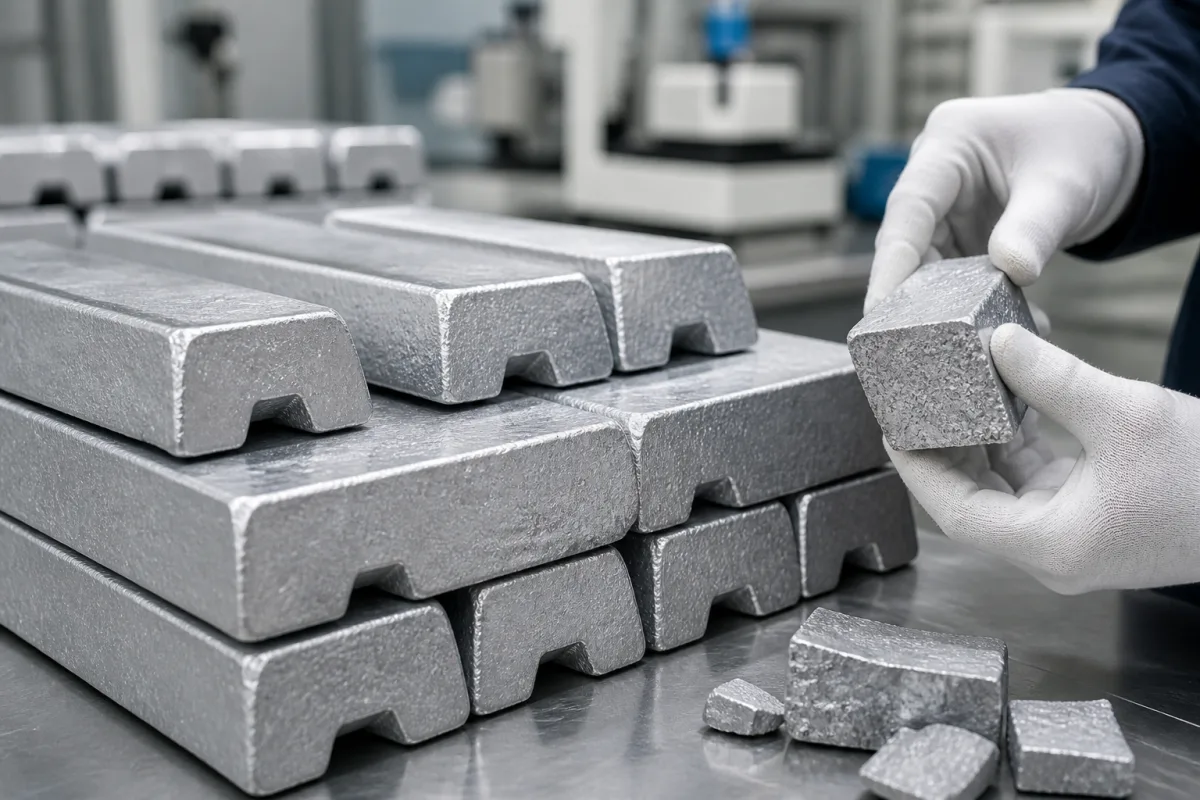
Zinc-aluminium master alloys (brighteners) for hot-dip galvanizing · ASTM B860 types 90/10, 95/5 and 96/4 Zn/Al in high and low purity, why aluminium is added, the 0.007% kettle maximum with flux galvanizing, ingot size and addition method
A zinc-aluminium master alloy is a zinc ingot or bar carrying a fixed, higher aluminium content (for example 10%, 5% or 4%) that galvanizers add to a molten zinc kettle to raise or hold its aluminium level, giving a brighter coating and better drainage; it is also called a brightener. Ask three things first: which ASTM B860 type and purity the bath needs, how much aluminium the kettle may carry with the flux and steel being galvanized, and what ingot size, packing and certificates the supplier provides.
Zinc-aluminium master alloys (brightener ingots and bars) for adjusting aluminium in batch hot-dip galvanizing kettles, and similar Zn-Al additions to continuous lines. Zinc-aluminium coating alloys to ASTM B997 (Galfan-type baths), special high grade zinc ingot, zinc die-casting alloys and other master alloys (nickel, bismuth, antimony) are outside this page except where compared.
CNFX editorial research · Sources checked October 11, 2026 · 4 sources
ASTM B860-18 (reapproved 2022) covers zinc master alloys used in hot-dip galvanizing to adjust the concentration of alloying elements in the molten zinc bath: six zinc-aluminium (brightener) alloys — Type A-1 90/10 Zn/Al high purity (UNS Z30750), A-2 90/10 low purity (Z31710), A-3 95/5 high purity (Z30503), A-4 95/5 low purity (Z31510), A-5 96/4 high purity (Z31520) and A-6 96/4 low purity (Z30504) — and one 90/10 zinc-antimony alloy (S-1). Its note distinguishes these from the zinc-aluminium alloys in ASTM B997. [1]
A Specialty Minerals patent (US 6,811,589, 2004) describes aluminium additions made with zinc or zinc-aluminium ingots or bars about 2 × 3 × 24 in and 40–50 lb each to ASTM B860 compositions, with 90/10 high-purity ingots of about 10–13% aluminium used because the aluminium lowers the ingot melting point and eases incorporation; it states that such ingot additions take about 16 hours for a 5,000 lb addition. [3]
Editorial note: the full composition and impurity limits for each type are in the standard itself; ask the supplier to certify the type, aluminium content and impurities (for example iron, lead, cadmium) for each lot against the current B860 edition.
Give the supplier the ASTM B860 type (or equivalent), purity grade, form (ingot, bar, plunging bar), unit weight and dimensions, quantity, packing, lot certificate contents, kettle size and operating temperature, flux process used, and delivery schedule.
02
Control the aluminium level in the kettle
The American Galvanizers Association (Dr Tom Langill) explains that aluminium added to the galvanizing kettle forms a thin oxide film on the bath surface, brightens the coating and slightly increases zinc fluidity, improving drainage. A maximum of 0.007% aluminium must be maintained to avoid bare spots caused by reaction with the zinc ammonium chloride flux. Because aluminium floats on zinc it is hard to keep in the bath, so it is added as brightener bar plunged under the surface to mix. The same note lists kettle zinc grades to ASTM B6 of at least 98% purity. [2]
Editorial calculation: raising aluminium in a 100 t zinc kettle by 0.002 percentage points requires about 2 kg of aluminium, or about 20 kg of a 90/10 Zn/Al master alloy, before losses to oxide and dross; measure bath aluminium before and after additions and stay at or below the 0.007% ceiling. [2][1]
Editorial note: continuous sheet lines run at different aluminium levels from batch galvanizing; give the supplier your process and target so the right alloy and form are offered.
03
Find zinc-aluminium master alloy manufacturers
Henan Yuguang Zinc and Inner Mongolia Xing'an Copper and Zinc Smelting each have a product page for zinc-aluminium master alloy; ask either one which B860 type and purity grade it casts.
04
Check lot chemistry against the brightener type
Eastern Alloys, a zinc alloy producer, publishes chemical limits for its 95-5 (5% aluminium) and 90-10 (10% aluminium) brightener alloys under the ASTM B860 type designations. Its high-purity Type A1 90-10 lists 9.5–10.5% aluminium with maximum iron 0.05%, lead 0.005%, cadmium 0.004%, tin 0.003% and copper 0.035%; its low-purity Type A2 allows iron 0.15%, lead 0.40% and copper 0.5%. Its 95-5 Types A3 and A4 carry 4.5–5.5% aluminium. [4]
The same page describes continuous galvanizing lines whose bath runs at 0.1% aluminium for galvannealed coating and 0.25% for galvanized coating, and says brighteners add the aluminium when a line converts back to galvanizing and hold it during production. That example is a continuous line; the AGA's 0.007% ceiling applies to batch kettles using zinc ammonium chloride flux. [4][2]
Editorial calculation: in this producer's table, Type A2 allows 80 times the lead of Type A1 (0.40% ÷ 0.005%). State the type letter and number on the order, and ask for the lot analysis of each limited element. [4]
The bath-limit row has no supplier answer: it is your own ceiling, 0.007% aluminium in a flux-process kettle according to the AGA, and it sets how much of each lot you can add. [2]
2 companies list this product among what they make. Company figures are quoted from each
company's own website; every card states where the relationship came from.
HENAN YUGUANG ZINC INDUSTRY CO.,LTD.
Manufacturing site to be confirmed for the order
Its website has a product page for zinc-aluminium master alloy.
Explore company information and manufacturing capabilities, then discuss the scope of your project with a relevant supplier.
Share this page
Compiled and source-reviewed by the CNFX editorial team.
Each manufacturer above links to the page on that company's own website where the product is listed, with the date we checked it. How we source and review
· Page last updated 13 October 2026
Buyer questions
What is a zinc-aluminium brightener?
A zinc master alloy with a fixed aluminium content, such as the 90/10, 95/5 or 96/4 Zn/Al types in ASTM B860, added to a galvanizing kettle to adjust its aluminium. [1]
How much aluminium can a galvanizing kettle contain?
The American Galvanizers Association says a maximum of 0.007% must be maintained to avoid bare spots with zinc ammonium chloride flux. [2]
How is the master alloy added?
Because aluminium floats on zinc, it is added as brightener bar plunged under the surface to mix. [2]
How much aluminium does a 90/10 brightener contain?
Eastern Alloys lists 9.5–10.5% aluminium for its 90-10 brightener, Types A1 and A2. [4]
Sources and what still needs a direct check
Sources checked 2026-10-11. The ASTM B860 scope names the alloy types; the AGA note gives kettle practice for batch galvanizing; the patent describes ingot additions as background to its own method. Bath targets for your plant come from your process and testing.