Industry-Verified Manufacturing Data (2026)

Integrated Non-Ferrous Metal Smelting and Casting System

Based on aggregated insights from multiple verified factory profiles within the CNFX directory, the standard Integrated Non-Ferrous Metal Smelting and Casting System used in the Non-Ferrous Metal Production sector typically supports operational capacities ranging from standard industrial configurations to heavy-duty production requirements.

Technical Definition & Core Assembly

A canonical Integrated Non-Ferrous Metal Smelting and Casting System is characterized by the integration of Smelting Furnace Module and Refining Vessel. In industrial production environments, manufacturers listed on CNFX commonly emphasize Refractory ceramics construction to support stable, high-cycle operation across diverse manufacturing scenarios.

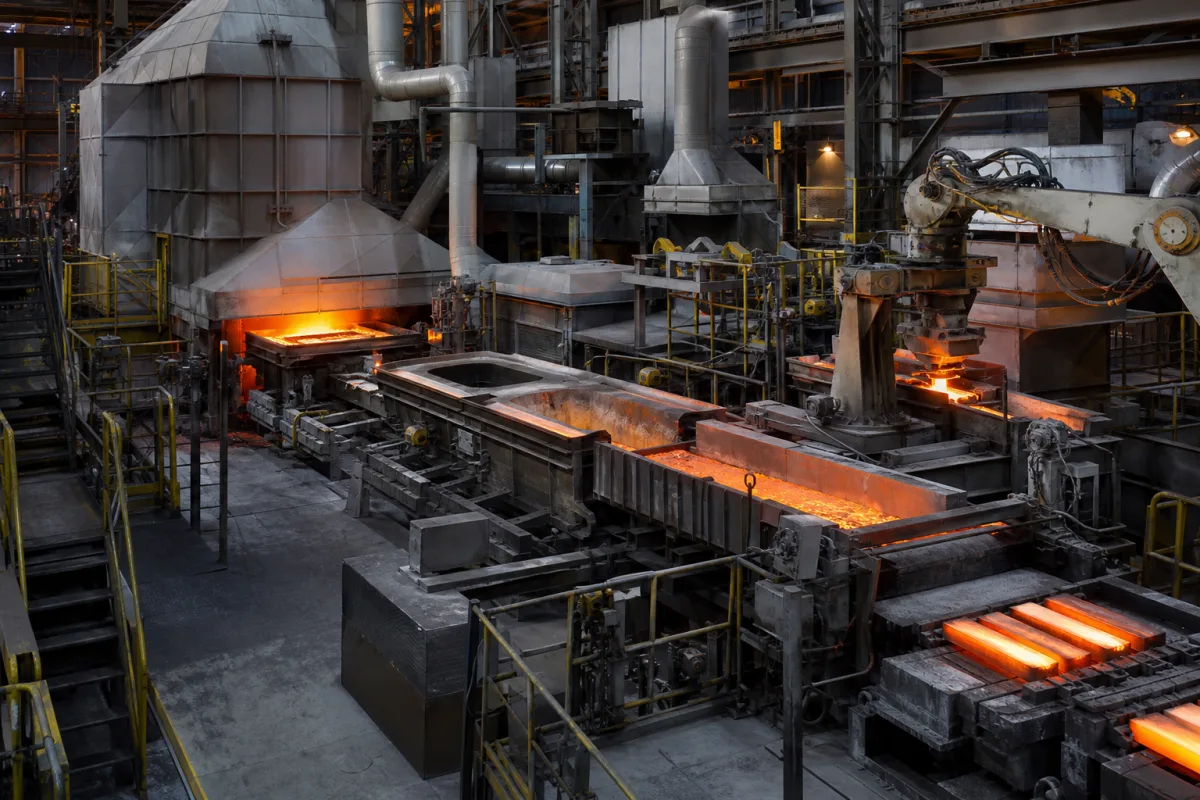
Complete production line for smelting, refining and casting non-ferrous metals

Product Specifications

Technical details and manufacturing context for Integrated Non-Ferrous Metal Smelting and Casting System

Definition
A fully integrated industrial system designed for the continuous production of non-ferrous metals including aluminum, copper, zinc, and lead. This coordinated multi-module solution encompasses the entire production chain from raw material processing to finished product casting. The system integrates smelting, refining, alloying, and casting operations into a seamless production flow with automated material handling and process control. It enables efficient, high-volume production of non-ferrous metal products with consistent quality and reduced energy consumption.
Working Principle
Raw materials are sequentially processed through interconnected modules: pre-treatment, smelting in high-temperature furnaces, refining to remove impurities, alloying for specific compositions, and continuous casting into final forms, with automated transfer systems maintaining material flow throughout the production chain.
Common Materials
Refractory ceramics, High-temperature steel alloys, Copper cooling elements, Insulation materials
Technical Parameters
  • Specific energy consumption per unit output (kWh/ton) Customizable
  • Maximum continuous output rate (tons/hour) Customizable
Components / BOM
Engineering Reasoning
0.1-1.5 MPa (melting chamber pressure), 650-1200°C (crucible temperature), 0.5-3.0 m³/min (protective gas flow)
Crucible wall temperature exceeding 1250°C (silicon carbide decomposition threshold), mold cooling rate dropping below 15°C/s (aluminum solidification defect threshold), refractory lining erosion depth exceeding 25mm (structural integrity limit)
Design Rationale: Thermal fatigue from cyclic heating/cooling (ΔT>800°C) causing refractory spalling, liquid metal penetration at 0.8 MPa exceeding capillary pressure of ceramic filters (Young-Laplace equation: ΔP=2γcosθ/r), electromagnetic stirring Lorentz force exceeding 500 N/m³ causing crucible wall erosion
Risk Mitigation (FMEA)
Trigger Induction coil insulation breakdown at 1500V/mm electric field strength
Mode: Copper coil melting and molten metal contamination
Strategy: Multilayer mica-mat insulation with 2000V/mm dielectric strength and active water cooling maintaining <80°C
Trigger Mold release agent depletion below 0.1μm coating thickness
Mode: High friction sticking causing casting tearing at 50MPa tensile stress
Strategy: Automated spray system with 0.3μm thickness control and boron nitride nanoparticle additives

Industry Taxonomies & Aliases

Commonly used trade names and technical identifiers for Integrated Non-Ferrous Metal Smelting and Casting System.

Industrial Ecosystem & Supply Chain DNA

Complementary Systems
Downstream Applications
Specialized Tooling

Application Fit & Sizing Matrix

Operational Limits
pressure: Atmospheric to 2 bar (controlled atmosphere systems)
flow rate: 1 to 50 tons/hour (continuous casting)
temperature: 400°C to 1600°C (depending on metal type and process stage)
melt capacity: 5 to 200 tons per batch
cooling water flow: 50 to 500 m³/hour
slurry concentration: N/A (solid/liquid metal processing)
Media Compatibility
✓ Aluminum and alloys (series 1000-7000) ✓ Copper and brass alloys ✓ Zinc and zinc alloys
Unsuitable: Highly reactive metals (lithium, sodium, potassium) or environments with explosive dust atmospheres
Sizing Data Required
  • Required annual production capacity (tons/year)
  • Specific metal/alloy types to be processed
  • Available plant footprint and utility connections (power, water, gas)

Reliability & Engineering Risk Analysis

Failure Mode & Root Cause
Thermal fatigue cracking
Cause: Repeated thermal cycling from molten metal pouring and solidification, causing expansion/contraction stresses in furnace linings, crucibles, and casting molds, leading to crack initiation and propagation.
Corrosive degradation
Cause: Exposure to aggressive chemical environments from molten non-ferrous metals (e.g., aluminum, copper alloys) and fluxes, which attack refractory materials, structural components, and heat exchangers, accelerating material loss and weakening integrity.
Maintenance Indicators
  • Visible cracks or spalling in furnace linings or crucible surfaces during routine inspections
  • Unusual temperature fluctuations or hot spots detected by infrared thermography on system components
Engineering Tips
  • Implement a strict thermal shock management protocol, including controlled preheating of refractory materials before exposure to molten metal and gradual cooling cycles to minimize thermal stress.
  • Use advanced refractory materials with high corrosion resistance specific to the non-ferrous metals being processed, and apply protective coatings to vulnerable components to extend service intervals.

Compliance & Manufacturing Standards

Reference Standards
ISO 9001:2015 - Quality Management Systems ASTM B85/B85M - Standard Specification for Aluminum-Alloy Die Castings CE Marking - EU Machinery Directive 2006/42/EC
Manufacturing Precision
  • Casting Dimensional Tolerance: +/-0.5mm per 100mm
  • Surface Finish: Ra 3.2μm maximum
Quality Inspection
  • X-Ray Fluorescence (XRF) Analysis for Alloy Composition
  • Pressure Tightness Test for Cast Components

Factories Producing Integrated Non-Ferrous Metal Smelting and Casting System

Verified manufacturers with capability to produce this product in China

✓ 98% Supplier Capability Match Found

P Project Engineer from Singapore Jan 09, 2026
★★★★★
"The Integrated Non-Ferrous Metal Smelting and Casting System we sourced perfectly fits our Non-Ferrous Metal Production production line requirements."
Technical Specifications Verified
S Sourcing Manager from Germany Jan 06, 2026
★★★★★
"Found 41+ suppliers for Integrated Non-Ferrous Metal Smelting and Casting System on CNFX, but this spec remains the most cost-effective."
Technical Specifications Verified
P Procurement Specialist from Brazil Jan 03, 2026
★★★★★
"The technical documentation for this Integrated Non-Ferrous Metal Smelting and Casting System is very thorough, especially regarding Maximum Operating Temperature (°C)."
Technical Specifications Verified
Verification Protocol

“Feedback is collected from verified sourcing managers during RFQ (Request for Quote) and factory evaluation processes on CNFX. These reports represent historical performance data and technical audit summaries from our B2B manufacturing network.”

14 sourcing managers are analyzing this specification now. Last inquiry for Integrated Non-Ferrous Metal Smelting and Casting System from USA (1h ago).

Frequently Asked Questions

What is the maximum throughput capacity of this integrated smelting and casting system?

The system is designed for a throughput capacity of up to [tons/day] tons per day, depending on the specific non-ferrous metal being processed and the alloy composition requirements.

How does the emission control system handle pollutants from the smelting process?

The integrated emission control system uses advanced filtration and scrubbing technologies to capture particulate matter and gaseous pollutants, ensuring compliance with environmental regulations and maintaining safe working conditions.

What level of automation does this production line offer for process control?

The system features [Automation Level:%] automation with a comprehensive process control system that monitors and adjusts parameters like temperature, flow rates, and alloy composition in real-time for consistent quality and efficiency.

Can I contact factories directly on CNFX?

CNFX is an open directory, not a transaction platform. Each factory profile provides direct contact information and production details to help you initiate direct inquiries with Chinese suppliers.

Get Quote for Integrated Non-Ferrous Metal Smelting and Casting System

Request technical pricing, lead times, or customized specifications for Integrated Non-Ferrous Metal Smelting and Casting System directly from verified manufacturing units.

Your business information is encrypted and only shared with verified Integrated Non-Ferrous Metal Smelting and Casting System suppliers.

Thank you! Your message has been sent. We'll respond within 1–3 business days.

Need to Manufacture Integrated Non-Ferrous Metal Smelting and Casting System?

Connect with verified factories specializing in this product category

Add Your Factory Contact Us
Previous Product
Industrial-Grade High-Purity Zinc-Aluminum Master Alloy
Next Product
Non-Ferrous Metal Continuous Casting and Rolling System