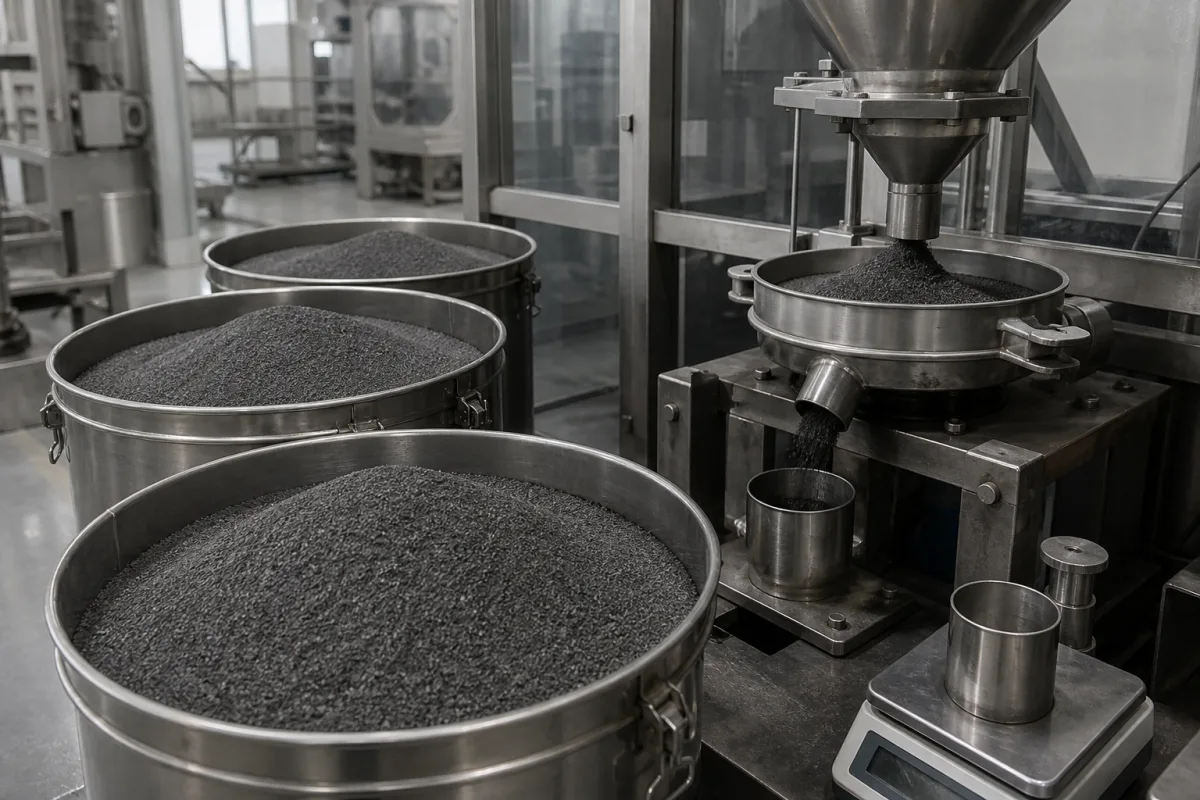
Nitrided ferrochrome (FeCrN) additions · Low-carbon ferrochrome nitrided at up to 1,300 °C and crushed to size, graded by chromium and nitrogen (3–4% or 6–9%), with silicon, sulfur, phosphorus and manganese limits, used to add nitrogen and chromium to stainless and special steels
Ferrochromium nitride (nitrided ferrochrome) is low-carbon ferrochrome that has absorbed nitrogen, so one addition brings both chromium and nitrogen into molten stainless or special steel. It is crushed to sizes from lumps down to granules and powder. Ask three things first: which chromium and nitrogen grade the melt calculation needs, which carbon and residual limits the steel allows, and what size range and packaging suit the addition method.
Nitrided low-carbon ferrochrome supplied as lumps, granules or powder for alloying steel melts, specified by chemistry, size and packaging. Standard high- and low-carbon ferrochrome without nitrogen, chromium metal, and other ferroalloy master alloys (for example high-purity ferromanganese master alloy) are outside this page.
CNFX editorial research · Sources checked October 12, 2026 · 5 sources
Choose the chromium and nitrogen grade and residual limits
ASTM A101 covers ferrochromium in high-carbon and low-carbon types, the low-carbon type including nitrogen-bearing and vacuum grades, available in different sizes and required to conform to limits for chromium, carbon, silicon, sulfur, phosphorus and nitrogen. [1]
Westbrook Resources lists two nitrided ferrochrome grades, both with 63–68% chromium, at most 1.50% silicon, 0.03% phosphorus, 0.03% sulfur and 0.5% manganese, and with either 3–4% or 6–9% nitrogen. It states carbon of around 0.05–0.07% for special steels that need tight carbon control. [2]
China's ferrochrome standard, GB/T 5683-2024 (issued 25 April 2024, in force 1 November 2024, replacing the 2008 edition and modified from ISO 5448:1981), covers ferrochrome for alloying steel and castings, including micro-, low-, medium- and high-carbon grades and new low-nitrogen low-carbon and low-nitrogen medium-carbon grades. It raises the number of grades from 28 to 68, changes the particle size and non-metallic inclusion requirements, and adds a distillation separation and Nessler reagent spectrophotometric method for nitrogen (Appendix C). Its scope does not list nitrided ferrochrome, so a nitrogen-bearing grade bought in China needs its chemistry and size written into the contract or a maker's own specification. [3]
Editorial note: name the nitrogen test method in the order; GB/T 5683-2024 gives a spectrophotometric method, and the supplier and your laboratory should use the same one when the lot is checked. [3]
Westbrook describes production as exposing ferrochrome to a nitrogen-rich atmosphere at up to 1,300 °C, then cooling and crushing it to size. [2]
Give the supplier the steel grades and melt practice, chromium and nitrogen grade, maximum carbon, silicon, phosphorus, sulfur and other residuals, size range (lump, granule or powder with a stated distribution), packaging, lot size, and the analysis certificate required with each shipment.
02
Set size, packing and expected nitrogen recovery
Westbrook supplies nitrided ferrochrome sized 5–100 mm, in drums on pallets or 25 kg bags, with other packing on request. It says nitrogen recovery, the share of added nitrogen that dissolves in the steel, depends on steel grade and melting temperature, and quotes 70–95% recovery from nitrided ferrochrome against 20–70% from nitrogen gas, because the nitrogen is released gradually as the alloy dissolves and chromium raises nitrogen solubility. [2]
Westbrook adds that too much nitrogen can reduce ductility, weldability, toughness and formability, and that nitrogen is an austenite stabiliser in stainless steels. [2] For powder or granule sizes below its listed 5 mm minimum, ask the supplier for the particle size distribution, fines content and how the material is packed to limit oxidation and dust.
Editorial calculation: 1 kg of a 6–9% N grade carries 60–90 g of nitrogen; at 70–95% recovery, about 42–86 g dissolves in the steel. [2]
03
See how published melts add nitrided ferrochrome and what nitrogen they reach
Two open-access studies from Chinese steel research groups describe nitrided ferrochrome as the nitrogen carrier in vacuum induction melting (VIM) and report the nitrogen that ended up in the steel. They show where in the melt sequence the alloy goes in and the nitrogen levels buyers of this product are aiming at.
In a 50 kg VIM furnace, researchers melting T91 heat-resistant steel charged pure iron and pure metals, melted them under a vacuum below 10 Pa, deoxidised with Ni-Mg, added graphite, then back-filled the furnace with argon to 30,000 Pa before adding ferrochromium nitride. The finished heats held 9.05–9.36 wt.% Cr and 0.039–0.066 wt.% N. The authors state that T91 is held to Al of no more than 0.02 wt.% with N/Al of at least 4, so nitrogen added through the alloy also sets the permissible aluminium. [4]
For a 00Cr20Ni18Mo6CuN super austenitic stainless steel, another group added ferrochrome nitride after breaking the vacuum, deoxidised with Ni–Mg, then forged and hot-rolled the ingots at 1150 °C to 5 mm sheet; the five heats analysed 20.02–20.37 wt.% Cr and 0.194–0.235 wt.% N. [5]
Editorial calculation: putting 0.2 wt.% N into a 50 kg heat needs 100 g of dissolved nitrogen; with a 6–9% N grade and the 70–95% recovery Westbrook quotes, that is roughly 1.2–2.4 kg of nitrided ferrochrome. [2][5]
After melting below 10 Pa, Ni-Mg deoxidation and graphite; Ar back-fill to 30,000 Pa, then ferrochromium nitride
Cr 9.05–9.36 wt.%; N 0.039–0.066 wt.%
00Cr20Ni18Mo6CuN super austenitic stainless, VIM [5]
After breaking vacuum, then Ni–Mg deoxidation; hot-rolled at 1150 °C to 5 mm
Cr 20.02–20.37 wt.%; N 0.194–0.235 wt.%
04
Lot analysis, size distribution and REACH status to ask any nitrided ferrochrome supplier for
Ask any supplier for the standard or specification met, lot analysis for Cr, N, C, Si, P, S and Mn, size distribution, packaging, REACH registration where needed, lead time and minimum order.
05
Chromium, nitrogen, carbon, residuals and size
Carbon matters as much as nitrogen in this alloy: Westbrook gives around 0.05–0.07% carbon for special steels, and ASTM A101 places its nitrogen-bearing grades under the low-carbon type. [2][1]
Chromium, nitrogen, carbon, sulfur and phosphorus, and size distribution for a nitrided ferrochrome order
Size is the row to settle with the supplier: Westbrook lists 5–100 mm, so a powder or granule order needs its own distribution, and the reviewed sources give no bulk density, flow or oxygen value for powder. [2]
2 companies list this product among what they make. Company figures are quoted from each
company's own website; every card states where the relationship came from.
Anyang Zhenxin Metallurgical Materials Co., Ltd.
Manufacturing site to be confirmed for the order
Its website lists nitrided low-carbon ferrochrome.
Explore company information and manufacturing capabilities, then discuss the scope of your project with a relevant supplier.
Share this page
Compiled and source-reviewed by the CNFX editorial team.
Each manufacturer above links to the page on that company's own website where the product is listed, with the date we checked it. How we source and review
· Page last updated 13 October 2026
Buyer questions
What does nitrided ferrochrome contain?
Westbrook lists 63–68% Cr with 3–4% or 6–9% N, Si ≤1.50%, P and S ≤0.03%, Mn ≤0.5%. [2]
Does ASTM cover nitrogen-bearing ferrochrome?
Yes; ASTM A101's low-carbon type includes nitrogen-bearing grades with limits including nitrogen. [1]
Why add nitrogen as nitrided ferrochrome rather than gas?
Westbrook quotes 70–95% nitrogen recovery for nitrided ferrochrome against 20–70% for nitrogen gas. [2]
Does China's ferrochrome standard cover nitrided ferrochrome?
No. GB/T 5683-2024 covers low-nitrogen grades among its 68 grades but does not list nitrided ferrochrome, so chemistry and size must be agreed in the contract. [3]
When is nitrided ferrochrome added in a vacuum induction melt?
In a published T91 melt it went in after deoxidation and an argon back-fill to 30,000 Pa; a super austenitic steel study added it after breaking the vacuum. [4][5]
Sources and what still needs a direct check
Sources checked 2026-10-12. ASTM International publishes the ferrochromium specification; Westbrook Resources supplies nitrided ferrochrome. The GB/T 5683-2024 text is read from a standards distributor's preview; the standard itself is sold by the issuing bodies and distributors. Two open-access melting studies (Materials 2025 and Heliyon 2023, via PubMed Central) report how nitrided ferrochrome was added in vacuum induction melting and the nitrogen reached in the steel.