Editorial Technical Reference

Nitrogen Carrier

This page explains how Nitrogen Carrier is classified within Basic Metal Manufacturing. Technical values and manufacturer relationships are research references; confirm the current specification and supplier evidence for each order.

Technical Definition & Core Assembly

A component that transports and delivers nitrogen gas during the nitriding process in alloy powder production.
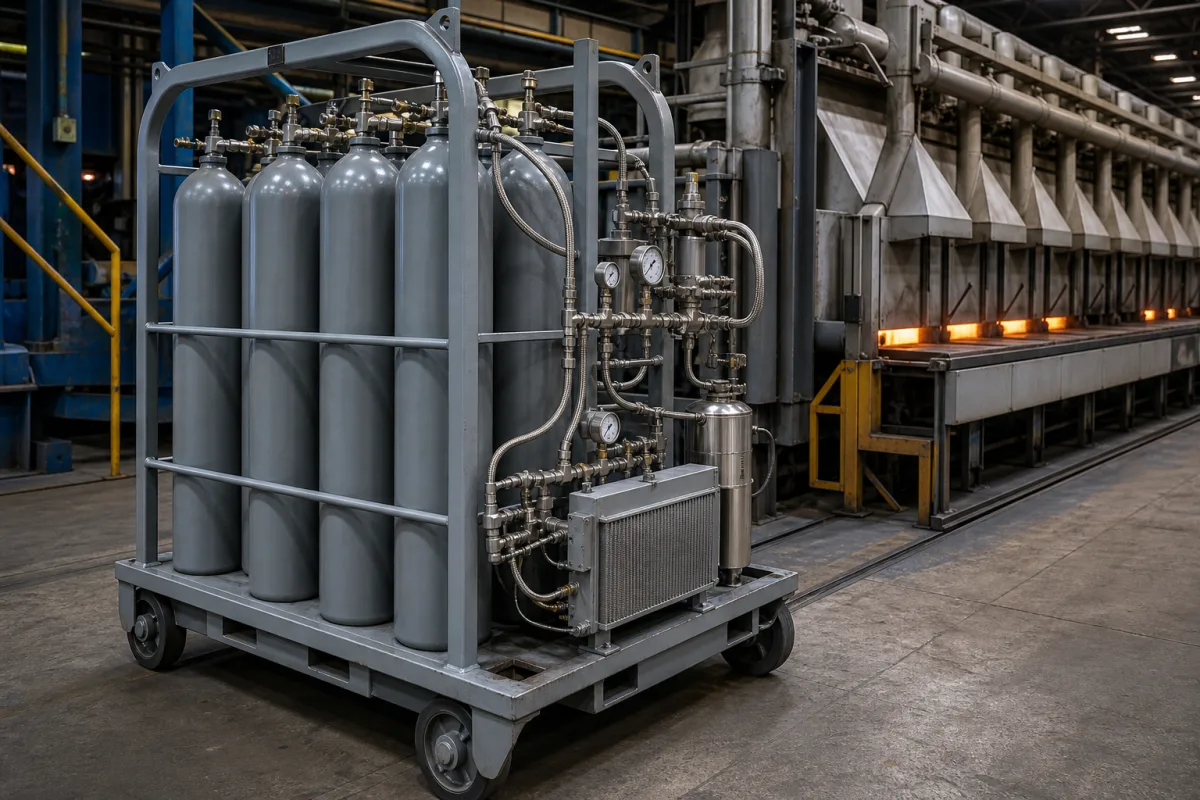
Representative product image. Confirm appearance and specifications with the manufacturer.

Product Specifications

Technical details and manufacturing context for Nitrogen Carrier

Definition
The nitrogen carrier is a critical component within the production system for Industrial-Grade Ferrochromium Nitride Alloy Powder. It is responsible for the controlled introduction, distribution, and delivery of nitrogen gas (N₂) into the reaction chamber or furnace where chromium and iron precursors are processed. Its function ensures the nitrogen is available at the correct pressure, flow rate, and location to facilitate the formation of the nitride phase within the alloy powder matrix. The carrier typically operates by receiving nitrogen gas from a supply line, regulating its flow via integrated valves or nozzles, and directing it into the processing zone. It may use pressure differentials, mechanical dispersion (e.g., through a porous diffuser or lance), or thermal gradients to ensure uniform nitrogen distribution around the raw material, enabling efficient and homogeneous nitridation. Materials on file include high-temperature resistant stainless steel (e.g., 310S) and heat-resistant ceramic (e.g., alumina). Reference parameters include operating pressure 1.0–1.6 MPa, operating temperature -20–80°C, flow capacity 5–20 m³/h at ΔP 0.1 MPa, connection size DN15–DN50 (ISO 7005), body material 316L (ASTM A240), seat material PTFE (ASTM D4894), leakage rate ≤0.01 mL/min at 1.1× rated pressure, response time ≤1 s, power supply 24 ±10% V DC, power consumption 8–15 W, ingress protection IP65 (IEC 60529), and weight 2.5–8.0 kg. These values are directory references and must be confirmed for the specific model and application. Always verify model-specific values and standards with the legal manufacturer or supplier.
Working Principle
The nitrogen carrier receives nitrogen gas from a supply line and regulates its flow via integrated valves or nozzles. It directs the gas into the processing zone using pressure differentials, mechanical dispersion through a porous diffuser or lance, or thermal gradients. This ensures uniform nitrogen distribution around the raw material, enabling efficient and homogeneous nitridation. The carrier's design must maintain proper pressure and flow to achieve the desired nitride phase in the alloy powder.
Common Materials
High-temperature resistant stainless steel (e.g., 310S), Heat-resistant ceramic (e.g., alumina)
Technical Parameters
ParameterTypical rangeNotes & selection driver
Operating Temperature-20–80 °CAbove 80°C seals degrade
Flow Capacity5–20 m³/hAt ΔP 0.1 MPa
Connection SizeDN15–DN50 mmFlanged or threadedISO 7005
Body Material316LCorrosion resistantASTM A240
Seat MaterialPTFEChemical compatibilityASTM D4894
Leakage Rate≤0.01 mL/minAt 1.1× rated pressureISO 5208
Response Time≤1 sFrom signal to full open
Power Supply24 ±10% V DCFor solenoid actuation
Power Consumption8–15 WDuring actuation
Ingress ProtectionIP65Dust-tight and water-jet protectedIEC 60529
Weight2.5–8.0 kgDepends on size and actuation

Ranges are indicative industry figures for RFQ preparation, not a supplier commitment. Confirm every value and standard with the legal manufacturer before ordering.

Components / BOM
  • Inlet Connection Port Part
    Provides a sealed interface for connecting the external nitrogen supply line to the carrier.
    Material: Stainless steel
  • Flow Control Orifice/Nozzle Part
    Regulates and directs the nitrogen gas flow into the processing chamber, often designed to create a specific dispersion pattern.
    Material: Heat-resistant ceramic or sintered metal
  • Thermal Shield/Insulation Layer Part
    Protects internal components and connection points from extreme furnace temperatures.
    Material: Ceramic fiber or refractory coating
  • Flow Regulating Valve
    Sets the nitrogen flow rate before it reaches the nozzle.
  • Porous Diffuser Optional
    Breaks the nitrogen into fine streams for even dispersion, on the diffuser-type carriers.

Industrial Ecosystem & Supply Chain Structure

Complementary Systems
Downstream Applications
Specialized Tooling

Application Fit & Sizing Matrix

Operational Limits
pressure: Up to 10 bar (operating), 15 bar (max burst)
flow rate: 0.5-50 Nm³/h (adjustable via control valves)
temperature: Ambient to 600°C (typical nitriding process range)
slurry concentration: Not applicable (gas-only component)
Media Compatibility
✓ Nitrogen gas (N₂) ✓ Nitrogen-hydrogen gas mixtures (N₂-H₂) ✓ Ammonia gas (NH₃) for nitriding atmospheres
Unsuitable: Oxygen-rich or oxidizing environments (risk of oxidation/combustion)
Sizing Data Required
  • Required nitrogen flow rate (Nm³/h)
  • System operating pressure (bar)
  • Connection size/interface requirements (e.g., flange type, tubing diameter)

Reliability & Engineering Risk Analysis

Failure Mode & Root Cause
Corrosion-induced leakage
Cause: Moisture ingress leading to acidic condensation and pitting, especially at welds and threaded connections
Valve seat degradation
Cause: Particulate contamination from supply lines causing abrasive wear and loss of sealing integrity
Maintenance Indicators
  • Hissing or whistling audible leak at connections during operation
  • Visible frost formation or ice buildup on external surfaces indicating internal moisture issues
Engineering Tips
  • Install and maintain high-efficiency particulate filters and moisture separators upstream to ensure clean, dry nitrogen supply
  • Implement regular ultrasonic leak detection surveys and torque verification on all connections during preventive maintenance cycles

Indicative industry ranges for design and RFQ preparation. Confirm the exact figures and applicable standard with the manufacturer before specifying.

Compliance & Manufacturing Standards

Applicable Standards
ISO 8573-1:2010 (Compressed air purity classes) ASTM D4629-17 (Standard Test Method for Trace Nitrogen in Liquid Petroleum Hydrocarbons) CE PED 2014/68/EU (Pressure Equipment Directive for safety)

Quoted from the published standard.

Manufacturing Precision
  • Purity: +/- 0.5% by volume
  • Pressure rating: +/- 2% of specified working pressure
Quality Inspection
  • Gas Chromatography Analysis for purity verification
  • Pressure Decay Leak Test for system integrity

Manufacturers of Nitrogen Carrier

Manufacturer profiles associated with Nitrogen Carrier.

Sourcing Nitrogen Carrier from China?
Tell us your specification and target quantity — we will match it against manufacturer records and come back with the factories that fit.
Request manufacturers We manufacture this

Manufacturer listings support early research and capability understanding. They are not certification, ranking, or transaction guarantees.

Technical documentation
Request current drawings, revision history, and a signed specification sheet.
Manufacturing capability
Verify equipment lists, process limits, capacity, and representative production evidence.
Inspection readiness
Confirm test methods, calibrated equipment, sampling plans, and traceable reports.
Supplier transparency
Check the legal entity, factory address, ownership, certifications, and direct contacts.

CNFX does not score or rank suppliers. Buyers must verify all claims and documents with the legal manufacturer before ordering.

Supply Chain Compatible Machinery & Devices

Vacuum Induction Melting Furnace

Industrial furnace for melting metals under vacuum using electromagnetic induction

Explore Specs →
Electroslag Remelting Furnace

An industrial furnace used in basic metal manufacturing for secondary refining of alloys through the electroslag remelting (ESR) process.

Explore Specs →
Molten Metal Temperature Measurement System

Automated system for continuous temperature monitoring of molten metals during processing.

Explore Specs →
Molten Metal Degassing System

The Molten Metal Degassing System is an industrial system used in basic metal manufacturing to remove dissolved hydrogen, oxygen, and nitrogen from molten aluminum, steel, and other non-ferrous metals.

Explore Specs →

Frequently Asked Questions

What is the primary function of a nitrogen carrier?

It transports and delivers nitrogen gas into the reaction chamber during nitriding, ensuring controlled pressure, flow, and distribution for nitride formation.

What materials are commonly used for the carrier?

High-temperature resistant stainless steel (e.g., 310S) and heat-resistant ceramic (e.g., alumina) are listed as reference materials.

What are typical operating pressure and temperature ranges?

Reference ranges are 1.0–1.6 MPa for pressure and -20–80°C for temperature, but these must be confirmed for the specific model.

How should I verify the carrier's specifications?

Always check the model-specific values and standards with the legal manufacturer or supplier, as directory references are not guarantees.

Data Basis

Editorial classification, named public sources where available, and source-reviewed manufacturer records.

Preliminary Technical Classification
This page supports structured research, RFQ preparation, and supplier evaluation. It does not replace buyer-led supplier qualification, standards review, or technical approval.
Buyer enquiry

Request manufacturing insight for Nitrogen Carrier

Ask for use case, specification boundaries, supplier type, and RFQ preparation information for this product.

Where it goes
Straight to the CNFX editorial desk, and to the manufacturer if this product is linked to a claimed profile. Nothing is broadcast to a supplier list.
Your details stay here
We do not sell or rent enquiry data, and we do not add you to a mailing list. Used only to answer this request.
No commission, no middleman
CNFX is a directory. We take no cut of any order and never negotiate on a supplier's behalf.
What we don't claim
A listing is not an endorsement. Qualify every supplier and verify every figure yourself before ordering.

Your business information is used only to process this request.

Thank you! Your message has been sent. We'll respond within 1–3 business days.
Sorry, we couldn't send your message. Please try again, or email us at contact@cnfx.com.

Need to Manufacture Nitrogen Carrier?

Compare manufacturer profiles with relevant product and process capability.

Previous Product
Molten Metal Temperature Measurement System
Next Product
Non-Ferrous Metal Induction Melting Furnace
Get QuotesChat