Structured Manufacturing Data (2026)

Spray Nozzles

Based on aggregated insights from structured factory profiles within the CNFX directory, the standard Spray Nozzles used in the Paper Manufacturing sector typically supports operational capacities ranging from standard industrial configurations to heavy-duty production requirements.

Technical Definition & Core Assembly

A canonical Spray Nozzles is characterized by the integration of Nozzle Body and Orifice Plate. In industrial production environments, manufacturers listed on CNFX commonly emphasize Stainless Steel 316 construction to support stable, high-cycle operation across diverse manufacturing scenarios.

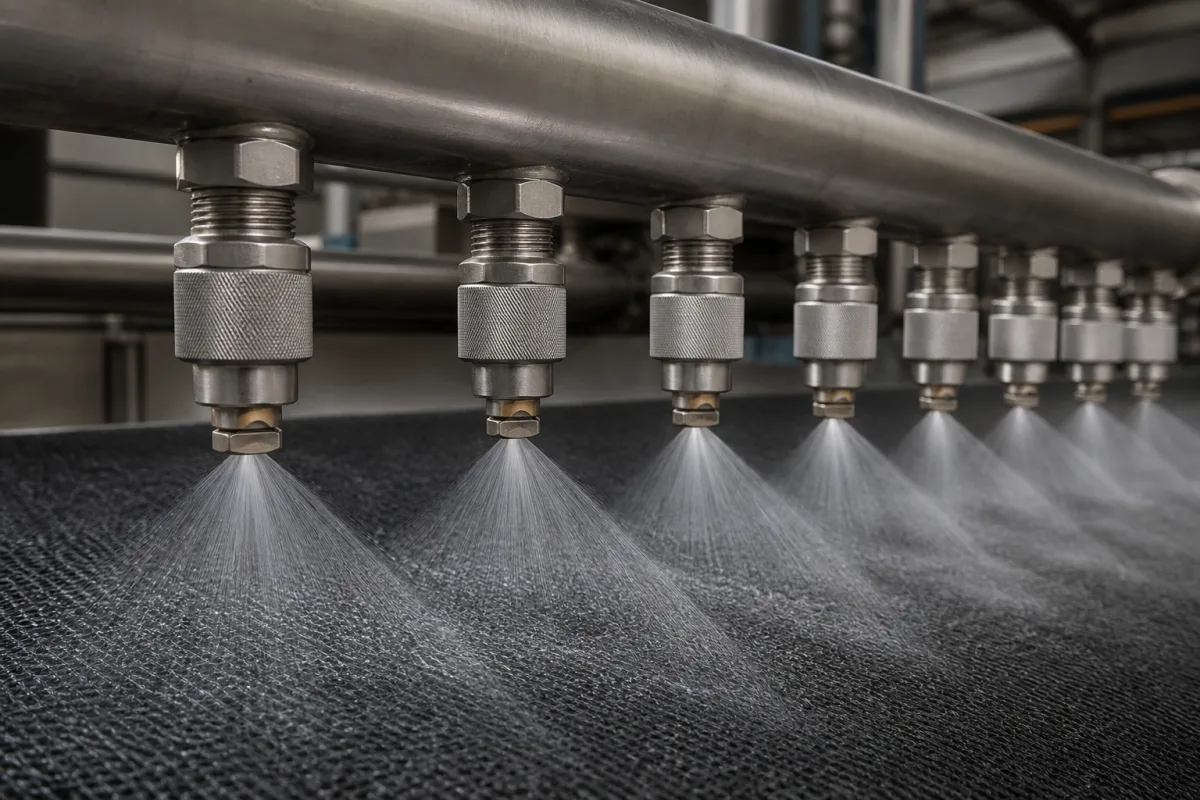
Precision components that atomize and distribute water or conditioning agents onto felt surfaces in paper manufacturing processes.
Product Specifications

Technical details and manufacturing context for Spray Nozzles

Definition
Spray nozzles are critical components within Felt Conditioning Shower systems used in paper manufacturing. They precisely control the atomization, spray pattern, and distribution of water, steam, or chemical conditioning agents onto paper machine felts to maintain optimal moisture levels, temperature control, and felt cleanliness during continuous paper production.
Working Principle
Spray nozzles operate by forcing fluid through a precisely engineered orifice under pressure, creating controlled atomization and spray patterns. In felt conditioning applications, they typically use hydraulic pressure or compressed air to generate fine mist or spray patterns that evenly coat the felt surface without causing waterlogging or uneven moisture distribution.
Common Materials
Stainless Steel 316, Ceramic, Polymer Composite
Technical Parameters
  • Orifice diameter ranging from 0.5mm to 3.0mm for precise flow control (mm) Per Request
Components / BOM
  • Nozzle Body
    Main structural housing containing fluid channels and mounting interface
    Material: Stainless Steel 316
  • Orifice Plate Part
    Precision component with engineered opening that controls spray pattern and atomization
    Material: Ceramic or Hardened Steel
  • Swirl Chamber Part
    Internal chamber that imparts rotational motion to fluid for optimal atomization
    Material: Stainless Steel 316
  • Mounting Thread Part
    Standardized threading for secure installation into shower pipe manifolds
    Material: Stainless Steel 316

Industry Taxonomies & Aliases

Commonly used trade names and technical identifiers for Spray Nozzles.

Applied To / Applications

This component is essential for the following industrial systems and equipment:

Industrial Ecosystem & Supply Chain Structure

Complementary Systems
Downstream Applications
Specialized Tooling

Application Fit & Sizing Matrix

Operational Limits
pressure: Up to 10 bar (145 psi)
flow rate: 0.5 to 50 L/min per nozzle
temperature: 10°C to 80°C
slurry concentration: Up to 5% solids by weight
Media Compatibility
✓ Water-based conditioning agents ✓ Starch solutions ✓ Polymer additives
Unsuitable: High-viscosity slurries with abrasive particles
Sizing Data Required
  • Required flow rate per nozzle
  • Desired spray pattern and coverage
  • System operating pressure

Reliability & Engineering Risk Analysis

Failure Mode & Root Cause
Abrasive erosion
Cause: Suspended solid particles in the fluid impinging on nozzle surfaces, gradually wearing away material and altering spray patterns.
Cavitation
Cause: Localized pressure drops below fluid vapor pressure, forming and collapsing vapor bubbles that cause pitting and material fatigue.
Maintenance Indicators
  • Visual: Irregular or asymmetric spray pattern (e.g., streaks, uneven distribution)
  • Audible: Unusual hissing, whistling, or knocking sounds indicating flow restriction or internal damage
Engineering Tips
  • Install in-line filters (e.g., 100-mesh) upstream to capture particulates and prevent abrasive wear
  • Maintain operating pressure within 10-15% of nozzle design specification to avoid cavitation and ensure optimal droplet size

Compliance & Manufacturing Standards

Reference Standards
ISO 9001:2015 - Quality management systems ANSI/ASME B40.100 - Pressure gauges and gauge attachments DIN EN 12266-1 - Industrial valves - Testing of metallic valves
Manufacturing Precision
  • Bore diameter: +/-0.02mm
  • Spray angle deviation: +/-2 degrees
Quality Inspection
  • Flow rate and spray pattern verification test
  • Material composition verification via X-ray fluorescence (XRF) analysis

Factories Producing Spray Nozzles

Manufacturer profiles with relevant production capability in China

Manufacturer listings support early research and capability understanding. They are not certification, ranking, or transaction guarantees.

Technical documentation
4/5
Manufacturing capability
4/5
Inspection readiness
5/5
Supplier transparency
3/5

These scores are example evaluation dimensions, not real customer ratings, country-specific buyer feedback, or live inquiry activity.

Supply Chain Compatible Machinery & Devices

Paper Machine Headbox

Distributes pulp slurry evenly onto forming wire for paper sheet formation

Explore Specs →
Paper Machine Calender Stack

Multi-roll system for paper surface finishing and thickness control.

Explore Specs →
Paper Machine Reel Spool

A rotating shaft that winds finished paper into large parent rolls.

Explore Specs →
Press Roll

A cylindrical component that applies pressure to materials during industrial processing operations.

Explore Specs →

Frequently Asked Questions

What materials are best for spray nozzles in paper manufacturing applications?

Stainless Steel 316 offers excellent corrosion resistance for harsh chemical environments, ceramic provides superior wear resistance for abrasive slurries, and polymer composites are lightweight and cost-effective for less demanding applications.

How do spray nozzles improve paper manufacturing processes?

They precisely atomize and distribute water or conditioning agents onto felt surfaces, ensuring uniform moisture control, reducing fiber shedding, extending felt life, and improving overall paper quality and production efficiency.

What maintenance is required for paper manufacturing spray nozzles?

Regular inspection for clogging or wear, cleaning of orifice plates and swirl chambers, and replacement based on material degradation. Ceramic nozzles typically last longer but require careful handling to prevent cracking.

Can I contact factories directly on CNFX?

CNFX is an open directory, not a transaction platform. Each factory profile provides direct contact information and production details to help you initiate direct inquiries with Chinese suppliers.

Data Basis

CNFX manufacturer profiles, technical classification, publicly available product information, and ongoing plausibility checks.

Preliminary Technical Classification
This page supports structured research, RFQ preparation, and supplier evaluation. It does not replace buyer-led supplier qualification, standards review, or technical approval.

Request Manufacturing Insight for Spray Nozzles

Ask for use case, specification boundaries, supplier type, and RFQ preparation information for Spray Nozzles.

Your business information is used only to process this request.

Thank you! Your message has been sent. We'll respond within 1–3 business days.

Need to Manufacture Spray Nozzles?

Compare manufacturer profiles with relevant product and process capability.

Create Manufacturer Profile Contact Us
Previous Product
Spray Manifold
Next Product
Suction Box