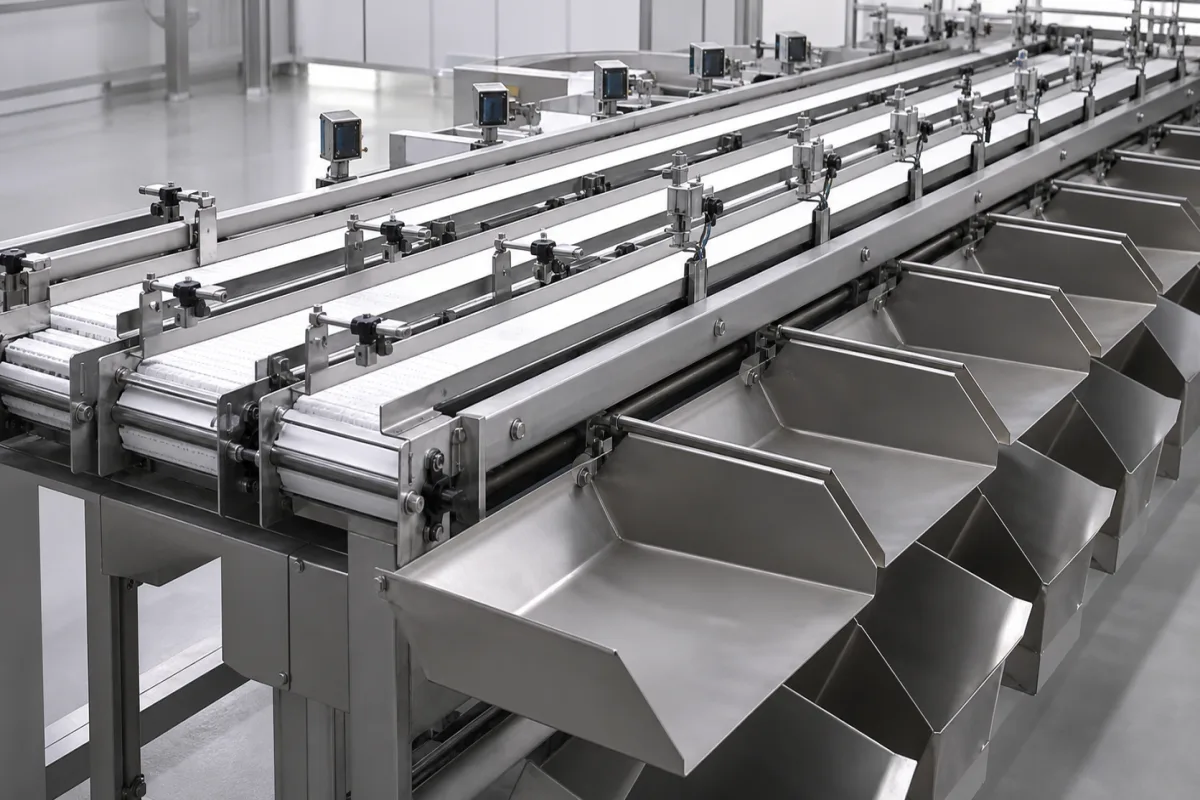
Infeed and sorting module for whole fish: lanes that weigh or image each fish and send it to a size or quality gate ahead of filleting and packing
Whole fish before filleting and packing · the lane that takes gutted salmon or whitefish one at a time, weighs or images each fish, and pushes it off at the gate for its size, quality or species into a bin, tub or box
A filleting machine is set for a size range, and a box of whole fish is sold by size grade, so whole fish are sorted before either step. The sorting module takes fish from an infeed one at a time, decides which grade each belongs to, and pushes it off its lane at the gate for that grade. What separates one module from another is how the decision is made: a dynamic scale under the lane, a camera that also judges colour and species, or a weight measured earlier at the gutting machine and carried with the fish. How many fish one lane can handle per minute then sets how many lanes a plant needs.
Infeed and sorting modules for whole fish, gutted or round: the infeed lane, dynamic in-line weighing or vision grading of each fish, gate and drop-off arms, bins, tubs and box chutes, buffer chutes, gate allocation by size, quality and order, and lane capacity in fish per minute. Machines that cut fillets from whole fish are covered on the Industrial fish filleting machine page; blade units of portion cutters on the Cutting assembly for fish and meat portion cutters page; freezing-line conveyors on the Variable-speed conveyor for freezing fish and seafood page; band saw tensioning on the Band saw blade tensioning mechanism for meat and fish saws page; X-ray bone detection in fillets on the Signal processing board for X-ray fish bone detection page. Checkweighers for finished prepacks are covered on the Checkweigher page and parcel sorters on the Sortation systems page.
CNFX editorial research · Sources checked October 13, 2026 · 5 sources
Fish per minute per lane, and how many lanes a plant's tonnage needs
Whole-fish graders are rated in fish per minute, so the tonnage a lane carries depends on the fish. The published ratings below come from four makers and cover salmon and whitefish.
Editorial calculation: one lane at 70 fish/min handling salmon averaging 4 kg carries about 16.8 t/h (70 × 60 × 4 kg); the same lane with 3 kg gutted cod carries about 12.6 t/h. Valka's 200 tons per shift, if the shift is taken as 8 hours, is 25 t/h; at a 4 kg average that is about 104 fish/min, more than one 60–70 fish/min lane, so a second lane or a faster grader would be needed. The 4 kg and 8-hour figures are assumptions for the calculation, not values from Valka.
In JBT Marel's inline infeed versions the rated throughput follows the number of loading workstations: a single inline lane rises from 50 to 70 fish/min when the workstations go from two to four, and a dual lane from 100 to 140 fish/min going from four to six. [1]
Machine
Published rate
Fish
Valka WholeFish Grader for salmon
60–70 fish/min per lane; daily capacity can exceed 200 tons per shift [4]
Salmon
JBT Marel whole salmon grading
Up to 70 fish/min single lane, 140 dual lane; distribution up to 120 baskets/min single lane, 240 dual [1]
Salmon, gutted
JBT Marel inline infeed for packing grader
50 fish/min single lane with two workstations, 70 with four; 100 dual lane with four, 140 with six [1]
Give the grader supplier the species, the weight range and average weight of the fish, the tonnes per hour or per shift, and how fish arrive (from a gutting machine, a bleeding tank or manual loading); ask for the fish-per-minute rating per lane at your average weight and how many loading stations it assumes.
02
Dynamic scale, vision camera or a weight carried from gutting: how each fish gets its gate
Every module decides a gate for each fish; the measurements behind that decision differ between makers.
JBT Marel's whole fish grader for onshore grading of fresh cod, haddock and pollock/saithe into tubs or boxes ties the sorting to the next machines: grading by size lets the plant optimise the settings of filleting and deheading machines, and the record of total weight, weight distribution and piece count supports quota accounting and settling with supplying vessels. [2] Skaginn 3X presents its vision grader as removing the need for manual pre-grading of the catch and offers its per-fish records for electronic catch logbooks. [5]
BAADER's 1870 also carries single-fish tracking data such as the k-factor and images from its 144 gutting machine through to the boxes leaving the packing line. [3]
Approach
How the fish is measured and placed
Dynamic in-line weighing (Valka)
Fish weighed in motion, then sent to its assigned gate, where a buffer chute directs it into a tub or box and can hold fish while the operator replaces a container; a printer can label each tub or box when full [4]
Weight carried from gutting (BAADER 1870)
No scales on the grader: individual weights taken in the gutting area are tracked with each fish; dynamic bin allocation sets the number of bins per size, scaled up or down with production [3]
Weighing plus quality grading (JBT Marel)
Each fish individually weighed and quality graded in the distribution system; optional dynamic order control allocates gates by size, quality and orders [1]
Vision grading (Skaginn 3X)
Camera grades groundfish by size, colour, quality (blood colour) and species, up to 99 % accuracy, size, colour and species recorded per fish; on the QC-Vision Batcher the vision system removes damaged fish and unwanted species [5]
Ask which measurement assigns the gate (scale on the lane, camera, or upstream weight), how many gates and bins the module has and whether their allocation can change during a run, and what per-fish data it records and exports.
03
Data for a whole-fish infeed and sorting module
Paste it into your enquiry below or into an email to a maker, then replace every bracket.
Fish: [species; gutted or round; weight range; average weight]
Rate: [t/h or t/shift; fish per minute]
Infeed: [from gutting machine, bleed tank or manual; loading stations]
Grading: [weight, quality, colour, species; number of grades]
Output: [gates; bins, tubs or boxes; buffer chutes; labelling]
Data: [per-fish records; batch reports; link to filleting or packing line]
Explore company information and manufacturing capabilities, then discuss the scope of your project with a relevant supplier.
Share this page
Compiled and source-reviewed by the CNFX editorial team.
Each manufacturer above links to the page on that company's own website where the product is listed, with the date we checked it. How we source and review
· Page last updated 13 October 2026
Buyer questions
How many fish per minute can one grading lane handle?
Valka rates its salmon wholefish grader at 60–70 fish/min per lane and JBT Marel at up to 70 fish/min single lane and 140 dual lane; BAADER rates its 1870 at up to 160 fish/min. [4][1][3]
Does a whole-fish grader need its own scale?
Not always. BAADER's 1870 has no weighing scales: it uses individual weights taken in the gutting area and tracked with each fish. [3]
Can a grader sort whole fish by species and quality as well as size?
Skaginn 3X's vision whole fish grader grades groundfish by size, colour, quality (blood colour) and species, with up to 99 % accuracy. [5]
Why grade whitefish before filleting?
JBT Marel says size grading lets processors optimise the settings of filleting and deheading machines and supports quota accounting with weight distribution and piece counts. [2]
Sources and what still needs a direct check
Sources checked 2026-10-13. Capacities, measuring methods and gate handling come from the product pages and catalogues of JBT Marel, BAADER, Valka and Skaginn 3X.