Industry-Verified Manufacturing Data (2026)

Automated Grading and Portioning Unit

Based on aggregated insights from multiple verified factory profiles within the CNFX directory, the standard Automated Grading and Portioning Unit used in the Food Manufacturing sector typically supports operational capacities ranging from standard industrial configurations to heavy-duty production requirements.

Technical Definition & Core Assembly

A canonical Automated Grading and Portioning Unit is characterized by the integration of Inspection Sensor Array and Sorting Mechanism. In industrial production environments, manufacturers listed on CNFX commonly emphasize Stainless steel (food-grade) construction to support stable, high-cycle operation across diverse manufacturing scenarios.

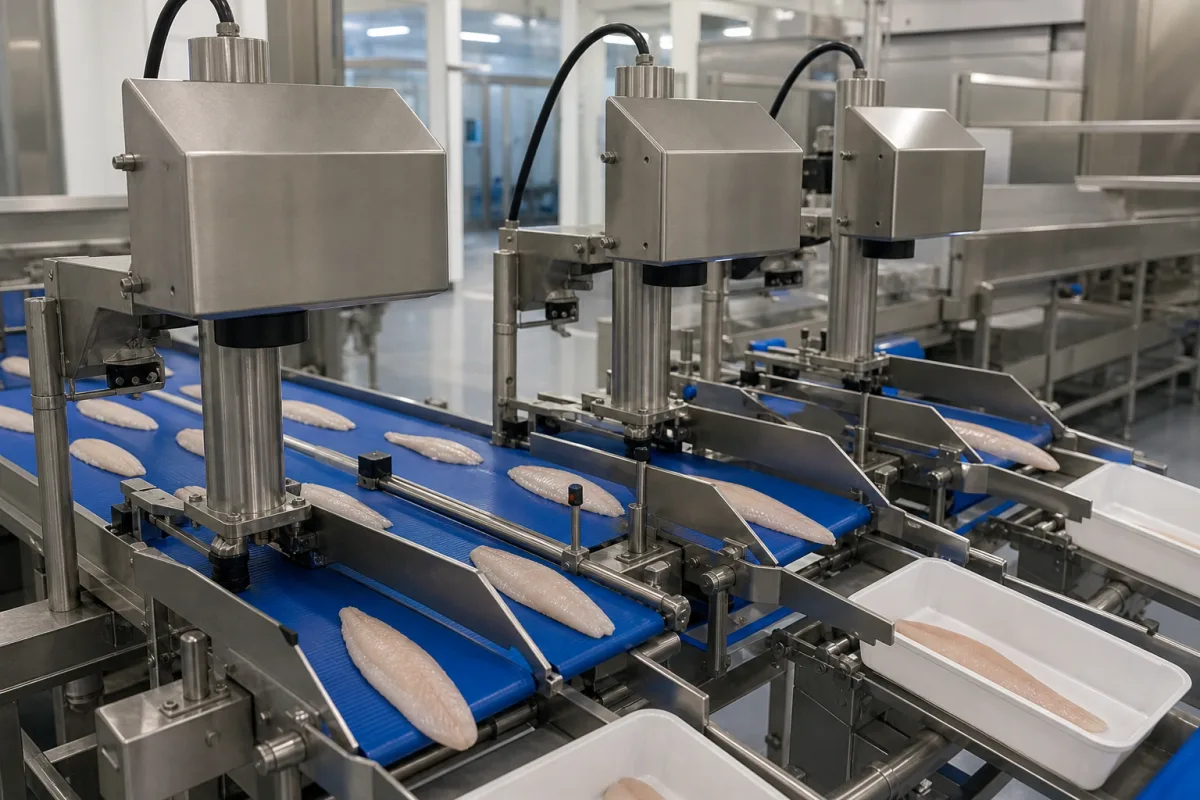
Automated unit for sorting fish by quality/size and cutting into standardized portions
Product Specifications

Technical details and manufacturing context for Automated Grading and Portioning Unit

Definition
A specialized component within the Modular Fish Processing and Preservation Line that automatically evaluates incoming fish based on predetermined quality and size criteria, then precisely cuts them into uniform portions for packaging and preservation. This unit ensures consistent product quality, reduces waste, and optimizes processing efficiency in fish manufacturing operations.
Working Principle
Utilizes a combination of sensors (optical, weight, dimension) to assess each fish, followed by automated cutting mechanisms (blades, saws, or water jets) that execute precise cuts according to programmed portion specifications. The system typically includes conveyors for fish transport, sorting gates or robotic arms for classification, and cutting stations with adjustable parameters.
Common Materials
Stainless steel (food-grade), Food-safe plastics, High-carbon steel blades
Technical Parameters
  • Cutting precision tolerance (mm) Customizable
Components / BOM
  • Inspection Sensor Array
    Detects fish size, weight, and quality defects using optical and weight sensors
    Material: Stainless steel housing with optical glass
  • Sorting Mechanism
    Directs fish to appropriate cutting stations based on grading results
    Material: Food-grade plastic and stainless steel
  • Cutting Assembly
    Precisely cuts fish into standardized portions using blades or saws
    Material: High-carbon steel
  • Control System
    Processes sensor data and controls all unit operations
    Material: Electronic components in sealed enclosure
Engineering Reasoning
0.5-2.0 m/s conveyor speed, 0-40°C ambient temperature, 85-110 kPa compressed air pressure
Conveyor speed exceeds 2.5 m/s causing fish misalignment, ambient temperature exceeds 45°C causing sensor drift >3mm, compressed air pressure drops below 70 kPa causing actuator stall
Design Rationale: Bernoulli principle causing fish lift/misalignment at high conveyor speeds, thermal expansion coefficient mismatch (aluminum frame vs steel guides) causing dimensional instability, Boyle's law pressure-volume relationship causing insufficient actuator force
Risk Mitigation (FMEA)
Trigger Hydraulic fluid contamination exceeding ISO 4406 18/16/13 cleanliness level
Mode: Proportional valve spool sticking causing portion weight deviation >15%
Strategy: Install 3μm absolute filtration with differential pressure monitoring at 150 kPa
Trigger Encoder signal loss for >100ms due to EMI from 400V VFD switching at 8kHz
Mode: Servo axis overshoot causing blade collision with conveyor at 1.2m/s
Strategy: Shielded twisted pair cabling with ferrite cores at both ends, ground plane separation of 50mm

Industry Taxonomies & Aliases

Commonly used trade names and technical identifiers for Automated Grading and Portioning Unit.

Industrial Ecosystem & Supply Chain DNA

Complementary Systems
Downstream Applications
Specialized Tooling

Application Fit & Sizing Matrix

Operational Limits
humidity: 40-80% RH (controlled environment to prevent condensation)
pressure: Atmospheric (no pressure requirements)
flow rate: 100-500 kg/hour (typical fish processing throughput)
temperature: 0-10°C (refrigerated environment for fish processing)
vibration tolerance: Low (requires stable mounting surface)
slurry concentration: Not applicable (handles solid fish products, not slurries)
Media Compatibility
✓ Fresh fish fillets (salmon, cod, haddock) ✓ Frozen fish blocks (thawed to processing temperature) ✓ Shellfish portions (shrimp, scallops)
Unsuitable: Bone-in whole fish with irregular shapes (requires pre-processing)
Sizing Data Required
  • Maximum throughput requirement (kg/hour)
  • Target portion sizes and weight tolerances (grams ± tolerance)
  • Fish species and initial product form (whole, fillets, blocks)

Reliability & Engineering Risk Analysis

Failure Mode & Root Cause
Conveyor belt misalignment or slippage
Cause: Worn drive components, improper tensioning, or accumulation of product debris causing tracking issues
Cutting blade degradation or failure
Cause: Fatigue from cyclic loading, abrasive wear from product contact, or improper blade alignment leading to premature dulling or breakage
Maintenance Indicators
  • Irregular or inconsistent portion sizes, indicating potential sensor drift, blade wear, or conveyor speed issues
  • Unusual grinding, scraping, or knocking noises from the cutting mechanism or drive system, suggesting mechanical wear or misalignment
Engineering Tips
  • Implement a predictive maintenance program using vibration analysis on drive motors and bearings, and laser alignment checks on conveyor and cutting systems to detect issues before failure
  • Establish a strict lubrication schedule for all moving parts and use food-grade lubricants where applicable, combined with regular cleaning protocols to prevent product buildup that accelerates wear

Compliance & Manufacturing Standards

Reference Standards
ISO 9001:2015 - Quality management systems ANSI/UL 61010-1 - Safety requirements for electrical equipment for measurement, control, and laboratory use CE Marking - Compliance with EU machinery directive 2006/42/EC
Manufacturing Precision
  • Cutting blade alignment: +/-0.05mm
  • Portion weight consistency: +/-1.5% of target weight
Quality Inspection
  • Load cell calibration verification test
  • Food contact surface material composition analysis

Factories Producing Automated Grading and Portioning Unit

Verified manufacturers with capability to produce this product in China

✓ 92% Supplier Capability Match Found

P Procurement Specialist from United States Feb 20, 2026
★★★★★
"Reliable performance in harsh Food Manufacturing environments. No issues with the Automated Grading and Portioning Unit so far."
Technical Specifications Verified
T Technical Director from United Arab Emirates Feb 17, 2026
★★★★★
"Testing the Automated Grading and Portioning Unit now; the technical reliability results are within 1% of the laboratory datasheet."
Technical Specifications Verified
P Project Engineer from Australia Feb 14, 2026
★★★★★
"Impressive build quality. Especially the technical reliability is very stable during long-term operation."
Technical Specifications Verified
Verification Protocol

“Feedback is collected from verified sourcing managers during RFQ (Request for Quote) and factory evaluation processes on CNFX. These reports represent historical performance data and technical audit summaries from our B2B manufacturing network.”

5 sourcing managers are analyzing this specification now. Last inquiry for Automated Grading and Portioning Unit from Thailand (1h ago).

Supply Chain Compatible Machinery & Devices

Intelligent Food Grade Metal Detector

Automated metal contamination detection system for food processing lines.

Explore Specs →
Automated Food Packaging Integrity Tester

Automated system for non-destructive testing of food package seals and integrity.

Explore Specs →
Automated Food Moisture Analyzer

Automated system for precise moisture content measurement in food products

Explore Specs →
Automated Food Color Consistency Analyzer

Automated inline system for real-time color measurement and consistency control in food processing.

Explore Specs →

Frequently Asked Questions

What materials are used in the construction of this automated grading and portioning unit?

The unit is constructed with food-grade stainless steel for durability and hygiene, food-safe plastics for non-contact components, and high-carbon steel blades for precise, long-lasting cutting performance.

How does the unit ensure consistent portion sizes?

The unit uses a combination of an inspection sensor array to measure fish dimensions and a precision cutting assembly with high-carbon steel blades to cut fish into standardized portions according to pre-set parameters in the control system.

What are the main components included in this automated grading system?

The system includes four key components: a control system for operation management, a cutting assembly for portioning, an inspection sensor array for quality/size assessment, and a sorting mechanism to categorize fish based on grading results.

Can I contact factories directly on CNFX?

CNFX is an open directory, not a transaction platform. Each factory profile provides direct contact information and production details to help you initiate direct inquiries with Chinese suppliers.

Get Quote for Automated Grading and Portioning Unit

Request technical pricing, lead times, or customized specifications for Automated Grading and Portioning Unit directly from verified manufacturing units.

Your business information is encrypted and only shared with verified Automated Grading and Portioning Unit suppliers.

Thank you! Your message has been sent. We'll respond within 1–3 business days.

Need to Manufacture Automated Grading and Portioning Unit?

Connect with verified factories specializing in this product category

Add Your Factory Contact Us
Previous Product
Automated Food Sterilization Tunnel
Next Product
Automated Ultra-High Temperature Sterilization Line