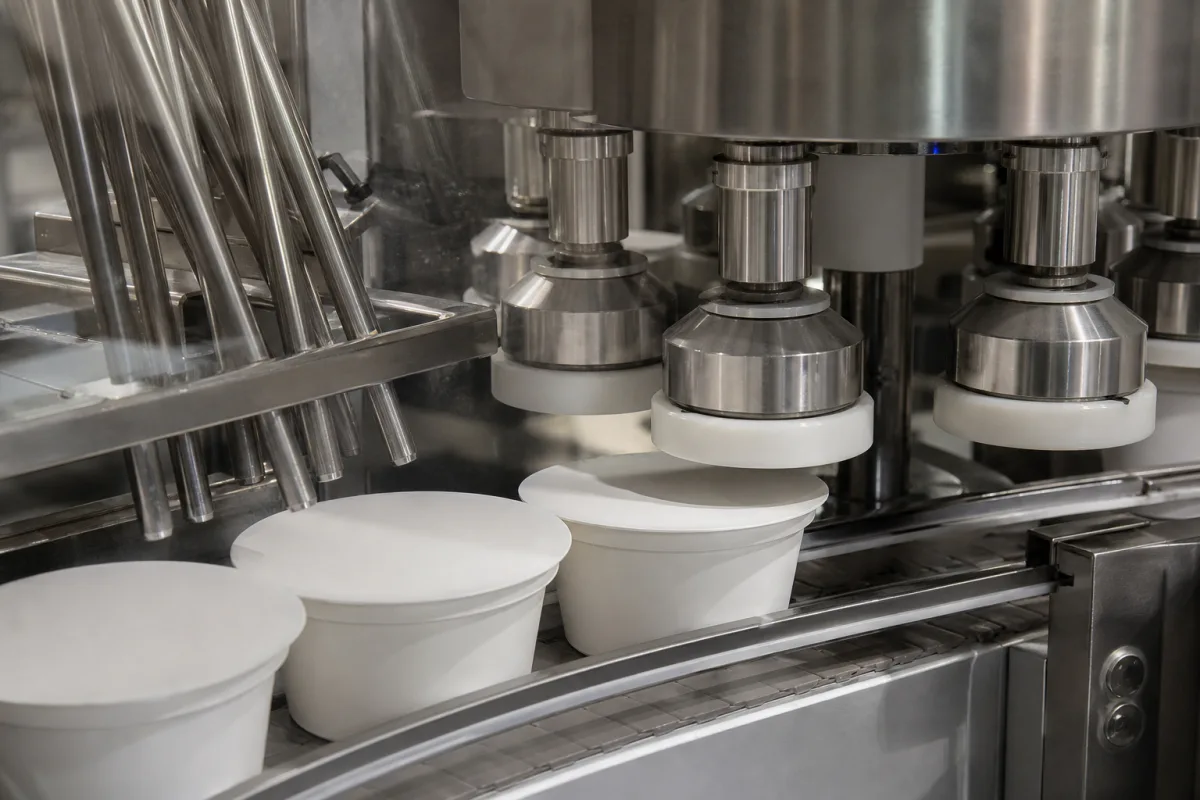
Gas-flush and lid-sealing station for modified atmosphere packs of fish: residual oxygen, gas mix and the cold chain it depends on
The gassing and lidding station that replaces air in a cup or tray before the lid is sealed · laminar nitrogen flushing that took residual oxygen from about 6 % to below 2 %, the 40/30/30 and 60/40 gas mixes advised for fish at 3 parts gas to 1 of fish, and the 3.3 °C limit set by non-proteolytic C. botulinum
Despite the name, a packing station of this kind does not control the atmosphere after sealing. It replaces the air in each pack with a gas mixture at the moment of sealing and leaves it there; what happens next depends on the pack, the fish and the temperature. The station is judged by how little air it leaves behind, whether it delivers the gas mixture specified for the product, and how the packs are kept cold afterwards.
Gassing and lid-sealing stations that flush the headspace of filled cups, tubs or trays with nitrogen, carbon dioxide or mixtures and seal a lid foil or film on, for chilled fish and seafood and other perishable foods: gas injection, residual oxygen, gas mixtures and gas-to-product ratio. Screw-capping machines for bottles are covered on the High-speed rotary bottle capping machine page and their spindles and chucks on the Capping spindle and Jaw-type capping head pages; crown, roll-on and cork closures on the Automated bottle capping machine page; gas flushing on vertical form-fill-seal bagging machines on the Vertical form fill seal (VFFS) machine page.
CNFX editorial research · Sources checked October 13, 2026 · 3 sources
From about 6 % to below 2 % residual oxygen: laminar nitrogen through a sintered tube
Ian Vokins's patent for FMC Corporation covers a cup-filling machine whose conveyor runs through loading, sterilising, drying, filling, gassing and sealing stations, with closures cut from foil and heat-sealed on. [1]
The patent explains that in a known machine nitrogen enters the gassing chamber through a slot in turbulent flow, drawing in air from surrounding parts of the machine, so residual oxygen could not be brought below about 6 % by volume, which it calls unacceptably high for a food of relatively high acidity. Its gassing chamber sits over the conveyor between filling and sealing, with the descending lidding foil forming one wall, and nitrogen is injected through a porous tube of sintered metal in laminar flow; with that arrangement the oxygen content in the unfilled part of the sealed containers was below 2 % by volume. Air for sterilising the gassing station is heated to 110–120 °C. [1]
Editorial calculation: air is about 21 % oxygen, so 6 % residual oxygen means roughly 29 % of the headspace is still air, and 2 % about 10 %.
Ask the supplier for residual oxygen measured in sealed packs of your container at production speed, and where in the station the gas meets the lid.
02
Gas mixtures for fish at 3 parts gas to 1 part fish
Torry Advisory Note 88 from the UK Torry Research Station distinguishes modified atmosphere packing, whose gas composition is fixed when the pack is sealed and may change slowly afterwards, from controlled atmosphere packing, whose composition is continuously controlled, which it says is possible in large storage units but not in small packs. Its recommendations assume 3 parts gas to 1 part fish by volume: [2]
The note explains the roles: carbon dioxide retards bacterial spoilage, but too much dissolves into the fish, collapsing the pack, causing drip and, in ready-to-eat products such as brown crab meat, an acidic flavour; oxygen prevents colour changes and bleaching; nitrogen dilutes. Where gases are mixed in the machine, it advises measuring pack composition at the start of a run and through the day. It asks for white fish equivalent to 1–4 days in ice, herring and mackerel of 1–3 days with at least 8 % fat, packs kept as near 0 °C as possible and never above 5 °C. [2]
Editorial calculation: at 3:1 gas to fish, a pack holding 250 cm³ of fish needs about 750 cm³ of headspace, a total of about 1 litre.
High-quality cod fillets keep up to 50 % longer than vacuum-packed or unwrapped; shell-on scampi and shrimp up to 30 % longer, with black spot inhibited [2]
Specify the product, the gas mixture and the gas-to-product ratio, and ask how the station's mix is checked during a run.
03
The cold chain after sealing: 3.3 °C for non-proteolytic Clostridium botulinum
FDA's Fish and Fishery Products Hazards and Controls Guidance, in its table of limiting conditions for pathogen growth, gives these limits for two groups of Clostridium botulinum and for Listeria monocytogenes: [3]
Editorial note: removing oxygen slows aerobic spoilage but does not stop these organisms, so the gas-flush station does not by itself make a fish pack safe; Torry's limit of never above 5 °C for MAP fish is above the 3.3 °C at which type E can grow in FDA's table. [2][3] The storage temperature, shelf life and any additional barrier for the product have to be set in the plant's hazard analysis.
Organism
Minimum growth temperature
Minimum water activity
Minimum pH
Maximum water-phase salt
C. botulinum type E and non-proteolytic types B and F
Ask the packer and the station supplier how pack temperature is held between filling, sealing and cold storage.
04
What to specify for a gas-flush lid-sealing station
Paste it into your enquiry below or into an email to a maker, then replace every bracket.
Product: [species; fresh, cooked or smoked; portion size]
Container: [cup, tub or tray; material; size; lid foil or film]
Gas: [mixture; supplied premixed or mixed in machine; gas-to-product ratio]
Performance: [residual oxygen target; packs per minute; measurement method]
Sealing: [temperature; pressure; time; leak test]
Hygiene and cold chain: [sterilisation of gassing station; product temperature before and after sealing]
Explore company information and manufacturing capabilities, then discuss the scope of your project with a relevant supplier.
Share this page
Compiled and source-reviewed by the CNFX editorial team.
Each manufacturer above links to the page on that company's own website where the product is listed, with the date we checked it. How we source and review
· Page last updated 13 October 2026
Buyer questions
How low can residual oxygen be taken in a gas-flushed cup?
FMC's patent reports below 2 % by volume with laminar nitrogen injection through a sintered tube, against about 6 % with turbulent slot injection. [1]
What gas mixture is used for modified atmosphere packs of fish?
The Torry Research Station advised 40 % CO₂, 30 % N₂ and 30 % O₂ for white fish and shellfish, and 60 % CO₂ with 40 % N₂ for salmon, oily and smoked fish, at 3 parts gas to 1 part fish. [2]
Is modified atmosphere packing the same as controlled atmosphere packing?
No; the Torry note defines MAP as gas fixed at sealing, and CAP as continuous control of the atmosphere, possible in large stores but not in small packs. [2]
Why does temperature matter for MAP fish?
FDA lists 3.3 °C as the minimum growth temperature of type E and non-proteolytic C. botulinum, anaerobes that are not stopped by removing oxygen. [3]
Sources and what still needs a direct check
Sources checked 2026-10-13. Gassing performance comes from an FMC Corporation patent; gas mixtures and storage effects from a Torry Research Station advisory note of the former UK Ministry of Agriculture, Fisheries and Food, hosted by FAO; pathogen limits from FDA's fish and fishery products hazards guidance.