Industry-Verified Manufacturing Data (2026)

Industrial Vacuum Cooling Tunnel

Based on aggregated insights from multiple verified factory profiles within the CNFX directory, the standard Industrial Vacuum Cooling Tunnel used in the Processing and Preserving of Fruit and Vegetables sector typically supports operational capacities ranging from standard industrial configurations to heavy-duty production requirements.

Technical Definition & Core Assembly

A canonical Industrial Vacuum Cooling Tunnel is characterized by the integration of Vacuum Chamber and Vacuum Pump System. In industrial production environments, manufacturers listed on CNFX commonly emphasize Stainless Steel 304 construction to support stable, high-cycle operation across diverse manufacturing scenarios.

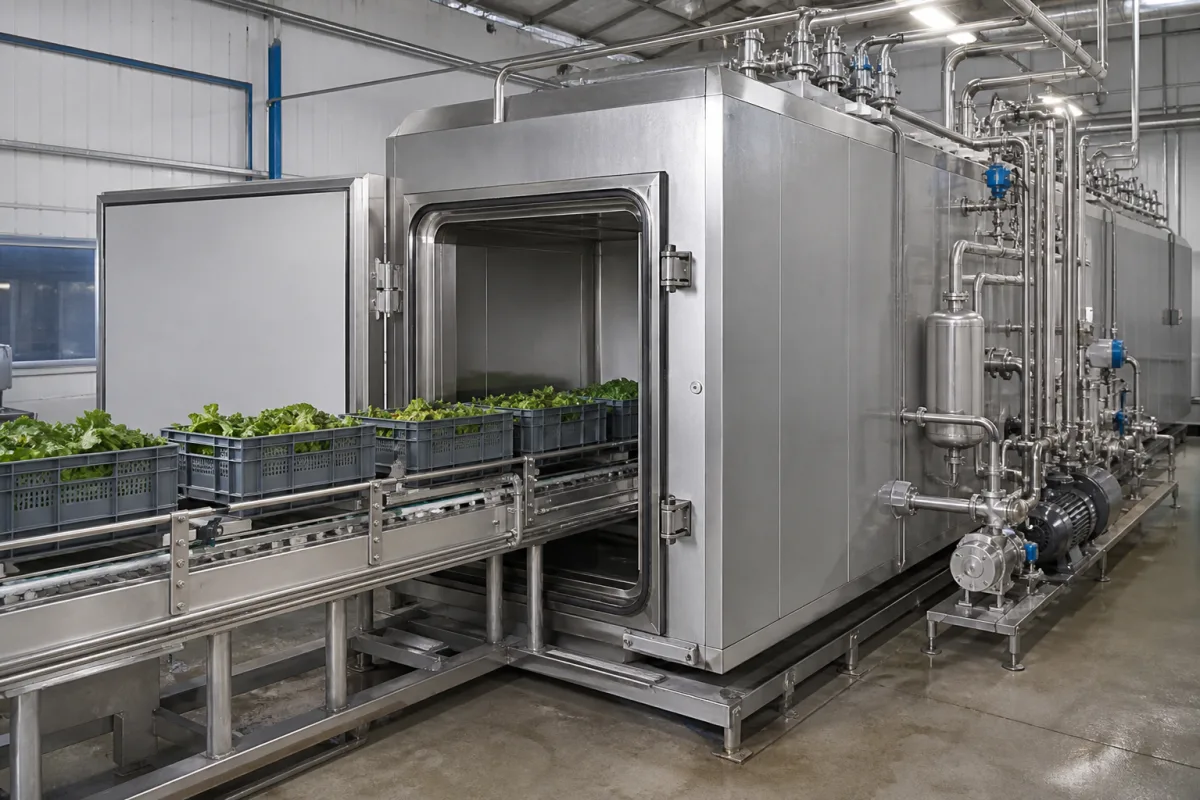
Industrial tunnel system for rapid cooling of processed fruits and vegetables using vacuum technology.
Product Specifications

Technical details and manufacturing context for Industrial Vacuum Cooling Tunnel

Definition
The Industrial Vacuum Cooling Tunnel is a critical post-processing equipment used in fruit and vegetable preservation facilities. It rapidly reduces product temperature through vacuum-induced evaporation, significantly extending shelf life while maintaining quality. This machine is essential in B2B supply chains for maintaining product integrity during packaging and distribution phases. It enables processors to meet strict food safety standards while optimizing production throughput.
Working Principle
Creates a vacuum environment that lowers water's boiling point, causing rapid evaporation and cooling of product surface moisture.
Common Materials
Stainless Steel 304, Food-grade Polycarbonate, High-vacuum Seals
Technical Parameters
  • Maximum throughput capacity (kg/hour) Per Request
  • Processing chamber volume (m³) Per Request
Components / BOM
  • Vacuum Chamber
    Creates and maintains low-pressure environment
    Material: Stainless Steel 304
  • Vacuum Pump System
    Removes air to achieve required vacuum levels
    Material: Cast Iron Housing
  • Conveyor Belt
    Transports products through cooling zone
    Material: Food-grade Polyurethane
  • Condensation System
    Collects evaporated moisture
    Material: Copper Tubes
Engineering Reasoning
0.1-0.9 bar absolute pressure, 2-15°C coolant temperature
0.05 bar absolute pressure (vacuum pump cavitation threshold), 18°C coolant temperature (phase change inhibition point)
Design Rationale: Vapor pressure collapse below 0.05 bar prevents efficient heat transfer via evaporation; coolant above 18°C exceeds latent heat of vaporization threshold for water (2257 kJ/kg at 1 atm)
Risk Mitigation (FMEA)
Trigger Vacuum seal degradation due to elastomer compression set exceeding 15%
Mode: System pressure rise to 0.12 bar within 30 seconds
Strategy: Dual redundant sealing system with PTFE primary and silicone secondary seals
Trigger Condenser coil fouling reaching 0.5 mm mineral deposit thickness
Mode: Heat transfer coefficient reduction to 850 W/m²·K from design 1200 W/m²·K
Strategy: Automated CIP system with 2% citric acid solution cycling every 8 hours

Industry Taxonomies & Aliases

Commonly used trade names and technical identifiers for Industrial Vacuum Cooling Tunnel.

Industrial Ecosystem & Supply Chain DNA

Complementary Systems
Downstream Applications
Specialized Tooling

Application Fit & Sizing Matrix

Operational Limits
pressure: Operating: 0.1-0.3 bar absolute, Design: Full vacuum to 0.5 bar
flow rate: 1-10 tons/hour product throughput
temperature: Inlet: 70-95°C, Outlet: 4-10°C
slurry concentration: Up to 40% solids by weight
Media Compatibility
✓ Fresh-cut fruits (berries, melons) ✓ Blanched vegetables (carrots, peas) ✓ Cooked pasta/grains
Unsuitable: High-viscosity purees or pastes (e.g., tomato paste, fruit concentrates)
Sizing Data Required
  • Required cooling capacity (kW or tons refrigeration)
  • Product inlet temperature and target outlet temperature
  • Production throughput rate (kg/hour or tons/hour)

Reliability & Engineering Risk Analysis

Failure Mode & Root Cause
Vacuum Seal Degradation
Cause: Wear and tear on elastomeric seals due to thermal cycling, chemical exposure to process residues, and mechanical stress from pressure differentials, leading to vacuum loss and reduced cooling efficiency.
Heat Exchanger Fouling
Cause: Accumulation of particulate matter, scale, or biological growth on heat exchanger surfaces from process fluids or cooling water, impairing heat transfer and increasing energy consumption.
Maintenance Indicators
  • Audible hissing or whistling from the tunnel housing, indicating vacuum seal failure or leaks.
  • Visible condensation or frost buildup on external surfaces, suggesting compromised insulation or inefficient heat exchange.
Engineering Tips
  • Implement a predictive maintenance program using vibration analysis and thermal imaging to detect early signs of seal wear and heat exchanger inefficiencies.
  • Use high-purity, treated cooling water and install inline filtration to minimize fouling and corrosion in the heat exchange system.

Compliance & Manufacturing Standards

Reference Standards
ISO 12100:2010 Safety of machinery - General principles for design - Risk assessment and risk reduction ANSI/ASHRAE 15 Safety Standard for Refrigeration Systems DIN EN 378 Refrigerating systems and heat pumps - Safety and environmental requirements
Manufacturing Precision
  • Vacuum chamber flatness: +/-0.5mm per meter
  • Cooling coil alignment: +/-1.0mm from centerline
Quality Inspection
  • Vacuum Leak Test (Helium Mass Spectrometry)
  • Temperature Uniformity Mapping Test

Factories Producing Industrial Vacuum Cooling Tunnel

Verified manufacturers with capability to produce this product in China

✓ 97% Supplier Capability Match Found

P Project Engineer from Canada Feb 06, 2026
★★★★★
"Standard OEM quality for Processing and Preserving of Fruit and Vegetables applications. The Industrial Vacuum Cooling Tunnel arrived with full certification."
Technical Specifications Verified
S Sourcing Manager from United States Feb 03, 2026
★★★★★
"Great transparency on the Industrial Vacuum Cooling Tunnel components. Essential for our Processing and Preserving of Fruit and Vegetables supply chain."
Technical Specifications Verified
P Procurement Specialist from United Arab Emirates Jan 31, 2026
★★★★★
"The Industrial Vacuum Cooling Tunnel we sourced perfectly fits our Processing and Preserving of Fruit and Vegetables production line requirements."
Technical Specifications Verified
Verification Protocol

“Feedback is collected from verified sourcing managers during RFQ (Request for Quote) and factory evaluation processes on CNFX. These reports represent historical performance data and technical audit summaries from our B2B manufacturing network.”

17 sourcing managers are analyzing this specification now. Last inquiry for Industrial Vacuum Cooling Tunnel from UAE (1h ago).

Frequently Asked Questions

How does vacuum cooling improve fruit and vegetable preservation?

Vacuum cooling rapidly reduces product temperature through evaporation under low pressure, minimizing quality degradation, extending shelf life, and maintaining texture and nutritional value better than conventional cooling methods.

What maintenance is required for the vacuum cooling tunnel?

Regular maintenance includes vacuum seal inspections, conveyor belt cleaning, vacuum pump oil changes, and stainless steel surface sanitization. We recommend quarterly professional servicing to ensure optimal performance and food safety compliance.

Can this system handle different fruit and vegetable sizes?

Yes, the adjustable conveyor belt and modular vacuum chamber design accommodate various product sizes from small berries to large leafy vegetables. Custom configurations are available for specific processing requirements.

Can I contact factories directly on CNFX?

CNFX is an open directory, not a transaction platform. Each factory profile provides direct contact information and production details to help you initiate direct inquiries with Chinese suppliers.

Get Quote for Industrial Vacuum Cooling Tunnel

Request technical pricing, lead times, or customized specifications for Industrial Vacuum Cooling Tunnel directly from verified manufacturing units.

Your business information is encrypted and only shared with verified Industrial Vacuum Cooling Tunnel suppliers.

Thank you! Your message has been sent. We'll respond within 1–3 business days.

Need to Manufacture Industrial Vacuum Cooling Tunnel?

Connect with verified factories specializing in this product category

Add Your Factory Contact Us
Previous Product
Industrial Ultrasonic Vegetable Washer
Next Product
Integrated Aseptic Fruit and Vegetable Processing Line