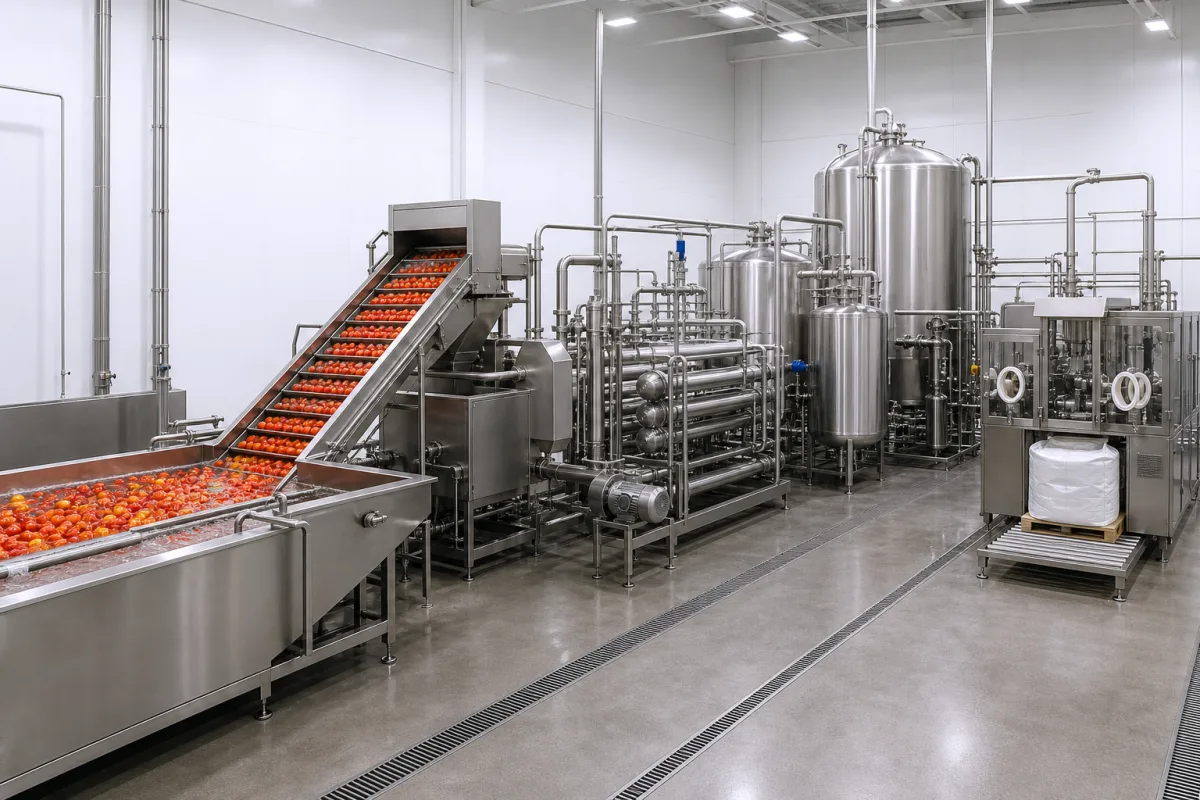
Integrated aseptic line for tomato paste and fruit purées, filled into 220 L drums and 1,000 L bins
Aseptic tomato paste and fruit purée lines that end in bulk bags · washing, hot or cold break, evaporation, a high-pressure tube sterilizer and bag-in-drum or bin fillers
An integrated aseptic fruit and vegetable processing line takes whole tomatoes or fruit from the receiving flume through washing, sorting, chopping and enzyme inactivation, refining, concentration in an evaporator, and then sterilises the concentrate continuously and fills it cold into pre-sterilised bags inside drums or bins. The bulk product is stored at ambient temperature and later reworked into sauces, ketchup or juices. Its difficult steps are heat-treating a thick, uneven paste uniformly and keeping the bag spout sterile while it is filled.
Complete lines and their aseptic end sections for tomato concentrate and fruit or vegetable purées: hot or cold break, evaporation, tube sterilizers for viscous products, and aseptic bag-in-drum, bag-in-bin and bag-in-box fillers. Continuous UHT plants for milk, cream and dairy drinks are covered on the Automated ultra-high temperature sterilization line page.
CNFX editorial research · Sources checked October 12, 2026 · 3 sources
From flume to concentrate: hot or cold break, then up to 50,000 L/h of water evaporated
Tropical Food Machinery of Parma describes its tomato concentrate lines as running from 20 to 1,500 tonnes of fresh tomato a day. [1]
The line is built on one of two enzyme-inactivation routes, a hot break inactivator or a cold break preheater, after which the pulp is concentrated in a forced-circulation evaporator that, depending on line size, evaporates up to 50,000 litres of water per hour; the final section sterilises the concentrate and fills it in an aseptic environment. [1]
The concentration target is set by the product's legal identity. Under 21 CFR 155.191 a tomato concentrate is named tomato purée or pulp at not less than 8.0% but less than 24.0% tomato soluble solids, and tomato paste at not less than 24.0%. Hydrochloric acid may be added before straining to a pH no lower than 2.0, provided it is then neutralised with sodium hydroxide back to pH 4.2 ± 0.2. A concentrate sealed for ambient storage must be processed by heat, before or after sealing, so as to prevent spoilage. [3]
Stage
What the line does
Published figure
Enzyme inactivation
Hot break or cold break, chosen by the paste wanted. [1]
State the fresh tomato or fruit intake per day, the target soluble solids and break type, and the bulk containers the customers accept.
02
Sterilising a thick, uneven paste: concentric-tube heating above 110 °C at more than 100 bar
Paste and purée do not flow evenly, so the sterilizer must heat every part of the stream; Tropical Food Machinery's POSEIDON TCMA plant shows the figures one maker publishes for this duty. [1]
Editorial note: the maker's figures give a maximum temperature and hold, not a process; the time and temperature for a given paste, solids and pH must be set and validated for that product, and FDA's identity rule requires heat processing sufficient to prevent spoilage for ambient storage. [3]
Item
POSEIDON TCMA (Tropical Food Machinery)
Plant
Collection tank, product circulation and filtering, homogeniser, concentric-tube sterilizer. [1]
Heating geometry
Modules of four concentric tubes, heating the product section from inside and outside. [1]
Pressure
Above 100 bar, for uniform treatment of non-homogeneous products such as tomato paste. [1]
Give the sterilizer maker the paste solids, viscosity and particle content, the hourly capacity, and the validated time and temperature the line must hold.
03
Aseptic filling into 220 L drums and 1,000 L bins: steam barriers and heat-sealed spouts
The filler decides whether the sterile product stays sterile in a bag that may sit in a warehouse for months.
Tropical Food Machinery lists aseptic fillers with one or two heads for drums up to 220 L, others for 220 L drums or 1,000 L bins and Goodpacks, and bag-in-box fillers for 3, 5, 10 and 20 L bags, with filling capacities from 1,000 up to 9,000 L/h depending on the filler. [1] Editorial calculation: at 1,000 L/h a 220 L drum takes about 13 minutes to fill and at 9,000 L/h about 88 seconds; a 1,000 L bin at 9,000 L/h takes about 6.7 minutes.
JBT's FranRica ABF1200 aseptic bag filler, which JBT says was conceived to stop spoilage events in the California tomato industry, fills 300-gallon bins or 55-gallon drums with bag-in-box or bag-in-drum containers. It uses an automatic heat-seal fitment to close the bag, a steam barrier on all product-handling areas instead of relying on positive product pressure, chemical-free operation, and JBT states a proven ability to maintain sterility for up to 100 days. [2]
Ask the filler maker how the spout and filling head are sterilised before each bag, how the fitment is closed, what sterility period has been demonstrated and for which product, and what bag and drum sizes it accepts.
04
Line data for an aseptic fruit and vegetable quotation
Paste it into your enquiry below or into an email to a maker, then replace every bracket.
Raw material: [tomato or fruit; tonnes per day; season length]
Product: [paste or purée; target soluble solids; hot or cold break]
Concentration: [water to evaporate per hour]
Sterilization: [capacity kg/h; product viscosity; temperature and hold set by validation]
Filling: [220 L drums; 1,000 L bins; bag-in-box sizes; filling rate]
Utilities: [steam; chilled water; CIP]
Market: [identity standard and labelling for target countries]
Explore company information and manufacturing capabilities, then discuss the scope of your project with a relevant supplier.
Share this page
Compiled and source-reviewed by the CNFX editorial team.
Each manufacturer above links to the page on that company's own website where the product is listed, with the date we checked it. How we source and review
· Page last updated 13 October 2026
Buyer questions
What soluble solids make a tomato concentrate 'paste'?
Under 21 CFR 155.191, tomato paste contains not less than 24.0% tomato soluble solids; between 8.0% and less than 24.0% it is tomato purée or pulp. [3]
What temperature does a tomato paste aseptic sterilizer reach?
Tropical Food Machinery lists a maximum above 110 °C with a hold of up to 60 s and pressures above 100 bar for its concentric-tube POSEIDON TCMA plant. [1]
How long can aseptically filled bulk bags stay sterile?
JBT states its FranRica ABF1200 bag filler has a proven ability to maintain sterility for up to 100 days. [2]
Sources and what still needs a direct check
Sources checked 2026-10-12. Line, sterilizer and filler figures are makers' published data (Tropical Food Machinery, JBT); the product identity limits come from the US FDA standard for tomato concentrates in the eCFR.