Meat processing · Vacuum tumbling time, speed and temperature, protein extraction and binding, added-solution labelling
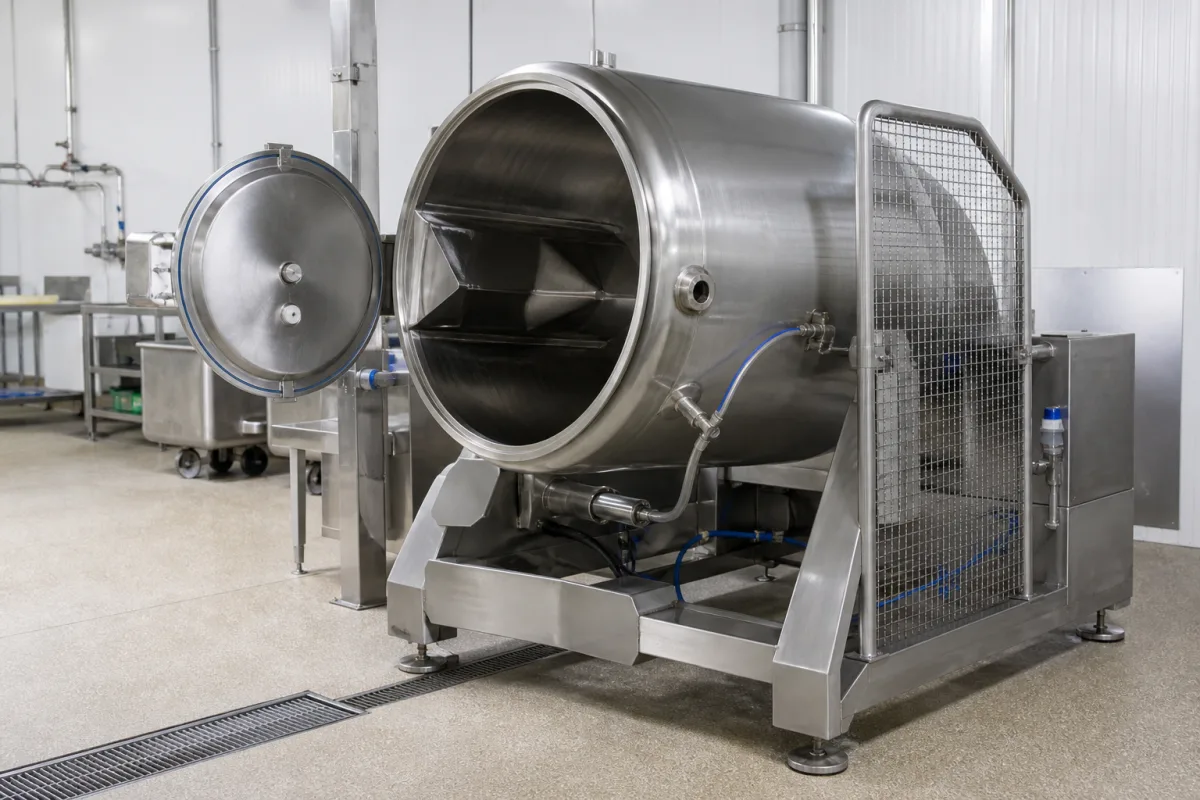
An industrial vacuum tumbler is a rotating stainless-steel drum with internal baffles that lifts and drops meat in a curing solution or marinade under vacuum, working the surface to draw out salt-soluble protein and help the solution penetrate. Ask three things first: what drum speed, vacuum level, time and temperature your product needs, how the machine controls and records them, and how the added solution will be declared on your labels.
Industrial vacuum tumblers and massagers for meat and poultry curing and marinating, batch drums with vacuum and optional cooling. Brine injectors, tenderisers, mixers and cooking equipment are outside this page.
CNFX editorial research · Sources checked October 12, 2026 · 4 sources
Set the tumbling cycle: time, speed, vacuum and temperature
Sharma, Kumar and Nanda (Indian Journal of Animal Sciences, 2002) tumbled 3–4 cm buffalo meat chunks with a 15% (w/w) curing solution for 1, 2 and 3 hours. Continuous tumbling for 3 hours at 11 rpm and 10 ± 2 °C significantly increased salt-soluble protein extraction, giving better binding, cohesiveness and tenderness than untumbled meat or shorter runs, and vacuum tumbling at 0.4 bar for 3 hours at the same speed extracted more protein and bound better than 3 hours of aerobic tumbling. [1]
The same study found that 10 minutes of massaging after 3 hours of vacuum tumbling improved yield, binding and tenderness, and that coarse-mincing half the chunks before massaging reduced gaps in restructured blocks. [1] Editorial note: these settings are for one restructured buffalo product; ask the supplier for trials with your own meat, cut size and solution, and record speed, vacuum, time and product temperature for each batch.
Editorial calculation: 3 hours at 11 rpm is 60 × 3 × 11 = 1,980 drum revolutions, which gives a way to compare recipes run at different speeds.
A 2025 study in Foods by a Fujian Agriculture and Forestry University group marinated beef knuckle slices (35 × 25 × 8 mm) in a reduced-sodium marinade (2.4 % NaCl with potassium lactate, magnesium chloride, calcium ascorbate, lysine and 4 % sorbitol) in a GR-30 vacuum tumbler for 3 h — 30 min tumbling, 10 min rest — at 4 °C, 0.06 MPa and 10 r/min, and compared it with 4 h of static marination at 4 °C. The authors report that vacuum tumbling raised product yield, water content and tenderness over static marination with the same marinade, and reduced the relaxation times of immobilised and free water. [4]
Editorial calculation: a 30-minute tumble plus 10-minute rest is a 40-minute cycle, so 3 h holds 4.5 cycles and about 135 min of rotation, or 135 × 10 = 1,350 revolutions — fewer than the 1,980 of the continuous 11 rpm buffalo schedule above. The study states its vacuum as 0.06 MPa without saying whether this is absolute or below atmosphere, the same ambiguity noted for the patent below, so ask suppliers to state vacuum both ways. [4][1]
Give the supplier the products and cut sizes, batch weight and solution percentage, required vacuum level, speed range, cycle programmes (including intermittent rest periods), product temperature limits and whether drum cooling is needed, loading and unloading method, cleaning, and electrical supply.
02
Declare the added solution on the label
Under US 9 CFR 317.2(e)(2), the product name for a raw meat product that contains added solution and does not meet a standard of identity must include the percentage of added solution, calculated as the total weight of the solution ingredients divided by the weight of the raw meat without solution or other added ingredients, times 100, shown as a number with the % symbol, for example 'contains 15% added solution of water and salt'. [2]
The designation must list the solution's ingredients in descending order of weight, be printed in a single easy-to-read style and colour on a contrasting background with lower-case letters at least one-third the size of the largest letter, and may not use the word 'enhanced' in the product name. [2]
Editorial calculation: 100 kg of raw meat that retains 15 kg of solution after tumbling carries 15 kg / 100 kg × 100 = 15% added solution; this is the retained, not the charged, amount, so weigh before and after. [2]
03
Decide between baffled and smooth drums and pulsed vacuum
US patent 6,040,013 (Vacuum tumbling of meats and other foods) contrasts conventional vacuum tumblers, whose baffles lift meat above the drum axis and drop it onto other pieces, with a smooth baffle-free drum in which the vacuum pump keeps drawing gas during tumbling so that pieces roll over each other. It states that baffles can cut meat, mark skin and break bones away from bone-in product, and that its method gives greater pick-up (weight gain divided by weight before treatment, in percent) in about half the conventional treatment time. [3]
For large pieces of five pounds or more (hams, large pork pieces, bone-in turkey) the patent describes pulsing: tumble at a first pressure P1, then stop rotation and rest at a second pressure P2, each interval about 20 minutes, repeated for about four hours. Its examples give P1 as 24 mm of mercury and P2 as 12 mm of mercury, while describing P2 as the higher pressure, so confirm whether a supplier's settings are absolute pressure or vacuum below atmosphere. [3]
Editorial calculation: 20-minute tumble and 20-minute rest intervals over four hours give six tumble–rest cycles.
Product in the patent's single-batch examples
Treatment time stated
Seafood
About 10 min
Boneless poultry
About 15 min
Bone-in poultry
About 25 min
Thick steaks, roasts and pork
About 25 min
Bone-in red meats and pork
About 35 min
Ask whether the drum is baffled or smooth, whether the controller supports pulsed vacuum with rest periods, and how vacuum is displayed (absolute pressure or gauge vacuum).
04
Tumblers, marinators and injectors on the linked listings
Listings include vacuum tumblers and marinators in a range of drum sizes, sometimes alongside injectors and other meat-processing machines.
05
Drum, vacuum pump, drive and cooling in a meat tumbler
Batch volume, rpm and vacuum programme per product run
The only published settings here come from the buffalo-meat study, the beef study and the patent; drum capacity, motor power and dimensions come from the supplier for your batch size.
Expro lists its BVRJ vacuum tumbler series with marinating machines; VER Food Solutions lists vacuum tumblers and marinators; Aokai, GEMS and Taibo list tumblers within wider food machine ranges.
Explore company information and manufacturing capabilities, then discuss the scope of your project with a relevant supplier.
Share this page
Compiled and source-reviewed by the CNFX editorial team.
Each manufacturer above links to the page on that company's own website where the product is listed, with the date we checked it. How we source and review
· Page last updated 13 October 2026
Buyer questions
How long should meat be vacuum tumbled?
It depends on the product; in an ICAR study of restructured buffalo meat, 3 hours at 11 rpm and 10 ± 2 °C extracted the highest salt-soluble protein. [1]
Is vacuum tumbling better than open tumbling?
In that study, vacuum tumbling at 0.4 bar gave better protein extraction, binding and cohesiveness than 3 hours of aerobic tumbling. [1]
How is added solution declared on US labels?
9 CFR 317.2 requires the percentage of added solution, by weight of the raw meat, and the solution ingredients in the product name. [2]
Do vacuum tumblers need baffles?
Not necessarily: US patent 6,040,013 describes a smooth, baffle-free drum with continuous vacuum pumping that it says gives greater pick-up in about half the time without mechanical damage. [3]
What tumbling cycle did a recent beef marination study use?
3 h at 4 °C, 0.06 MPa and 10 r/min, tumbling 30 min and resting 10 min, which raised yield and tenderness over 4 h of static marination. [4]
Sources and what still needs a direct check
Sources checked 2026-10-12. The ICAR study (buffalo meat) and the 2025 Foods study (beef) are peer-reviewed research on single products; US patent 6,040,013 describes one inventor's drum and pulsing method; 9 CFR 317.2 is the US labelling regulation and other markets have their own rules.