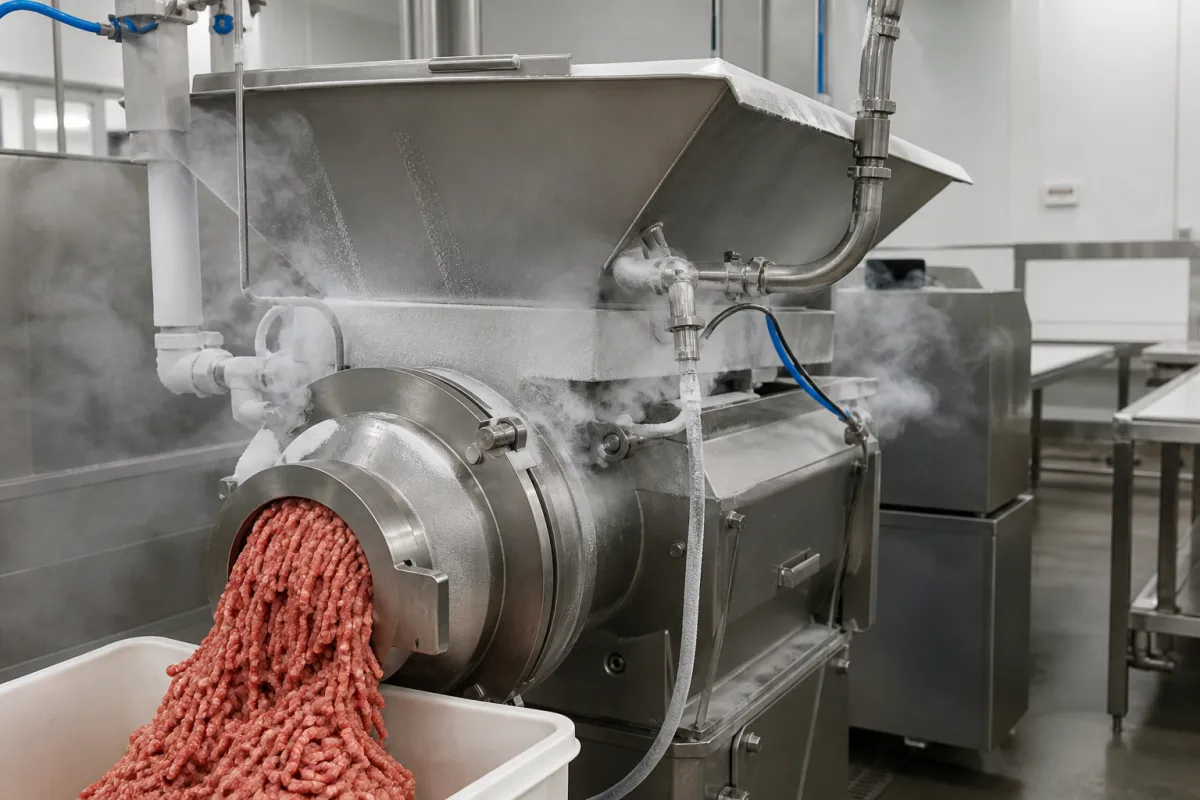
Industrial meat grinders and mixer-grinders with liquid nitrogen or CO2 injection · bottom or top cryogen injection to remove friction heat and hold product temperature before forming, oxygen-deficiency and frostbite hazards of the cryogens, CO2 exposure limits, and US record-keeping for raw ground beef lots and grinder cleaning
This equipment is a production meat grinder, or a mixer-grinder, fitted with nozzles that inject liquid nitrogen or carbon dioxide into the product so that heat from friction and mechanical work is removed before forming. Ask three things first: which cryogen and injection arrangement suits your products and plant, what temperature and throughput you need, and how the room will be ventilated and monitored for oxygen deficiency and carbon dioxide.
Industrial meat grinders, mixers and mixer-grinders with liquid nitrogen or carbon dioxide injection, and the injection, control and exhaust systems fitted to them. Bowl cutters, emulsifiers, tunnel freezers and forming machines are outside this page except where compared.
CNFX editorial research · Sources checked October 12, 2026 · 4 sources
Air Products describes its bottom injection cooling systems as delivering liquid nitrogen or carbon dioxide to a blender, mixer or grinder during mixing, blending or grinding. The aim is to remove heat from friction and mechanical energy, or to cool products before forming. Its examples include chilling ground meat before forming patties and marinated chicken before forming nuggets. The company states the systems bring product within ½ degree of the desired temperature. [1]
The brochure says the systems can be configured for bottom or top injection, with the company recommending bottom injection for efficiency, and can be retrofitted to new or existing mixers, blenders or stainless steel vessels. Nozzle number, arrangement and configuration are engineered for the specific equipment, and the full package includes recipe functions, exhaust systems, safety controls and clean-in-place. [1]
Air Products describes an optional analytics platform that keeps daily records of production, helps troubleshoot issues and tracks equipment performance, and says precise temperature control and cryogen consumption are achieved through a choice of modular control schemes. Ask any supplier which control scheme is offered, which signals are logged, and whether the logs can be kept with the lot and cleaning records the plant must hold. [1][4]
Give the supplier the grinder or mixer model and capacity, the products and recipes, the target product temperature, the cryogen (liquid nitrogen or CO2) and supply arrangement, the cleaning method, the room size and ventilation, gas detection, and the food safety and workplace rules that apply.
02
Control gas hazards and keep grinding records
The ILO International Chemical Safety Card for liquefied nitrogen (ICSC 1199) gives a boiling point of −196 °C and warns that the liquid may cause frostbite. On loss of containment it can cause serious risk of suffocation in confined areas, and high concentrations in air cause oxygen deficiency with risk of unconsciousness or death; it advises checking oxygen content before entering. [2] The card for carbon dioxide (ICSC 0021) gives a sublimation point of −78.5 °C, the same suffocation warning, and occupational limits of TLV 5,000 ppm as TWA and 30,000 ppm as STEL. [3]
The carbon dioxide card adds that rapid evaporation of the liquid may cause frostbite, that inhalation of high levels may affect multiple organs and cause acidosis, and that high concentrations could cause asphyxiation. It gives a relative vapour density of 1.5 (air = 1). Editorial note: because CO2 is heavier than air on that figure, place detectors and exhaust intakes with the low points of the room, pits and floor drains in mind, and ask the supplier where its exhaust draws from. [3]
For raw ground beef, US rule 9 CFR 320.1(b)(4) requires official establishments and retail stores to keep records for each lot. Records cover supplier establishment numbers, lot numbers and production dates, the names of supplied materials including carry-over, the date and time each lot is produced, and the date and time grinding equipment and other food-contact surfaces are cleaned and sanitised. A lot is the ground beef produced between clean-ups from the same source materials. [4]
The same rule applies to official establishments and retail stores that grind beef at an individual customer's request, so a grinder sold for a retail or butcher setting falls under the same record keeping. Because a lot runs from one clean-up to the next with the same source materials, the cleaning interval of the grinder sets the size of each lot for traceability. [4]
03
Hopper and auger, injection nozzles, temperature control, exhaust and cleaning
The nozzles and exhaust are what turn a standard grinder into this product: Air Products engineers nozzle number and layout per machine, and the ILO cards explain why the released gas has to be taken out of the room. [1][2]
Component
Role
Fix in the order
Feed hopper and auger
Carry meat to the grinding head; the mixer, blender or grinder receives the cryogen. [1]
Capacity, speed range, injection point.
Cryogen injection nozzles
Inject liquid nitrogen or CO2 at the bottom or top; number and layout engineered per machine. [1]
Nozzle count, position and cryogen.
Temperature control
Brings product to the target temperature through a control scheme. [1]
Sensor type, control accuracy, logging.
Exhaust and safety controls
Remove gas from the work area; cryogens cause oxygen deficiency on release. [1][2][3]
Exhaust rate, O2 and CO2 monitoring, interlocks.
Cleaning provisions
Grinding equipment cleaning and sanitising times must be recorded for ground beef lots (US). [4][1]
CIP or manual cleaning, record keeping.
04
Cryogen, injection point, temperature control, gas safety and lot records for a grinder quotation
The temperature row carries the only performance figure, Air Products' claim of holding product within ½ degree of target; ask for the accuracy measured on your own product and recipe. [1]
Explore company information and manufacturing capabilities, then discuss the scope of your project with a relevant supplier.
Share this page
Compiled and source-reviewed by the CNFX editorial team.
Each manufacturer above links to the page on that company's own website where the product is listed, with the date we checked it. How we source and review
· Page last updated 13 October 2026
Buyer questions
Why inject liquid nitrogen or CO2 while grinding meat?
To remove heat from friction and mechanical work and bring the product to the desired temperature before forming, according to Air Products' description of its injection systems. [1]
What are the hazards of cryogens in a grinding room?
ILO safety cards warn of frostbite and of suffocation in confined areas on loss of containment; CO2 has limits of 5,000 ppm TWA and 30,000 ppm STEL. [2][3]
What grinding records does US law require for ground beef?
9 CFR 320.1(b)(4) requires lot records of source materials and the date and time of production and of grinder cleaning and sanitising. [4]
Sources and what still needs a direct check
Sources checked 2026-10-12. The Air Products brochure (2021) is read from an Internet Archive copy. The ILO cards are international chemical safety cards. The eCFR section is the current US meat inspection record rule.