Mold Conveyor System
View system integration details
This page explains how Mold Carriers/Fixtures is classified within Rubber and Plastic Product Manufacturing. Technical values and manufacturer relationships are research references; confirm the current specification and supplier evidence for each order.
Precision components that securely hold and transport molds within automated conveyor systems during rubber and plastic manufacturing.
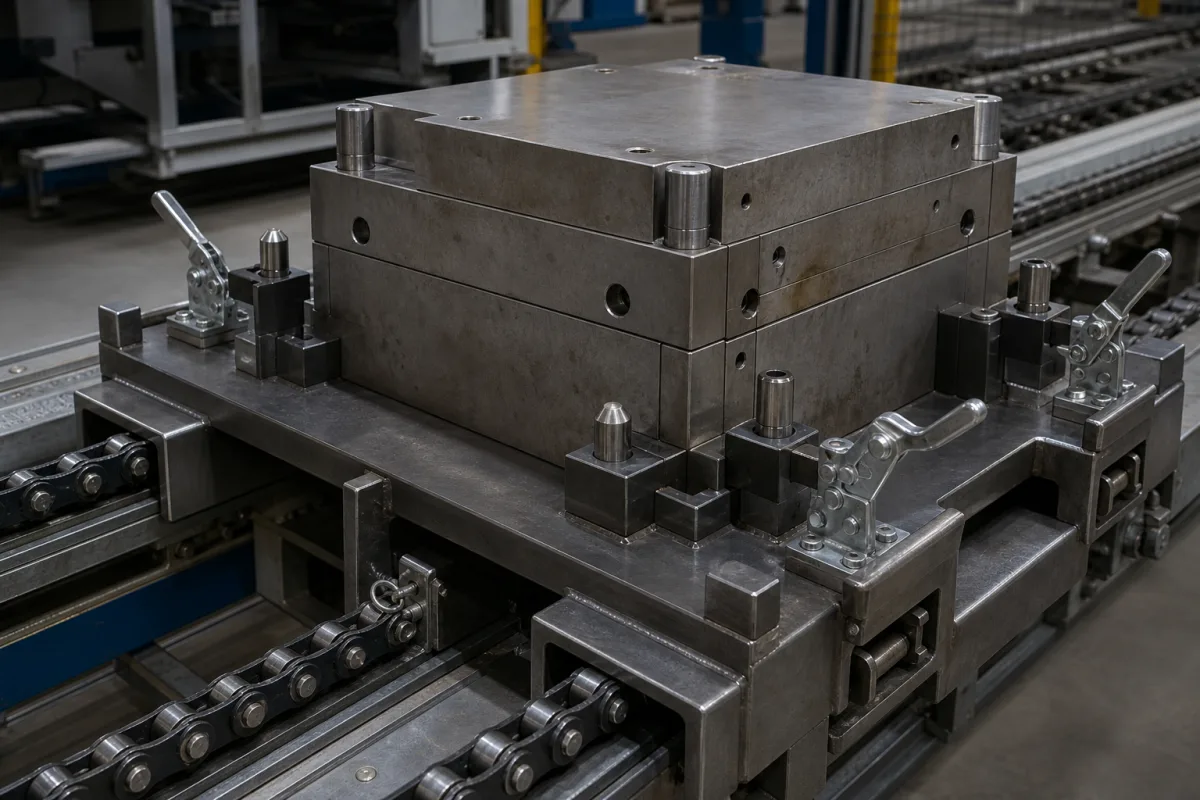
Technical details and manufacturing context for Mold Carriers/Fixtures
| Parameter | Typical range | Notes & selection driver |
|---|---|---|
| Load Capacity | 500–5000 kg | Maximum mold weight the carrier can support |
| Mold Size Range | 200–1200 mm | Compatible mold width or diameter |
| Positioning Accuracy | ±0.05 mm | Repeatability for mold alignment |
| Operating Temperature | -20–80 °C | Continuous operation range |
| Electrical Supply | 24 ±10% V DC | For sensors and actuators |
| Ingress Protection | IP54–IP65 | Dust and water resistanceIEC 60529 |
| Material Grade | S45C–S55C | Carbon steel for structural partsJIS G4051 |
| Surface Hardness | HRC 40–50 | Induction hardened for wear resistance |
| Weight | 50–300 kg | Affects conveyor load and handling |
| Clamping Force | 10–50 kN | Holds mold securely during transport |
| Repeatability | ±0.02 mm | For automated mold change systems |
Ranges are indicative industry figures for RFQ preparation, not a supplier commitment. Confirm every value and standard with the legal manufacturer before ordering.
Commonly used trade names and technical identifiers for Mold Carriers/Fixtures.
This component is essential for the following industrial systems and equipment:
| pressure: | Max 10 bar (145 psi) |
| other spec: | Max mold weight: 5000 kg, Vibration tolerance: ≤ 0.5g RMS |
| temperature: | -20°C to +80°C |
Indicative industry ranges for design and RFQ preparation. Confirm the exact figures and applicable standard with the manufacturer before specifying.
Quoted from the published standard.
Manufacturer profiles associated with Mold Carriers/Fixtures.
Manufacturer listings support early research and capability understanding. They are not certification, ranking, or transaction guarantees.
A practical evidence checklist for RFQ preparation and supplier evaluation.
CNFX does not score or rank suppliers. Buyers must verify all claims and documents with the legal manufacturer before ordering.
According to directory data, load capacity ranges from 500 to 5000 kg. However, the exact capacity depends on the specific model and application. Always verify with the manufacturer.
Common materials include carbon steel, stainless steel, and aluminum alloy. For structural parts, carbon steel grades such as S45C to S55C (JIS G4051) are often used, with induction hardening for wear resistance.
Precision alignment features and repeatable clamping mechanisms provide positioning accuracy of ±0.05 mm and repeatability of ±0.02 mm for automated systems. These values are reference ranges and should be confirmed for specific models.
Standards such as protection are referenced. However, compliance must be verified with the manufacturer for each product.
Editorial classification, named public sources where available, and source-reviewed manufacturer records.
Ask for use case, specification boundaries, supplier type, and RFQ preparation information for this product.
Compare manufacturer profiles with relevant product and process capability.