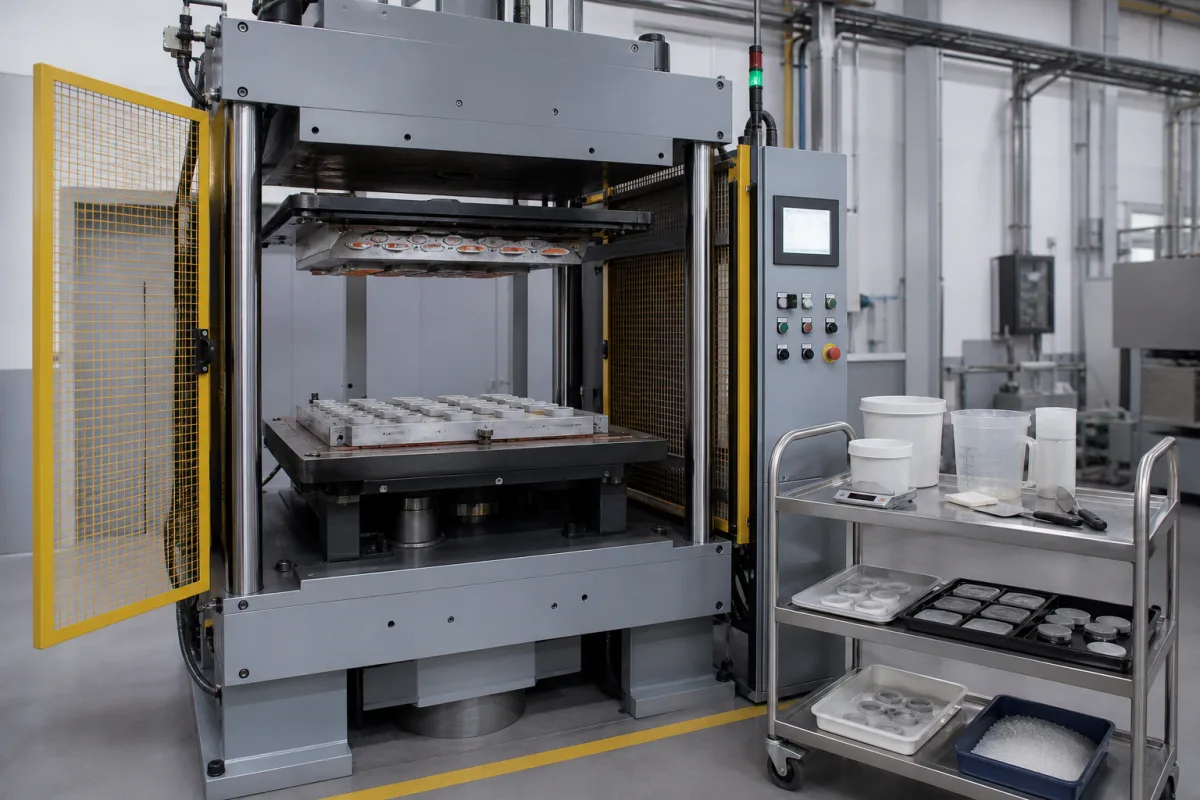
A heated platen press for molding solid silicone rubber
Select the compound and mold before fixing the press cycle. The press must accommodate the tool, apply the required clamp force and reproduce the agreed temperature and movement sequence. Validate the finished part on that combination rather than ordering from a nominal platen size or temperature range alone.
Heated platen compression presses that mold solid/high-consistency silicone rubber in charged molds, including hydraulic drive, platen heating, cycle controls and tool-handling interfaces. Two-part LSR injection cells are covered on page 202; separate post-cure ovens on 216; electrically heated platens as components on 4701 and fluid-heated platens on 2781. Transfer/injection units and complete product-manufacturing lines are separate supply scopes. General-purpose hydraulic press frame and movement selection is covered on page 192.
CNFX editorial research · Sources checked October 19, 2026 · 3 sources
Compression molding starts with a measured charge in the mold
WACKER’s October 2025 processing guide describes compression molding of solid silicone rubber, with a weighed charge in each cavity and vulcanization by heat and pressure. Its next section distinguishes transfer molding, where a plunger forces material from a pot through a runner. Specify which process the proposed machine will perform. [1]
Provide the exact compound grade and cure system, part drawing, cavity count, charge preparation and mold-loading method. Define inserts, vents, release requirements and the intended removal method with the toolmaker. These establish what the press has to hold, move and control.
French’s TMP series article separately identifies Econo-Tech RC compression presses, Econo-Jet RIVH injection presses and Vacu-Jet vacuum-assisted presses. A family offered for silicone processing can contain different molding routes; name the actual machine and process in the quotation. [2]
02
Clamp force and mold geometry must fit the same machine
French describes Econo-Tech RC compression presses with dual mold plates and capacities from 200 to 600 tons. This is a series description, not a selected mold/force combination. Confirm the force unit, usable force and plate/tool arrangement for the quoted machine. [2]
Specify clamp force separately from hydraulic-circuit pressure and pressure on a defined mold area. Obtain the press designer’s force and stiffness assessment for the actual mold, projected area, cavity arrangement and cure process. A hydraulic gauge reading is not a mold-cavity pressure measurement.
Check platen mounting, tool height, daylight, stroke, loading access, opening/ejection clearance and support for any sliding mold arrangement. State whether the press includes the mold, loading equipment and demolding provisions.
Function group
Define for the press and tool
Hydraulic drive
Required clamp-force range, movement/hold sequence and monitoring.
Heated platens
Usable area, mounting, heating zones, sensing and mold temperature verification.
Programmable controller / operator interface
Recipes, sequence, process records, access and line interfaces.
Guards and protective functions
Tool/loading access, interlocks, stopping behaviour and documented assessment of the supplied arrangement.
Platen control and material cure are separate acceptance questions
WACKER discusses about 150–200 °C mold temperature for the specified C1/C6 peroxide mixtures and platinum-catalyzed solid silicone. It ties vulcanization time to material temperature, mold temperature and part thickness. Qualify the selected grade and part; that process discussion is not a universal press cycle. [1]
Wabash’s Genesis page lists programmable cycle control and automatic transfer from closing to pressing speed. Heated platens, PID temperature controllers and an automatic bump/breathe sequence appear among configurable options. Establish which controls and thermal functions are included in the offer. [3]
Agree sensor locations, mold/platen measurement points, warm-up and loaded conditions for temperature uniformity. Separate controller stability, platen-surface mapping and actual part-cure acceptance. Run the agreed loading, cure, opening and removal sequence with production tooling before accepting cycle output.
04
Define press handover and the downstream finishing boundary
WACKER describes post-curing as a later treatment used to improve properties and remove volatiles, with requirements depending on the material and application. Identify that operation separately from primary molding and obtain the compound supplier’s applicable instructions. [1]
A press or material trade name does not establish the finished article’s suitability for body contact or another regulated application. Assign responsibility for compound documentation, processing records and finished-part acceptance to the relevant suppliers and product manufacturer.
Obtain the actual machine’s documentation and agreed functional acceptance, including the selected guard/tool-handling arrangement. Wabash lists CE and UL certifications as available options; a range-page statement does not establish the documentation supplied with a particular order. [3]
Press field
Settle for the selected mold and compound
Molding force (ton-force)
Specify clamp force and its unit/basis; hydraulic pressure and cavity pressure are different quantities.
Platen size (mm)
Usable area, mounting pattern and the mold arrangement approved at the required force.
Temperature range (°C)
Equipment limits and the validated mold/process window for the named compound.
Cycle time (s)
Complete accepted cycle including loading, cure, movement and removal; specify automation and test conditions.
Platen flatness (mm)
Drawing tolerance, datum, measurement area and thermal/load condition.
Temperature uniformity (°C)
Measurement points and allowed variation under the agreed operating condition.
Heating power (kW)
Installed zones, warm-up duty, utilities and actual supplied equipment.
Power supply (V AC)
Voltage, phases, frequency and auxiliary connections for the ordered configuration.
Control system
Recipe functions, monitoring, records, interfaces and included options. [3]
Safety functions
Supplied access/guarding arrangement, protective-function documentation and functional acceptance.
Machine weight (kg)
Installed mass, tool and handling loads, support and lifting requirements.
Footprint (mm)
General arrangement with charging, tool-change, service and utility clearances.
Mold accommodation
Tool height, daylight, stroke, opening/ejection space and included mounting/handling equipment.
05
Send the compound, mold drawing and complete molding sequence
Paste it into your enquiry below or into an email to a maker, then replace every bracket.
Explore company information and manufacturing capabilities, then discuss the scope of your project with a relevant supplier.
Share this page
Compiled and source-reviewed by the CNFX editorial team.
Define mould and silicone-compound requirements, platen/heating conditions and press controls, with cure-process acceptance agreed on the intended moulded parts. How we source and review
· Page last updated 19 October 2026
Buyer questions
Is a compression press the same process as a two-part LSR injection cell?
WACKER distinguishes solid-rubber compression molding from injection routes. Specify the compound form and how the mold is filled. [1]
Does the TMP series name establish the molding route?
French’s article includes separately named compression, injection and vacuum-assisted machines. Identify the exact quoted machine and process. [2]
Are heated platens and all cycle functions automatically included?
Wabash lists thermal and sequence functions among configurable options. Obtain an itemized configuration and acceptance scope. [3]
Sources and what still needs a direct check
Sources checked 2026-10-19. WACKER’s October 2025 guide explains solid-silicone processing and later post-curing. French and Wabash describe press families and configurable equipment. These sources do not establish a finished product’s body-contact suitability, a universal cure cycle or certification of an unidentified press.