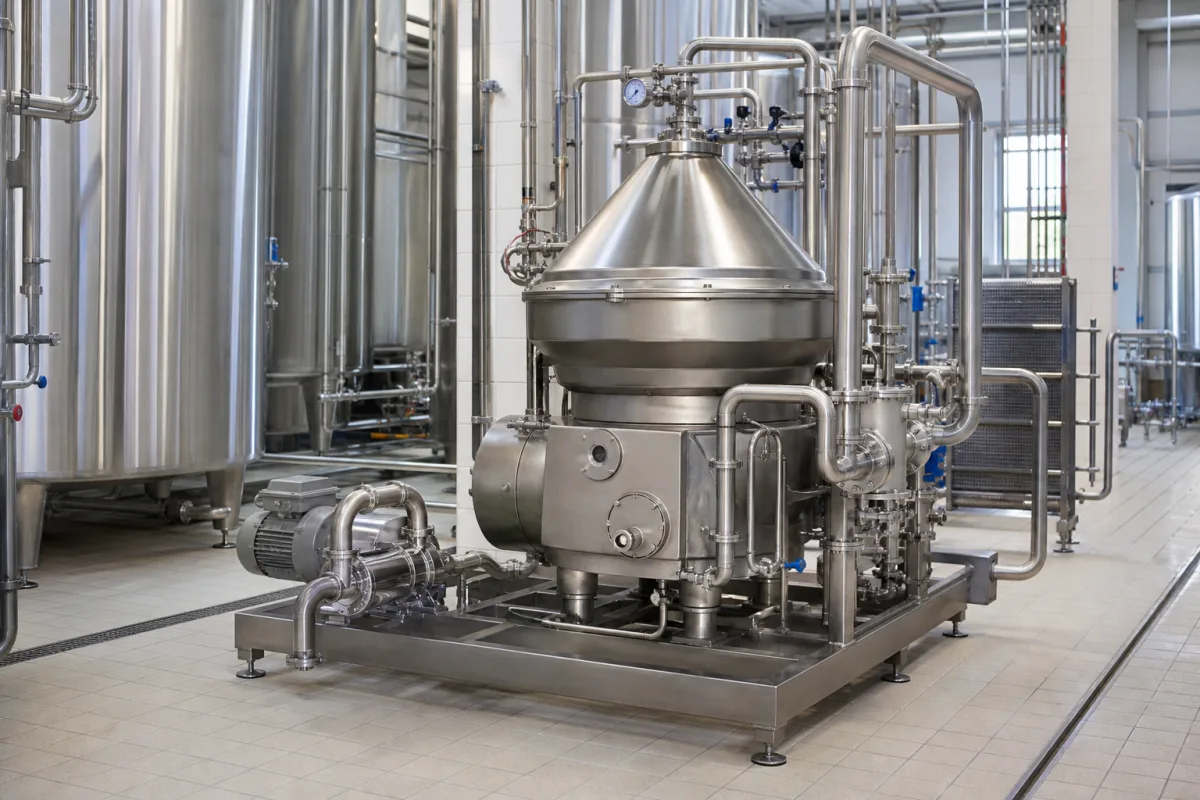
Hot wort and trub separation in the brewhouse · Self-cleaning disc-stack separators against whirlpools, hot-wort and trub-wort capacities in hl/h, inlet and outlet solids, oxygen pick-up, automatic solids discharge, CIP and materials
An automated wort clarification separator is a self-cleaning disc-stack centrifuge in the brewhouse that removes hot trub — coagulated protein, polyphenol complexes and hop and grain debris — from boiled wort before it is cooled, either on the full wort stream or on the trub-rich wort left in a whirlpool, discharging the solids automatically while the clarified wort goes on to the cooler. Ask three things first: whether it replaces or supports a whirlpool, what flow in hectolitres per hour and how much trub it must handle, and what clarity, oxygen pick-up and cleaning regime the brewery requires.
Disc-stack centrifugal separators used to clarify hot wort and recover wort from trub in breweries, with their feed, discharge, control and CIP equipment, compared with whirlpool vessels. Beer clarifiers used after fermentation, decanters for spent grain, lauter tuns and wort coolers are outside this page except where compared; for disc-stack design see disc stacks and disc stack separators.
CNFX editorial research · Sources checked October 11, 2026 · 4 sources
Decide what the separator does beside the whirlpool
A brewing handbook from Apex Publishers explains that boiled wort carries hot break (coagulated proteins and polyphenol-protein complexes) with hop and grain debris amounting to about 1–1.5 kg of wet solids per hL of wort, depending on wort strength and hopping, and should be clarified hot, before cooling, by sedimentation, whirlpool, centrifuge or a combined kettle-whirlpool; it calls the whirlpool the method of choice where pellets or extracts are used, warns that trub carried into fermentation gives vegetable flavours and can coat the yeast, and says a centrifuge does not guarantee better hot-break removal than a whirlpool but gives a more consistent turbidity, with a strainer ahead of it if the wort is heavily hopped because hop solids are abrasive. [3]
GEA describes its WORTSTAR Whirl system as separating hot wort into liquid and sediment by fluid dynamics and vessel geometry, removing between 95% and 99% of hot trub, with a specially shaped base and an automated trub removal system. [2]
SPX Seital lists two hot-side duties for its brewery clarifiers: hot wort, with inlet solids below 1.5% v/v and outlet below 0.05% v/v, and trub wort, with inlet below 15% v/v and outlet below 0.2% v/v — the second being wort recovered from the trub-rich fraction. [1]
Editorial calculation: at 1–1.5 kg/hL, a 200 hL brew carries about 200–300 kg of wet trub; size the separator's solids space and discharge frequency, or the whirlpool's trub handling, for that load. [3]
Give the supplier the brew length in hL and brews per day, cast-out time, wort gravity and hopping (whole hops, pellets, extract), whether the separator treats full hot wort or trub wort from the whirlpool, expected trub load, target outlet turbidity or solids, wort temperature, oxygen pick-up limit, CIP regime, utilities (water for bowl operation, power, air), and the control system interface.
02
Size capacity, solids discharge and hygiene
Seital's capacity table rates its hermetic clarifiers on hot wort from 15 hl/h (SE101) through 45 (SE111), 50 (SE161), 140 (SE201), 200 (SE301), 250 (SE401), 290 (SE451), 330 (SE501) and 400 (SE601) to 530 hl/h (SE701), and on trub wort from 3 hl/h (SE101) to 120 hl/h (SE601), noting that real capacity depends on the product and the degree of clarification required. [1]
The brochure lists hermetic design with oxygen pick-up below 10 ppb (typ.), soft feeding and discharge, product recirculation to limit outlet turbidity, an electromagnetic flow meter, fast and precise solids discharge on a time basis or by measured turbidity, extra CIP spray nozzles in the bowl cover, bowl main parts in duplex and super-duplex stainless steel, vibration monitoring with pneumatic or electric fast braking for unattended operation, and a bowl comprising product inlet, distributor, disc stack, centrifugal pump, clarified outlet, sludge chamber, ejecting ports and a sliding piston operated by opening and closing water. [1]
Editorial calculation: on a model rated 140 hl/h for hot wort, a 200 hL brew takes about 200 ÷ 140 ≈ 1.4 h at full rating; compare this with the brewhouse cycle and cast-out time, and confirm the achievable rate at your trub load. [1]
03
Whirlpool, hot-wort separator, trub-wort separator or settling tank
The whirlpool and the hot-wort separator are alternatives on the full stream; the trub-wort duty works on the trub-rich fraction, so a separator can run behind a whirlpool. [3][1]
Method
How it separates
Points to check
Whirlpool vessel
Rotation and geometry settle trub into a cone. [3][2]
Seital's trub-wort duty above treats the trub-rich fraction with a disc-stack clarifier at up to 15% v/v inlet solids. Flottweg describes the alternative of a decanter centrifuge on the whirlpool trub. It states that hot trub settled in the whirlpool still contains 70–85% wort, and that its decanter removes up to 99% of the solids so the wort can be returned to the process; elsewhere on the same page it gives recovery of up to 98 percent of the liquid wort from the separated hot trub. The decanter has an adjustable impeller to adapt to varying solid loads and hopping rates, including late- and dry-hopped beers. [4][1]
Flottweg argues that, compared with disc centrifuges, the decanter handles highly concentrated trub, which leads to lower volume flows, reduced energy consumption and less maintenance, and that removing hops and trub relieves an overloaded whirlpool and shortens residence time. On the cold side it lists the same machine type for dry-hopped beer, removing up to 99% of hop particles and recovering up to 97% of the beer volume, and its Sedicanter for yeast, separating yeast with an efficiency of over 98% without dilution. [4]
Editorial calculation: the handbook's 1–1.5 kg of wet trub per hL gives 200–300 kg on a 200 hL brew; at 70–85% wort that is about 140–255 kg of wort, or roughly 1.3–2.4 hL at an assumed wort density of 1.05 kg/L, before applying the decanter's recovery. Use your own trub load and wort gravity when comparing a decanter on trub with a disc-stack separator on the full hot-wort stream. [3][4]
Adjustable impeller for solid load and hopping rate [4]
05
Bowl, disc stack, sliding piston, discharge pump and CIP nozzles of a hermetic wort clarifier
Every row is taken from the bowl and machine description in Seital's brochure; the sliding piston, moved by opening and closing water, is what releases the trub through the ejection ports. [1]
Hot-wort and trub-wort rates, outlet solids, discharge volume and bowl materials
Flow rate and separation efficiency are the rows with published numbers; size the solids discharge against the handbook's 1–1.5 kg of wet trub per hL. [1][3]
Field
What it means and published values
Ask the supplier for
Maximum flow rate
15–530 hl/h hot wort; 3–120 hl/h trub wort across one range. [1]
Huading's announcement names hot and cold wort separation among the uses of its PLC disc stack separator for breweries.
Huading Separator
Manufacturing site to be confirmed for the order
Announces a PLC disc stack separator for the brewing industry, listing hot and cold wort separation, green beer clarification and beer recovery among its uses.
Explore company information and manufacturing capabilities, then discuss the scope of your project with a relevant supplier.
Share this page
Compiled and source-reviewed by the CNFX editorial team.
Each manufacturer above links to the page on that company's own website where the product is listed, with the date we checked it. How we source and review
· Page last updated 13 October 2026
Buyer questions
Does a centrifuge remove hot trub better than a whirlpool?
A brewing handbook says it does not guarantee better hot-break removal but gives a more consistent turbidity; GEA cites 95–99% trub removal for its whirlpool system. [3][2]
How clear is wort after a hot-wort separator?
One maker rates hot wort from below 1.5% v/v solids at the inlet to below 0.05% v/v at the outlet. [1]
How much trub must be removed?
About 1–1.5 kg of wet solids per hL of wort, depending on wort strength and hopping. [3]
How much wort is left in whirlpool trub?
Flottweg states that hot trub settled in the whirlpool still contains 70–85% wort, and that its decanter recovers up to 98 percent of the liquid wort from it. [4]
Sources and what still needs a direct check
Sources checked 2026-10-11. The Seital brochure, GEA page and Flottweg application page describe their own equipment and the handbook excerpt describes brewing practice; capacity and clarity for your wort must come from the supplier offered.