Industry-Verified Manufacturing Data (2026)

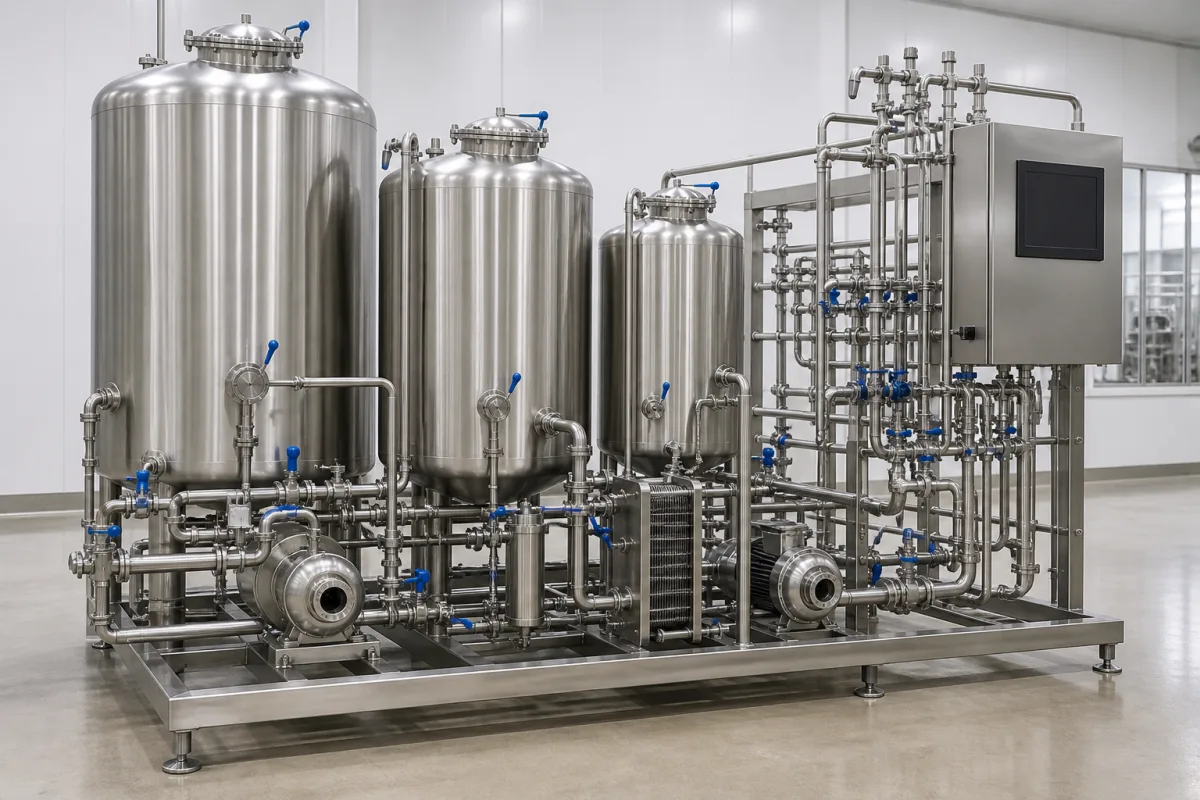
CIP (Clean-in-Place) System

Based on aggregated insights from multiple verified factory profiles within the CNFX directory, the standard CIP (Clean-in-Place) System used in the Food Manufacturing sector typically supports operational capacities ranging from standard industrial configurations to heavy-duty production requirements.

Technical Definition & Core Assembly

A canonical CIP (Clean-in-Place) System is characterized by the integration of Cleaning Solution Tanks and Circulation Pumps. In industrial production environments, manufacturers listed on CNFX commonly emphasize Stainless Steel 316L construction to support stable, high-cycle operation across diverse manufacturing scenarios.

Automated cleaning system that cleans processing equipment without disassembly

Product Specifications

Technical details and manufacturing context for CIP (Clean-in-Place) System

Definition
A critical component of the Integrated Aseptic Fruit and Vegetable Processing Line that performs automated cleaning and sanitization of processing equipment, piping, and vessels in their installed positions, ensuring aseptic conditions and preventing cross-contamination between production batches.
Working Principle
Uses programmed cycles of cleaning solutions (detergents, sanitizers) and rinse water circulated through the processing equipment at controlled temperatures, pressures, and flow rates to remove soil, microorganisms, and residues without requiring equipment disassembly.
Common Materials
Stainless Steel 316L
Technical Parameters
  • Flow rate capacity for cleaning solution circulation (L/min) Customizable
Components / BOM
  • Cleaning Solution Tanks
    Store and heat cleaning chemicals and rinse water
    Material: Stainless Steel 316L
  • Circulation Pumps
    Provide pressure for solution flow through equipment
    Material: Stainless Steel 316L
  • Spray Balls/Nozzles
    Distribute cleaning solutions inside tanks and vessels
    Material: Stainless Steel 316L
  • Control Panel
    Program and monitor cleaning cycles and parameters
    Material: Stainless Steel/IP65 Enclosure
Engineering Reasoning
1.5-6.0 bar (21.8-87.0 psi) at 60-85°C
Pressure drop below 1.0 bar or exceeding 7.0 bar at 85°C
Design Rationale: Cavitation-induced erosion at low pressure (below vapor pressure of cleaning solution at operating temperature) and material fatigue from cyclic pressure loading exceeding yield strength of 316L stainless steel (205 MPa)
Risk Mitigation (FMEA)
Trigger Calcium carbonate scaling accumulation exceeding 2 mm thickness on heat exchanger surfaces
Mode: Heat transfer coefficient reduction from 850 W/m²·K to below 300 W/m²·K
Strategy: Integrate citric acid injection system with conductivity monitoring to maintain pH below 4.5 during cleaning cycles
Trigger Air ingress through pump seals during low-pressure cycles
Mode: Two-phase flow causing 40% reduction in cleaning solution velocity and incomplete surface coverage
Strategy: Install vacuum degassing system maintaining dissolved oxygen below 2 ppm and positive pressure control during all operational phases

Industry Taxonomies & Aliases

Commonly used trade names and technical identifiers for CIP (Clean-in-Place) System.

Industrial Ecosystem & Supply Chain DNA

Complementary Systems
Downstream Applications
Specialized Tooling

Application Fit & Sizing Matrix

Operational Limits
pressure: Standard: 3-6 bar (45-90 psi), High-pressure: up to 10 bar (150 psi)
flow rate: 50-500 L/min (13-132 gal/min) depending on pipe diameter and pump capacity
temperature: Typically 20°C to 85°C (68°F to 185°F), with high-temperature models up to 140°C (284°F)
slurry concentration: Up to 5% solids by weight for standard systems, specialized models up to 15%
Media Compatibility
✓ Food and beverage processing lines ✓ Pharmaceutical manufacturing equipment ✓ Dairy processing tanks and piping
Unsuitable: Highly corrosive chemical environments without specialized corrosion-resistant materials
Sizing Data Required
  • Total system volume to be cleaned (L or gal)
  • Required cleaning cycle time (minutes)
  • Pipe diameter and circuit complexity (number of bends, valves, etc.)

Reliability & Engineering Risk Analysis

Failure Mode & Root Cause
Cavitation in pumps
Cause: Insufficient NPSH (Net Positive Suction Head) due to improper pump sizing, clogged inlet filters, or high fluid temperature reducing vapor pressure, leading to vapor bubble formation and implosion damaging impellers and casings.
Corrosion and pitting in piping and tanks
Cause: Chemical attack from aggressive cleaning agents (e.g., caustics, acids) or residual product, exacerbated by improper rinse cycles, material incompatibility (e.g., using carbon steel with chlorides), or stagnant zones allowing microbial-influenced corrosion.
Maintenance Indicators
  • Unusual pump noise (e.g., knocking, grinding) or vibration indicating cavitation, bearing failure, or impeller damage
  • Visible leaks, discoloration, or pitting on surfaces, especially at welds, valves, or seals, suggesting corrosion or erosion
Engineering Tips
  • Implement real-time monitoring of pressure, flow, and temperature to optimize CIP cycles, ensuring adequate NPSH and preventing chemical overexposure or thermal stress
  • Use corrosion-resistant materials (e.g., 316L stainless steel, duplex alloys) for critical components, and apply regular passivation treatments to maintain protective oxide layers

Compliance & Manufacturing Standards

Reference Standards
ISO 14159:2008 (Safety of machinery - Hygiene requirements for the design of machinery) ANSI/ASME BPE-2022 (Bioprocessing Equipment) DIN 11866-1:2014 (Fittings in stainless steel - Part 1: Hygienic fittings)
Manufacturing Precision
  • Surface Roughness: Ra ≤ 0.8 μm for product contact surfaces
  • Weld Seam Alignment: ±0.5 mm for piping connections
Quality Inspection
  • Pressure Test (Hydrostatic/Pneumatic) at 1.5x operating pressure
  • Surface Finish Verification using profilometer per Ra specification

Factories Producing CIP (Clean-in-Place) System

Verified manufacturers with capability to produce this product in China

✓ 95% Supplier Capability Match Found

S Sourcing Manager from Brazil Jan 12, 2026
★★★★★
"Reliable performance in harsh Food Manufacturing environments. No issues with the CIP (Clean-in-Place) System so far."
Technical Specifications Verified
P Procurement Specialist from Canada Jan 09, 2026
★★★★☆
"Testing the CIP (Clean-in-Place) System now; the technical reliability results are within 1% of the laboratory datasheet. (Delivery took slightly longer than expected, but technical support was excellent.)"
Technical Specifications Verified
T Technical Director from United States Jan 06, 2026
★★★★★
"Impressive build quality. Especially the technical reliability is very stable during long-term operation."
Technical Specifications Verified
Verification Protocol

“Feedback is collected from verified sourcing managers during RFQ (Request for Quote) and factory evaluation processes on CNFX. These reports represent historical performance data and technical audit summaries from our B2B manufacturing network.”

12 sourcing managers are analyzing this specification now. Last inquiry for CIP (Clean-in-Place) System from Mexico (36m ago).

Supply Chain Compatible Machinery & Devices

Intelligent Food Grade Metal Detector

Automated metal contamination detection system for food processing lines.

Explore Specs →
Automated Food Packaging Integrity Tester

Automated system for non-destructive testing of food package seals and integrity.

Explore Specs →
Automated Food Moisture Analyzer

Automated system for precise moisture content measurement in food products

Explore Specs →
Automated Food Color Consistency Analyzer

Automated inline system for real-time color measurement and consistency control in food processing.

Explore Specs →

Frequently Asked Questions

What are the main benefits of using a CIP system in food manufacturing?

CIP systems provide automated, consistent cleaning without equipment disassembly, reducing labor costs, minimizing contamination risks, and ensuring compliance with food safety standards like HACCP and FDA regulations.

Why is Stainless Steel 316L used for CIP system components?

Stainless Steel 316L offers superior corrosion resistance against cleaning chemicals and food acids, meets sanitary standards with smooth surfaces that prevent bacterial growth, and provides durability for long-term use in food processing environments.

How does the control panel optimize CIP system performance?

The control panel automates cleaning cycles with precise timing, temperature control, and chemical concentration monitoring, ensuring repeatable results, reducing water/chemical usage, and providing data logging for compliance documentation.

Can I contact factories directly on CNFX?

CNFX is an open directory, not a transaction platform. Each factory profile provides direct contact information and production details to help you initiate direct inquiries with Chinese suppliers.

Get Quote for CIP (Clean-in-Place) System

Request technical pricing, lead times, or customized specifications for CIP (Clean-in-Place) System directly from verified manufacturing units.

Your business information is encrypted and only shared with verified CIP (Clean-in-Place) System suppliers.

Thank you! Your message has been sent. We'll respond within 1–3 business days.

Need to Manufacture CIP (Clean-in-Place) System?

Connect with verified factories specializing in this product category

Add Your Factory Contact Us
Previous Product
Central Mixing Vessel
Next Product
CIP Pump