CNC cutting rooms for apparel · Low-ply versus high-ply cutters, compressed lay height, vacuum hold-down under an air-tight film, reciprocating knives on bristle beds, perimetric speed, cutting width, spreading and conveyorised tables
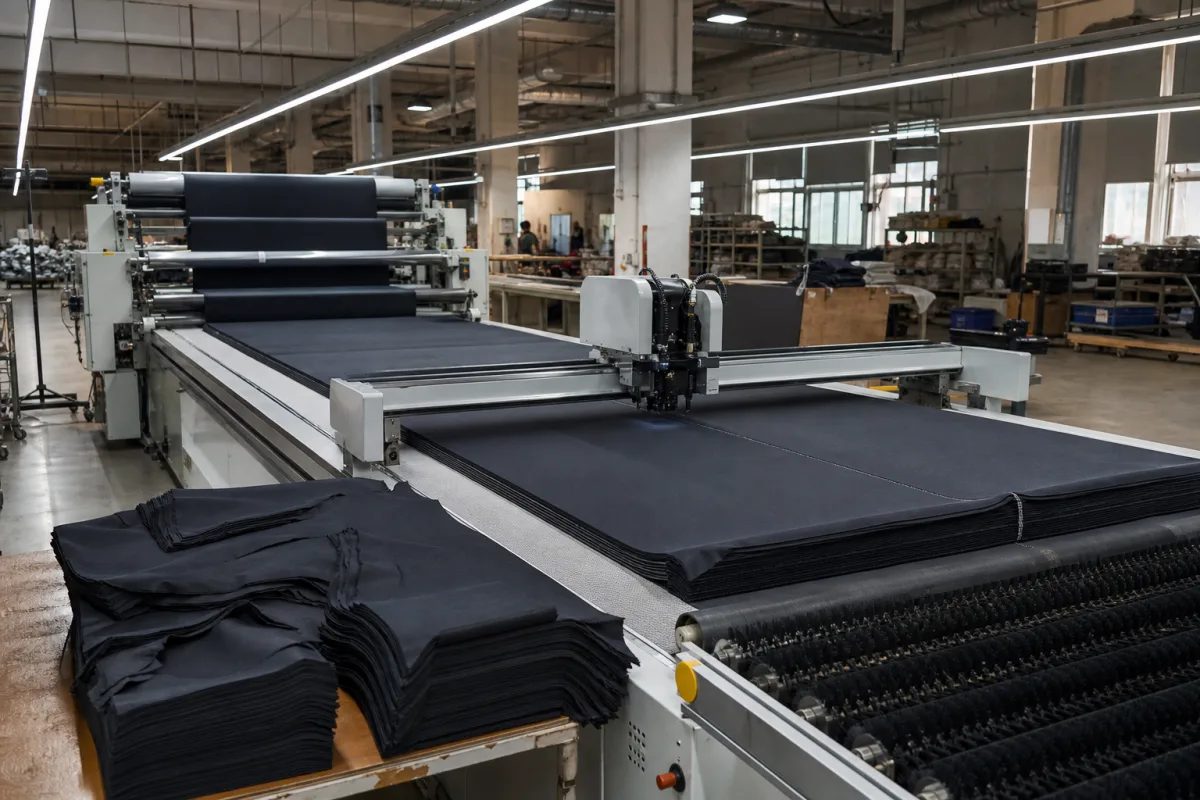
An automatic fabric cutting machine is a computer-controlled cutter for apparel cutting rooms: a spread lay of one ply or a stack of plies of fabric is held down on a porous table by vacuum under an air-tight film, and a gantry-mounted reciprocating knife, steered by the marker from the pattern system, cuts the garment parts through all plies, while a conveyor advances the next section of the lay. Ask three things first: how many plies and what compressed lay height the orders need, what fabric widths and types the cutter must hold flat, and what cutting speed and spreading line the room needs.
Conveyorised CNC knife cutters for woven and knitted apparel fabrics, from low-ply to high-ply, with vacuum hold-down tables, spreaders and fabric handling. Single-ply leather and digital cutters (see automated leather cutting system), laser cutters, manual straight-knife and band-knife machines and CAD pattern software are outside this page except where compared.
CNFX editorial research · Sources checked October 11, 2026 · 4 sources
US patent 3,495,492 describes the hold-down principle behind automatic cloth cutters: a table, conveyor or drum with a porous bed through which a vacuum chamber draws air, applied zone by zone as the cutting or spreading tool travels along it, and a sheet of air-impervious material laid over the fabric so that the vacuum pulls it down and compresses the lay into a more rigid, compact state; the blade penetrates a resilient bed so that the lowest plies are cut cleanly, and the vacuum and film can hold a lay between spreading and cutting so that plies do not shift. [1]
A dealer listing for a Lectra Vector Q25 describes a low-ply cutter for small orders with a cutting height of up to 1 in (2.5 cm), an effective width of 72 in (1.83 m), blade cooling by compressed-air jet and a 22 kW vacuum booster for hold-down; Lectra itself describes the Vector Fashion range as cutting low to high fabric plies, with the Q2 and iX2 models for small orders, the iQ series for repetitive production and the iX series for high-volume work. [3][2]
A dealer listing for a 2022 Gerber Paragon XR line gives a 2,200 mm cutting width, a maximum compressed material height of about 72 mm for multi-ply cutting, vacuum hold-down, real-time knife-deflection correction, automatic blade sharpening and a long vertical knife stroke, sold with a spreader of 220 mm maximum lay height and over 100 m/min spreading speed. [4]
Give the supplier the fabrics (woven, knit, stretch, coated; weight and thickness), order sizes and ply counts, required compressed lay height, fabric widths, marker lengths, pattern system and file formats, cutting accuracy and notching or drilling needs, daily output, spreading and offloading arrangement, floor space, power and compressed air, and dust and noise limits.
02
Set cutting speed, width and the cutting-room line
Lectra states that Vector Fashion cutting heads adapt to the actual fabric characteristics and reach cutting speeds of 8 m/min average perimetric speed, cut tangent and intricate parts with zero buffer between pieces to save material, carry hundreds of sensors for preventive-maintenance alerts and remote support with up to 98% uptime, use an energy-efficient turbine that reduces idling, and offer cutters for lingerie, denim and footwear. [2]
The Gerber patent places the cutter within an automatic line: spreading a lay of vertically stacked plies and cutting garment components from it under numerical or computer control. [1]
Editorial calculation: if the parts in a marker add up to 50 m of cut perimeter, a head averaging 8 m/min needs about 50 ÷ 8 ≈ 6.3 minutes per lay whatever the number of plies, so more plies per lay — within the cutter's compressed height — cut more parts per minute; check that ply count against the accuracy you need on the lowest plies. [2]
03
Compare cutter classes
Each row rests on one model or range: a Lectra Vector Q25 for low-ply, a Gerber Paragon XR line for high-ply, and Lectra's Vector Fashion series for the split by order size. [3][4][2]
Class
Published values
Points to check
Low-ply cutter
Up to 2.5 cm cutting height, 1.83 m width in one model. [3]
Order size, vacuum power.
High-ply cutter
About 72 mm compressed, 2.2 m width in one line. [4]
Perimetric speed, compressed lay height and working width for a cutter order
Speed, compressed height and width carry published figures from single models; cutting accuracy has none, so ask for it on the top and bottom ply of your own lay. [2][3][4]
Field
What it means and published values
Ask the supplier for
Cutting speed
Up to 8 m/min average perimetric in one range. [2]
Speed on your fabric and marker.
Cutting accuracy
Fit of cut parts to the marker.
Accuracy top and bottom ply.
Maximum material thickness
2.5 cm low-ply; about 72 mm compressed high-ply. [3][4]
2 companies list this product among what they make. Company figures are quoted from each
company's own website; every card states where the relationship came from.
Changyuan Equipment Manufacturing Co., Ltd.
Manufacturing site to be confirmed for the order
Its website has a product page for automatic fabric cutting machine.
Product scope checked 2026-10-12
Product page on own website · profile compiled by CNFX from public sources
Explore company information and manufacturing capabilities, then discuss the scope of your project with a relevant supplier.
Share this page
Compiled and source-reviewed by the CNFX editorial team.
Each manufacturer above links to the page on that company's own website where the product is listed, with the date we checked it. How we source and review
· Page last updated 13 October 2026
Buyer questions
How does an automatic cutter hold a stack of plies still?
Vacuum is drawn through a porous bed while an air-tight film over the lay is pulled down, compressing the plies. [1]
How high a lay can an automatic cutter cut?
One low-ply model cuts up to 2.5 cm; one high-ply line is listed at about 72 mm compressed height. [3][4]
How fast do automatic fabric cutters cut?
Lectra states up to 8 m/min average perimetric speed for its Vector Fashion range. [2]
Sources and what still needs a direct check
Sources checked 2026-10-11. The Lectra page describes its own range, the dealer listings describe specific machines offered for sale, and the patent describes the hold-down principle; values for your fabrics must come from the supplier offered.