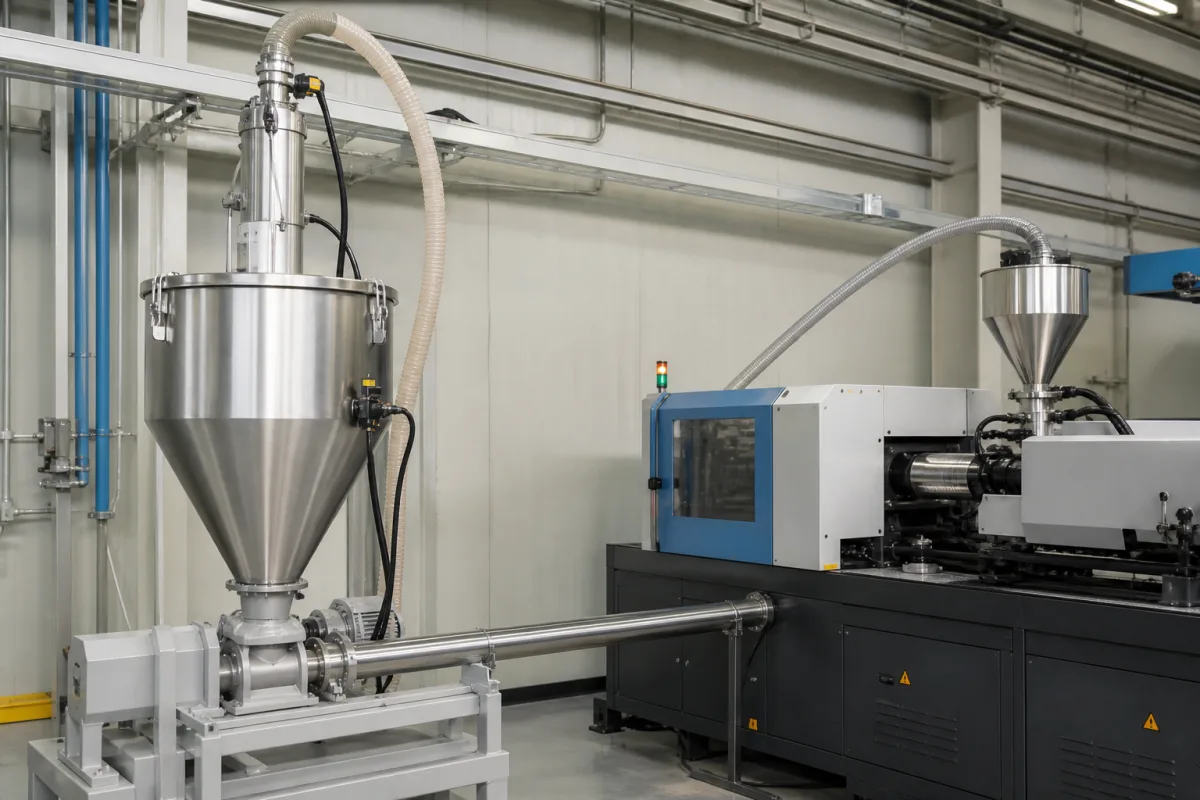
Vacuum material feeding system for plastics processing (hopper loaders and central vacuum)
Vacuum material feeding for plastics machines · venturi, single-phase and three-phase loaders, rate against distance and bulk density, central vacuum
A vacuum material feeding system draws plastic pellets, regrind or powder through hoses from a bag, octabin, dryer or silo into a receiver on top of each processing machine, using compressed-air venturi, a built-in vacuum motor or a central vacuum station. Ask three things first: what conveying rate each machine needs, over what horizontal and vertical distance and with what material, and whether each loader has its own vacuum source or shares a central one.
Vacuum hopper loaders and central vacuum conveying systems that feed plastic granules, regrind and powders to moulding and extrusion machines. General unit-load and bulk conveyor systems are covered on the Conveyor systems page; screw and belt conveyors, dryers and dosing units sold alone are outside this page.
CNFX editorial research · Sources checked October 12, 2026 · 3 sources
Size the conveying rate against distance and material
Shini's manual for its VL series venturi loaders, which use compressed air at about 6-8 kgf/cm² to create the conveying vacuum, lists the VL-50, VL-100 and VL-120 at 40, 60 and 80 kg/h with material hoppers of 0.5, 2.8 and 3.0 L, a maximum conveying distance of 6 m and 1.25 inch hose, and states that the rates were measured with plastic material of 0.8 kg/L bulk density and 3-5 mm diameter, lifted 2 m vertically and moved 1 m horizontally. [1]
Piovan's group page for its vacuum loaders states that the conveying rate of its standard units runs from 1 to 2,000 kg/h depending on material properties and conveying routes, with higher rates for custom solutions, and lists options including self-cleaning filters for dusty bulk materials, discharge aids, PTFE coating, loaders built as vacuum weighing units on load cells, sight glasses and bottom flap or slide gate discharge. [2]
Editorial calculation: the VL-50's 40 kg/h of 0.8 kg/L material is 40 ÷ 0.8 = 50 L/h, or about 100 fills an hour of its 0.5 L hopper; a material with lower bulk density, such as regrind, moves fewer kilograms at the same volume, so give suppliers the bulk density and the longest route rather than the machine's throughput alone. [1]
Give the supplier each machine's consumption in kg/h, the materials with bulk density, pellet size and whether regrind or powder, the source (bag, octabin, dryer, silo), horizontal and vertical distances and bends, the number of machines, compressed air or electrical supply, dust and cleanliness needs, controls and quantity.
02
Choose venturi, single-phase, three-phase or central vacuum
Woywod lists its hopper loaders as modular, for long conveying distances, in variants for granulates and regrind up to 120 kg/h with single-phase motors (ISP), up to 3,000 kg/h with three-phase motors (ITP), granulates, regrind and powder up to 2,800 kg/h (IPL), and a compact venturi conveyor for granules up to 130 kg/h (IVL 01). [3]
Piovan states that, on economic grounds and above all to reduce energy costs, central vacuum stations are "die optimale Lösung" (the optimal solution), built with side-channel or Roots blowers, self-cleaning separators or filters in different sizes, central vacuum with negative-pressure control and Siemens controls. [2] Shini's venturi loaders run on compressed air and list a single-phase 115/230 V ac, 50/60 Hz power supply. [1]
Editorial note: a venturi loader needs no vacuum motor but uses compressed air whenever it conveys, while motor loaders and central stations use electricity; ask each supplier for energy per kilogram conveyed at your rate and distance before comparing prices.
03
Receiver, vacuum source, filter, hoses and pick-up lance
The vacuum source sets rate and distance; the receiver's filter and separator sit between the material and that source.
Explore company information and manufacturing capabilities, then discuss the scope of your project with a relevant supplier.
Share this page
Compiled and source-reviewed by the CNFX editorial team.
Each manufacturer above links to the page on that company's own website where the product is listed, with the date we checked it. How we source and review
· Page last updated 13 October 2026
Buyer questions
How far can a venturi loader convey?
Shini lists a maximum of 6 m for its VL series, at 40 to 80 kg/h. [1]
What rates do vacuum loaders reach?
Woywod lists up to 120 kg/h single-phase and 3,000 kg/h three-phase; Piovan's standard units cover 1 to 2,000 kg/h. [3][2]
Why does bulk density matter?
Shini's rates were measured with 0.8 kg/L pellets; lighter material moves fewer kilograms for the same volume (editorial note). [1]
When is a central vacuum station used?
Piovan states that, on economic grounds and above all to reduce energy costs, central vacuum stations are the optimal solution. [2]
Sources and what still needs a direct check
Sources checked 2026-10-12. Shini, Piovan and Woywod describe their own loaders and vacuum systems; Shini's figures come from a 2013 manual.