Laser cutting · Power rating, focal length and autofocus, protective windows, nozzle and height sensing
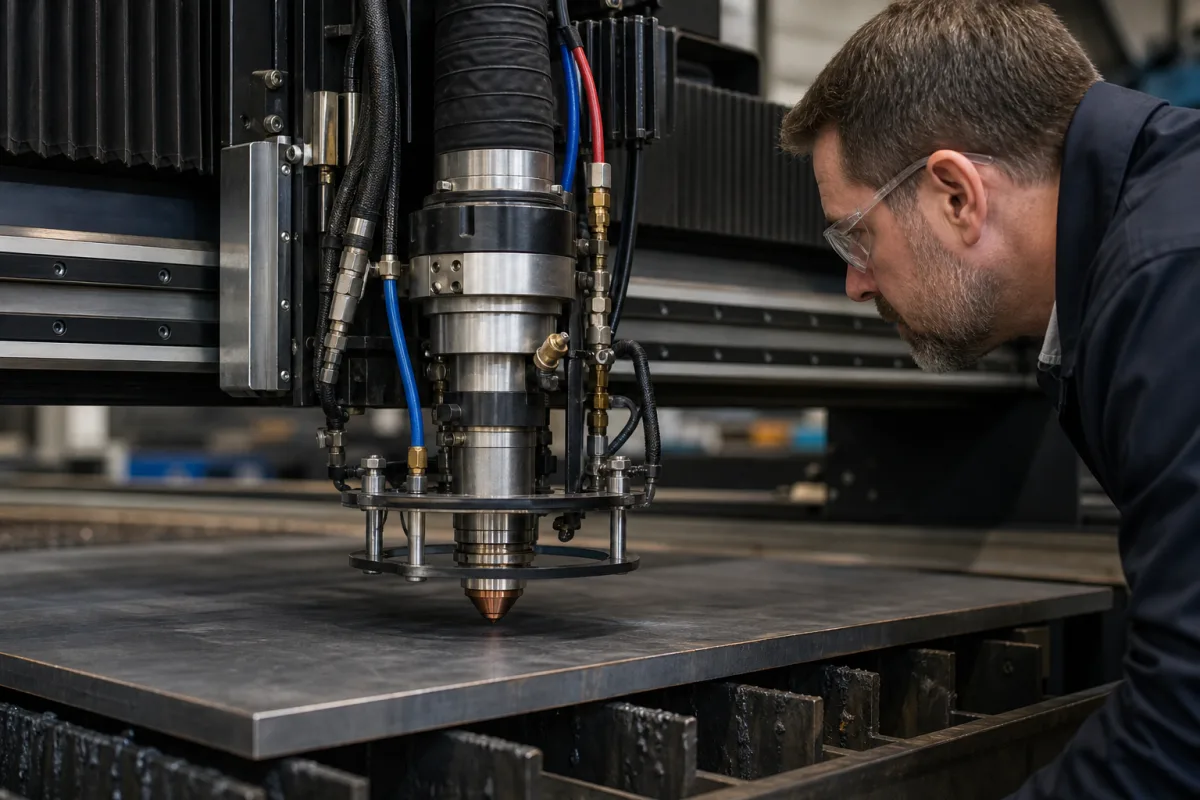
A laser cutting head takes the beam from the delivery fiber, focuses it through a nozzle and directs the cutting gas onto the sheet. Ask three things first: what laser power and fiber connector it must accept, what materials and thicknesses it will cut, and how focus, height and window contamination are controlled.
Laser cutting heads for fiber laser cutting machines, with their optics, nozzles and height sensing, and replacement heads and parts. Waterjet heads, knife-cutting heads, laser sources and complete machines are outside this page.
CNFX editorial research · Sources checked October 11, 2026 · 4 sources
Precitec's ProCutter, described in a Messer Cutting brochure, is a fiber laser cutting head for lasers up to 8 kW with a 150 mm focal length as standard (others on request), an HP Plus collimator, an exchangeable lens cartridge and automatic focus position for faster setup and shorter piercing. [1]
IPG, a fiber laser maker, says its cutting heads handle laser powers above 40 kW, offer a wide range of focus and collimator lens options for thick or thin work and for small spots, and cites cutting of mild and stainless steel up to 50 mm and copper up to 6 mm. [2]
Match the head's power rating, fiber connector and lens options to the laser source and to the thickest material; ask what focal lengths and focus range are offered.
02
Check protection, sensing and gas path
The ProCutter seals the beam path against micro-dust, uses quick-change protective window cartridges with permanent window monitoring, monitors pressure in the nozzle area and the head, keeps a constant height with Precitec's EG8030 height sensing at high cutting speeds, and has a ceramic insert near the nozzle for collision protection. [1]
IPG lists a pierce sensor option, real-time optics temperature feedback, a permanent secondary protective window and a gas path designed for both low- and high-pressure process gas. [2]
Ask how window contamination is detected, how the height sensor copes with piercing spatter, and what spare windows, nozzles and ceramic rings cost per shift.
Give the supplier the laser source make, power and fiber connector, machine and controller, materials and thickness range, assist gases and pressures, required focus control, height-sensing interface, and spare-parts needs.
03
BT-series heads, lenses, windows and nozzles listed by DMK and StartNow
DMK lists laser cutting heads with laser sources, controllers and consumables; StartNow lists BT210 and BT240S cutting heads with focusing and collimating lenses, protective windows, ceramic rings and nozzles. [3][4]
04
Collimator, focusing lens, protective windows, nozzle, height sensor and gas path
Protective windows and the nozzle with its ceramic ring are the wear items in this list: StartNow sells them as separate spares, and the ProCutter monitors its window permanently. [4][1]
Low- and high-pressure gas; temperature feedback. [2]
Gas pressure rating and cooling.
05
Laser power, cutting capacity, gas pressure and height accuracy for a cutting head
Rated power and cutting capacity are the rows with published numbers: 8 kW for the ProCutter, and above 40 kW with steel up to 50 mm for IPG heads. Spindle speed does not apply to a laser head. [1][2]
Field
What it means and published values
Ask the supplier for
Operating pressure (MPa)
Assist gas pressure; low and high-pressure designs. [2][1]
Maximum gas pressure.
Cutting capacity (mm)
E.g. steel up to 50 mm, copper up to 6 mm with high power. [2]
4 companies list this product among what they make. Company figures are quoted from each
company's own website; every card states where the relationship came from.
DMK Laser
Manufacturing site to be confirmed for the order
Lists laser cutting heads with sources, controllers and consumables.
Explore company information and manufacturing capabilities, then discuss the scope of your project with a relevant supplier.
Share this page
Compiled and source-reviewed by the CNFX editorial team.
Each manufacturer above links to the page on that company's own website where the product is listed, with the date we checked it. How we source and review
· Page last updated 13 October 2026
Buyer questions
What laser power can a cutting head take?
It depends on the head; one standard head is rated to 8 kW, while some makers offer heads for above 40 kW. [1][2]
Why monitor the protective window?
The window shields the focusing lens from process spatter; some heads monitor the window permanently so its condition is known during cutting. [1][2]
What does autofocus do on a cutting head?
It sets the focus position automatically, shortening machine setup and piercing time. [1]
Sources and what still needs a direct check
Sources checked 2026-10-11. Precitec and IPG make laser cutting heads; the ProCutter brochure is published by Messer Cutting Systems. DMK and StartNow are suppliers listed on this page.