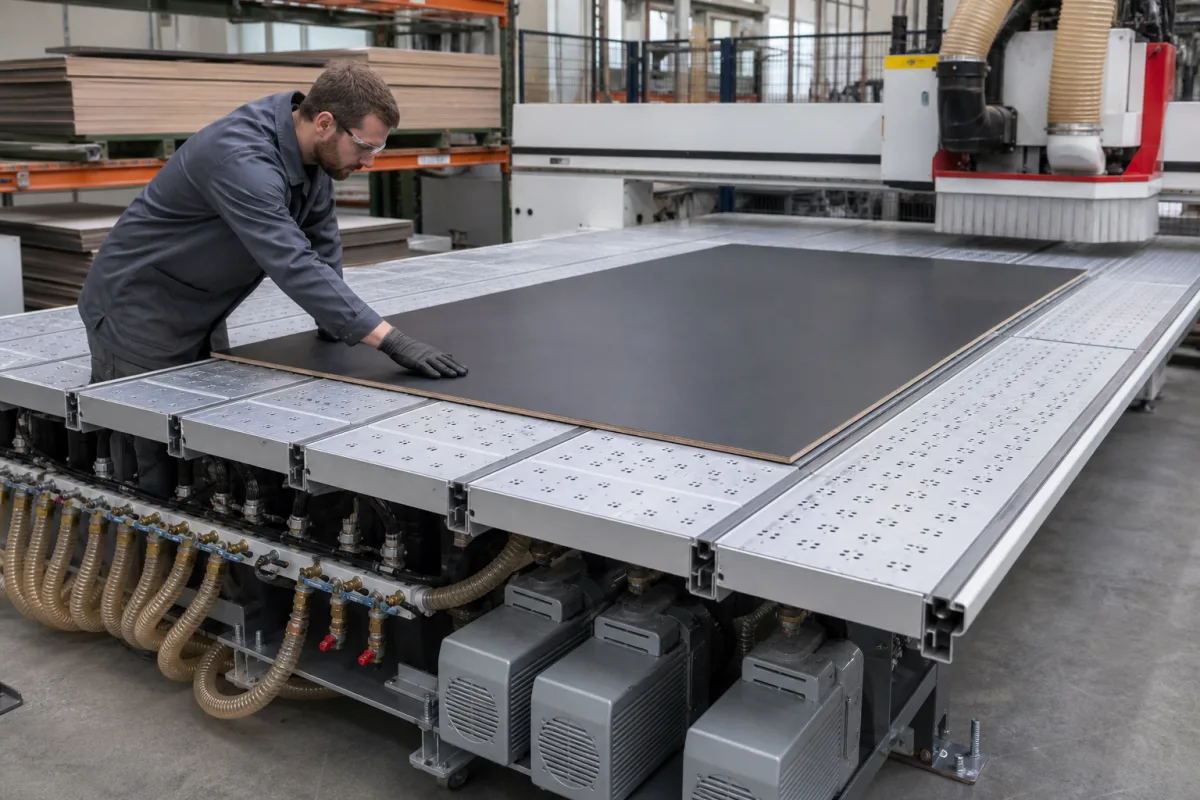
Vacuum hold-down tables · Pump flow per table area, flow-through spoilboards, gridded zones, pods, sealing open areas, hold-down force
A vacuum table is a machine work surface with a plenum, grid or perforated top connected to vacuum pumps, so sheets or parts are held flat by atmospheric pressure while they are routed, cut or printed. Ask three things first: whether you need a flow-through spoilboard, a zoned grid or pods for your parts, what pump flow the table area needs, and how open areas and edges are sealed so the vacuum holds small parts.
Vacuum hold-down tables for CNC routers, cutting tables and flatbed printers: flow-through spoilboard plenums, gridded and zoned tables, honeycomb and perforated tops, and pod-and-rail systems, with their pumps and valves. Vacuum lifters, vacuum chucks for metal machining and vacuum pumps sold alone are outside this page.
CNFX editorial research · Sources checked October 11, 2026 · 4 sources
Becker Pumps, a vacuum pump maker, states that a spoilboard or nested-base table needs 5.5 CFM per square foot of surface area, and lists 176 CFM for a 4 × 8 ft table (32 ft²), 275 CFM for 5 × 10 ft, 330 CFM for 5 × 12 ft and 550 CFM for 5 × 20 ft; pod-and-rail tables, with small suction cups, need far less flow, 66 CFM in its chart. It notes the chart is for estimating, at sea level, and should be confirmed with its engineers. [1]
Editorial calculation: 5.5 CFM per square foot is about 100 m³/h per m² (5.5 × 1.699 ÷ 0.0929), so a 1,220 × 2,440 mm table of about 3.0 m² needs roughly 300 m³/h, matching Becker's 176 CFM for 4 × 8 ft. At sites well above sea level, ask the supplier to correct the pump size. [1]
Editorial calculation: hold-down force is the pressure difference times the sealed area under the part; at an assumed 50 kPa difference, a 600 × 400 mm part is held with about 50,000 × 0.24 = 12,000 N. Ask the supplier for the vacuum level the pump holds at your table's leakage.
02
Choose the top, zoning and sealing for your parts
Woodshop News describes a flow-through vacuum hold-down surface for high-speed cabinet-part production: an MDF spoilboard over a tray the size of the working area that acts as a plenum. The MDF is porous enough to hold a full panel flat, but the vacuum needed is significant, requiring 20–25 hp pumps, and it is not easy to use for parts smaller than a full sheet or for lumber; some users cover open areas with 1/4 in plywood, plastic or rubber runners to reduce loss. [2]
A more versatile method it describes is a gridded MDF spoilboard with zoned delivery: small machined squares, holes in some squares, channels with rubber tubing cordoning sections, and PVC piping with hand valves. The column describes machines fitted with two smaller pumps instead of one large one, so only one runs for smaller parts. Vacuum pods are a further variation for parts held above the table. [2]
Editorial note: for honeycomb or perforated tops, as used on flatbed printers, ask suppliers how zones are switched, how open areas are masked, and how the top is resurfaced or replaced.
For pod-and-rail (console) tables, Schmalz's page for its VCBL-K1 vacuum blocks describes a hose-free clamping system for CNC machining centres with a console table (single-circuit system): the vacuum clamps the block onto the console and the workpiece onto the block, guide strips position and pre-fix the block on the console during set-up, and an optional touch valve lets unneeded blocks stay on the table. It lists block heights of 50, 85 and 125 mm, a bottom suction plate of 140 × 115 mm, top suction plates in sizes including 120 × 50 mm and 125 × 75 mm, a plastic main body, and suction plates that can be replaced without tools. [4]
Editorial calculation: holding force is the pressure difference times the sealed area. For a 125 × 75 mm top plate (0.009375 m²) at an assumed 0.8 bar below atmosphere (80 kPa), the force is about 0.009375 × 80,000 ≈ 750 N, or roughly 76 kgf, per block before seal losses; four blocks under a panel give about 3,000 N. The 0.8 bar level is an assumption, not a Schmalz figure; ask the supplier for the vacuum level its pump holds with your blocks and the rated holding force per block. [4]
Give the supplier the machine and working area, materials and their porosity, smallest and largest parts, nesting or single parts, top type (flow-through, grid, honeycomb, pods), number of zones and switching, pump type and power, site altitude and power supply, noise limits and filtration.
03
Consider valved ports instead of a fully porous top
Thermwood's US patent 6,089,801 (filed 1 July 1998, granted 18 July 2000) contrasts two router hold-down systems: a conventional system with a vacuum port and a fixture with a peripheral rubber seal for each part, suited to long runs, and a universal system with a rigid lower plate, a gridded intermediate plate and a porous particleboard spoilboard forming a plenum, suited to short runs but needing a large airflow to remove the air drawn through the board. [3]
Its alternative spoilboard has an array of vacuum ports over the plenum, each holding a reversible check valve: one way up it blocks the port and protrudes above the board, which also stops a part being placed in the wrong position; inverted, it sits flush and lets the vacuum act under the part. Peripheral seals between the plates limit leakage into the plenum. The patent states that 1 in diameter ports with valve flanges of 1½ in suited conventional table sizes, with valve bodies of moulded thermoplastic elastomer such as polyurethane, porous bronze closure members and rubber or polyurethane valve discs, and that selecting only the ports under the part reduces the energy needed for hold-down. [3]
Editorial calculation: a 1 in (25.4 mm) port has an open area of about 5.07 cm²; at an assumed 50 kPa pressure difference, the force acting over that port area alone is about 25 N, but the hold-down force acts over the whole sealed area under the part, as in the 600 × 400 mm example above. Ask suppliers of valved or pod tables for the port pattern and pitch against your smallest part. [3]
04
Honeycomb tops for UV flatbed printers
Listings include honeycomb vacuum tables for UV flatbed printers alongside honeycomb panels and cores.
05
How vacuum gets from the pump to the underside of the part
Table area, pump flow and zone count for a hold-down enquiry
Only the pump rows carry published sizing — flow per area from Becker and pump power from the Woodshop News column; vacuum level, flatness and top material have to come from the supplier at your table's leakage. [1][2]
Explore company information and manufacturing capabilities, then discuss the scope of your project with a relevant supplier.
Share this page
Compiled and source-reviewed by the CNFX editorial team.
Each manufacturer above links to the page on that company's own website where the product is listed, with the date we checked it. How we source and review
· Page last updated 13 October 2026
Buyer questions
How big a vacuum pump does a CNC router table need?
Becker estimates 5.5 CFM per square foot for spoilboard tables, about 176 CFM for 4 × 8 ft, and far less for pod-and-rail tables. [1]
Why do small parts slip on a vacuum table?
Open areas leak; Woodshop News notes users cover them with plywood, plastic or rubber runners, and zoned grids limit vacuum to the parts. [2]
What is a flow-through spoilboard?
A porous MDF board over a plenum tray covering the working area, holding full panels flat but needing large pumps. [2]
Can a vacuum table hold parts without a fully porous spoilboard?
Thermwood's US patent 6,089,801 uses an array of 1 in ports with reversible check valves, opened only under the part, to cut the airflow a porous board needs. [3]
What sizes do vacuum blocks for pod-and-rail tables come in?
Schmalz lists its VCBL-K1 blocks for 1-circuit console tables at 50, 85 and 125 mm high, with a 140 × 115 mm bottom plate and top plates such as 120 × 50 and 125 × 75 mm. [4]
Sources and what still needs a direct check
Sources checked 2026-10-11. Becker is a vacuum pump maker giving its own sizing chart for estimates; Woodshop News is a trade magazine column; Thermwood's patent describes its own valved-port table. Confirm pump size with the supplier for your table and altitude. Schmalz describes its own vacuum blocks for console tables.