Industry-Verified Manufacturing Data (2026)

Casting Mold Temperature Control Cartridge Heater

Based on aggregated insights from multiple verified factory profiles within the CNFX directory, the standard Casting Mold Temperature Control Cartridge Heater used in the Basic Metal Manufacturing sector typically supports operational capacities ranging from standard industrial configurations to heavy-duty production requirements.

Technical Definition & Core Assembly

A canonical Casting Mold Temperature Control Cartridge Heater is characterized by the integration of Heating Element Coil and Outer Sheath. In industrial production environments, manufacturers listed on CNFX commonly emphasize Incoloy 800 construction to support stable, high-cycle operation across diverse manufacturing scenarios.

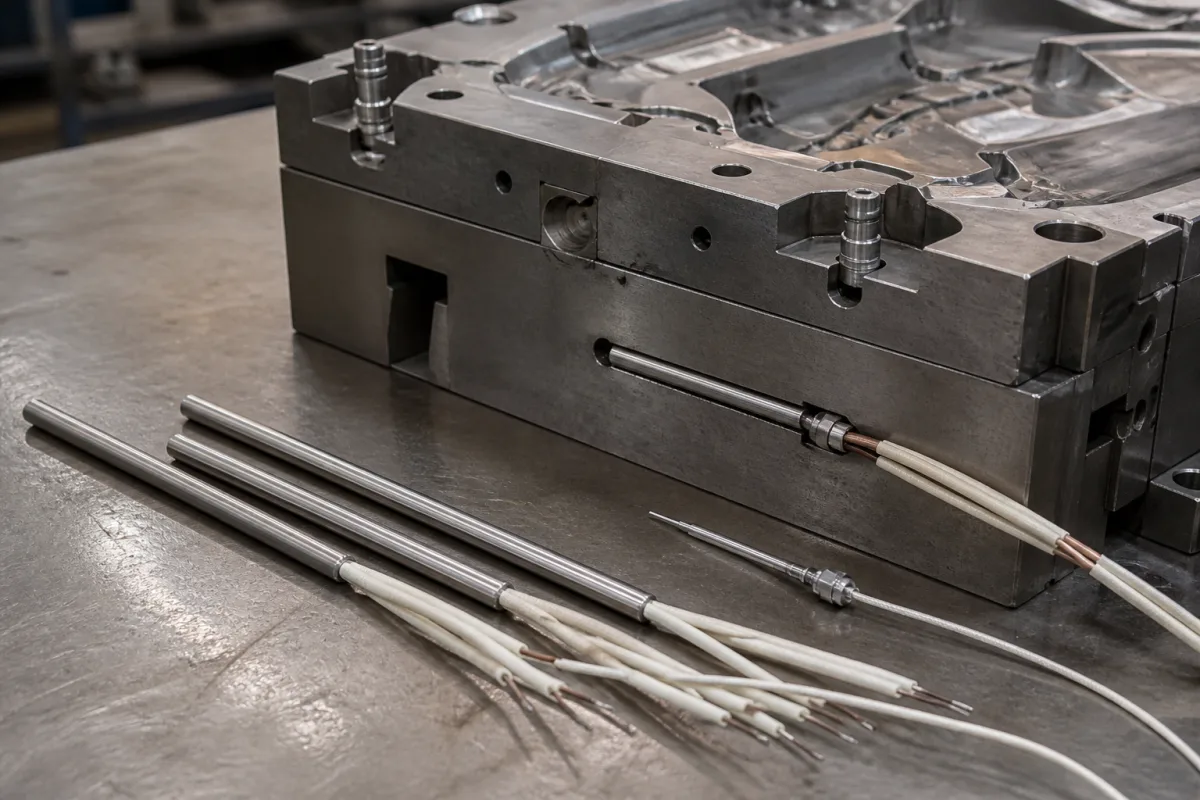
Precision heating element inserted into casting molds for controlled thermal management
Product Specifications

Technical details and manufacturing context for Casting Mold Temperature Control Cartridge Heater

Definition
A cylindrical heating element designed for insertion into drilled cavities within metal casting molds to provide localized, controlled heating. It maintains optimal mold temperature profiles during casting processes, preventing premature solidification and reducing thermal stress. This component ensures consistent metal flow and improves casting quality by minimizing defects like cold shuts and shrinkage porosity. It's essential for precision casting applications requiring tight dimensional tolerances.
Working Principle
Electrical resistance heating converts electrical energy to thermal energy, transferring heat through the cartridge body to the surrounding mold material via conduction to maintain precise temperature zones.
Common Materials
Incoloy 800, Stainless Steel 304, Magnesium Oxide Insulation, Nickel-Chromium Alloy Wire
Technical Parameters
  • Cartridge diameter for mold cavity fit (mm) Standard Spec
  • Power rating for thermal output capacity (W) Standard Spec
Components / BOM
  • Heating Element Coil
    Generates heat through electrical resistance
    Material: Nickel-chromium alloy
  • Outer Sheath
    Protects internal components and transfers heat
    Material: Incoloy 800
  • Insulation Material
    Electrically isolates heating element from sheath
    Material: Magnesium oxide powder
  • Terminal Connection
    Provides electrical connection points
    Material: Stainless steel
  • Seal Plug Optional
    Seals end of cartridge against moisture ingress
    Material: Ceramic
Engineering Reasoning
200-500°C
650°C sheath temperature
Design Rationale: Nickel-chromium alloy (80Ni-20Cr) wire embrittlement due to chromium carbide precipitation at grain boundaries above 650°C, reducing tensile strength below 50 MPa
Risk Mitigation (FMEA)
Trigger Insufficient mold contact pressure below 0.5 MPa
Mode: Localized sheath overheating to 700°C
Strategy: Interference-fit installation with 0.05-0.10 mm oversize diameter and thermal interface compound with 3.5 W/m·K minimum conductivity
Trigger Cyclic thermal stress from 200-500°C temperature swings exceeding 10,000 cycles
Mode: Sheath fatigue cracking at weld joints
Strategy: Seamless Incoloy 800 sheath with 0.3 mm minimum wall thickness and controlled cooling rate below 100°C/min

Industry Taxonomies & Aliases

Commonly used trade names and technical identifiers for Casting Mold Temperature Control Cartridge Heater.

Industrial Ecosystem & Supply Chain DNA

Complementary Systems
Downstream Applications
Specialized Tooling

Application Fit & Sizing Matrix

Operational Limits
pressure: Max 300 bar (4350 psi) in static mold applications
flow rate: Not applicable (static insertion heating)
temperature: Up to 750°C (1382°F) continuous operation
slurry concentration: Not applicable (solid mold contact only)
Media Compatibility
✓ Steel alloy molds ✓ Copper alloy molds ✓ Tool steel dies
Unsuitable: Corrosive molten metals (e.g., magnesium alloys without protective coatings)
Sizing Data Required
  • Required mold temperature (°C)
  • Mold cavity insertion depth (mm)
  • Available cartridge bore diameter (mm)

Reliability & Engineering Risk Analysis

Failure Mode & Root Cause
Thermal fatigue cracking
Cause: Repeated heating and cooling cycles causing expansion/contraction stress in the heater sheath material, especially at high temperature differentials or rapid cycling rates.
Electrical insulation breakdown
Cause: Moisture ingress, contamination from casting release agents, or prolonged overheating degrading the magnesium oxide insulation between the heating element and sheath.
Maintenance Indicators
  • Inconsistent or fluctuating mold temperature readings despite stable controller output
  • Visible discoloration (blueing or oxidation) or physical deformation of the heater sheath
Engineering Tips
  • Implement controlled ramp-up/down protocols to minimize thermal shock during startup and shutdown cycles
  • Ensure proper sealing of heater installation points and use compatible thermal compounds to prevent moisture ingress and improve heat transfer efficiency

Compliance & Manufacturing Standards

Reference Standards
ISO 9001:2015 Quality Management Systems ASTM E165/E165M-18 Standard Practice for Liquid Penetrant Testing CE Marking (EU Machinery Directive 2006/42/EC)
Manufacturing Precision
  • Bore Diameter: +/-0.02mm
  • Heater Sheath Flatness: 0.1mm per 100mm length
Quality Inspection
  • Dye Penetrant Test for surface defects
  • Resistance and Insulation Resistance Testing

Factories Producing Casting Mold Temperature Control Cartridge Heater

Verified manufacturers with capability to produce this product in China

✓ 93% Supplier Capability Match Found

P Procurement Specialist from Germany Jan 11, 2026
★★★★★
"The technical documentation for this Casting Mold Temperature Control Cartridge Heater is very thorough, especially regarding Diameter (mm)."
Technical Specifications Verified
T Technical Director from Brazil Jan 08, 2026
★★★★★
"Reliable performance in harsh Basic Metal Manufacturing environments. No issues with the Casting Mold Temperature Control Cartridge Heater so far."
Technical Specifications Verified
P Project Engineer from Canada Jan 05, 2026
★★★★★
"Testing the Casting Mold Temperature Control Cartridge Heater now; the Diameter (mm) results are within 1% of the laboratory datasheet."
Technical Specifications Verified
Verification Protocol

“Feedback is collected from verified sourcing managers during RFQ (Request for Quote) and factory evaluation processes on CNFX. These reports represent historical performance data and technical audit summaries from our B2B manufacturing network.”

15 sourcing managers are analyzing this specification now. Last inquiry for Casting Mold Temperature Control Cartridge Heater from Thailand (1h ago).

Supply Chain Commonly Integrated Components

Signal Processor

Electronic device that conditions, amplifies, filters, and converts raw sensor signals into standardized outputs for temperature measurement systems

Explore Specs →
Purge Air System

A system that provides controlled airflow to clear optical paths and protect sensors in molten metal temperature measurement applications.

Explore Specs →
Degassing Chamber

A specialized vessel within a molten metal degassing system where dissolved gases are removed from molten metal through controlled processes.

Explore Specs →
Gas Control System

A system that regulates and controls the flow, pressure, and composition of gases used in molten metal degassing processes.

Explore Specs →

Frequently Asked Questions

What are the benefits of using Incoloy 800 in casting mold cartridge heaters?

Incoloy 800 offers excellent oxidation resistance and high-temperature strength up to 1150°C, making it ideal for prolonged use in foundry environments where molds require precise, consistent heating.

How do I select the right power rating for a casting mold cartridge heater?

Choose based on mold material, desired heating rate, and operating temperature. Higher power ratings (e.g., 500-2000W) suit rapid heating, while lower ratings provide steady control. Consult thermal load calculations for optimal performance.

Can these cartridge heaters be customized for specific mold dimensions?

Yes, they are often customizable in diameter (typically 6-25mm), length, and lead length to fit mold cavities precisely, ensuring efficient heat transfer and avoiding hotspots in casting processes.

Can I contact factories directly on CNFX?

CNFX is an open directory, not a transaction platform. Each factory profile provides direct contact information and production details to help you initiate direct inquiries with Chinese suppliers.

Get Quote for Casting Mold Temperature Control Cartridge Heater

Request technical pricing, lead times, or customized specifications for Casting Mold Temperature Control Cartridge Heater directly from verified manufacturing units.

Your business information is encrypted and only shared with verified Casting Mold Temperature Control Cartridge Heater suppliers.

Thank you! Your message has been sent. We'll respond within 1–3 business days.

Need to Manufacture Casting Mold Temperature Control Cartridge Heater?

Connect with verified factories specializing in this product category

Add Your Factory Contact Us
Previous Product
Casting Core
Next Product
Casting Mold Thermal Management Plate