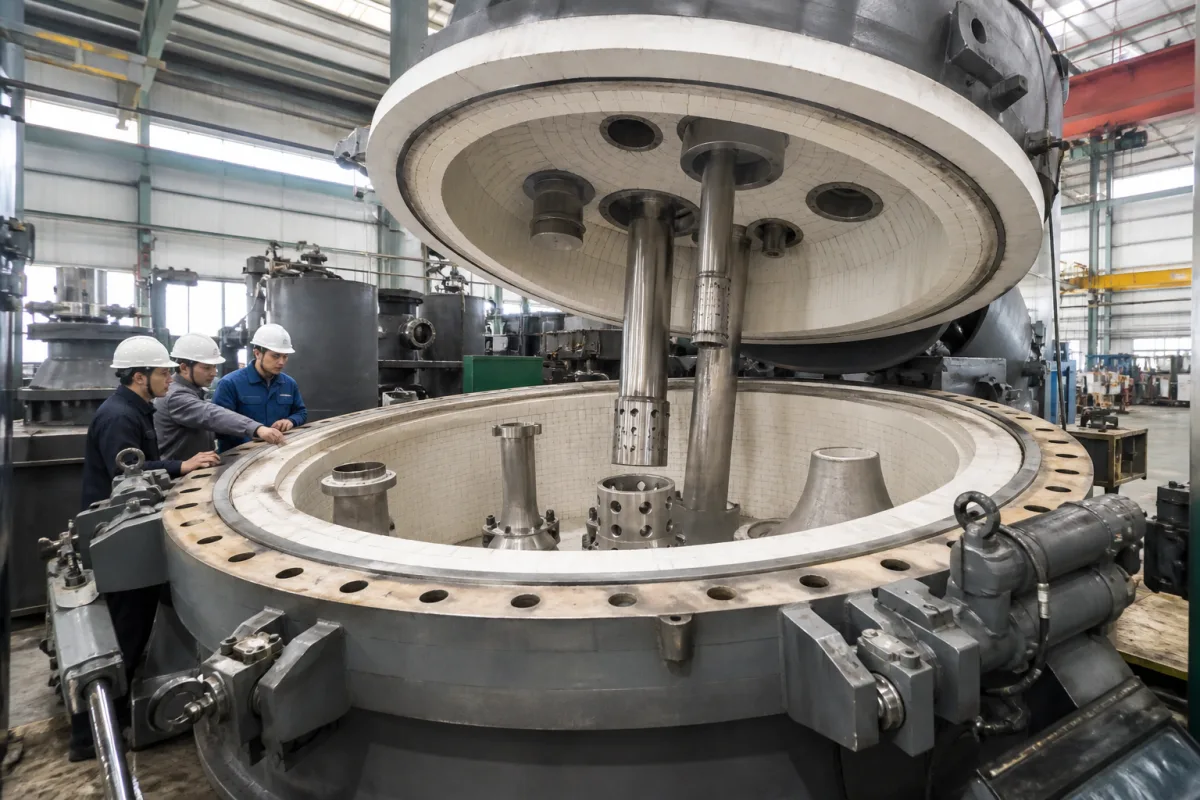
Degassing chamber for liquid steel: vacuum tank degasser (VD/VOD) with ladle tank, lid and pumping set
Steel secondary metallurgy · Vacuum tank degasser (VD, VD-OB, VOD): ladle set in a tank under a lid, argon through bottom plugs, vacuum pumping set, hydrogen below 1 ppm
A degassing chamber for liquid steel, in the sense used on this page, is the vacuum tank of a ladle degassing station: the full ladle from the furnace is set into a tank, a lid is closed over it, a pumping set draws the tank down to the treatment pressure, and argon blown through porous plugs in the ladle bottom stirs the steel and carries hydrogen and nitrogen out of the bath. Fitted with an oxygen lance it becomes a VD-OB or VOD for decarburising. The purchase turns on how low the pumping set takes the tank and how fast, how much freeboard the ladle needs for the boil, and the argon flow and time that reach the hydrogen target.
Vacuum tank degassers for liquid steel: VD, VD-OB and VOD stations in which a ladle with porous bottom plugs is placed in a tank under a lid and treated under vacuum with argon stirring, together with the tank, lid, alloy hopper, argon supply and vacuum pumping set. Rotary impeller degassing of molten aluminium in ladles, crucibles and in-line boxes is covered on the Molten aluminium degassing system (rotary degasser) page. Furnaces that melt and degas steel under vacuum are covered on the Vacuum induction degassing unit page; vacuum chambers for resins, liquids and test parts on the Vacuum chamber page; electrolyte degassing for lithium-ion cells on the Vacuum degassing chamber for lithium-ion battery electrolyte page. RH recirculation degassers are outside this page.
CNFX editorial research · Sources checked October 12, 2026 · 3 sources
Set vacuum level, argon per plug and time against a hydrogen target
Paura and co-authors from Centro Sviluppo Materiali, Società delle Fucine and ThyssenKrupp Acciai Speciali Terni modelled hydrogen removal in a 140 t ladle with a diameter-to-height ratio of 1 and two eccentric bottom plugs, one at half radius and the second 800 mm from it, at argon flows of 100 and 200 Nl/min per plug. In the tank layout the vacuum chamber is formed by closing a roof over a tank, and it reached lower pressures than a design whose cover seals directly on the ladle. [1]
In their results, a lower pressure did much more than a higher gas flow, though below 10 mbar the gain in degassing rate became smaller. They estimate that half of the gas expansion takes place within the top 20% of the bath height, so that beyond about 100 Nl/min, the flow needed for reasonably rapid mixing, extra gas is spent at the surface and raises the splashing risk instead of speeding recirculation. [1]
Editorial calculation: two plugs at 100–200 Nl/min each for a 30 min treatment use 2 × 100 × 30 = 6,000 Nl to 2 × 200 × 30 = 12,000 Nl of argon, that is about 43–86 Nl per tonne on 140 t, assuming both plugs run at the stated flow throughout. [1]
Give the supplier the steel grades and hydrogen, nitrogen and carbon targets, heat size and ladle drawings with freeboard and plug positions, the treatments per day and time available between furnace and caster or teeming, whether oxygen blowing (VD-OB or VOD) is needed, and the steam, power, water and argon available on site.
02
Leave freeboard for the boil: 600–800 mm on a VD, more with an oxygen lance
Primetals states that ladles in its VD plants need a freeboard of approximately 600–800 mm, that adding an oxygen lance for forced decarburisation (VD-OB) raises this to around 1200 mm, and that ladles in a VOD plant for stainless steel need more than 1200 mm. Its VD plants adjust composition through a vacuum alloy hopper, and its VLD variant serves heat sizes of 5 to 20 t. [2]
Paura and co-authors note that a tank with a higher roof makes splashing harmless, so a higher argon flow can be used than where the cover sits directly on the ladle. [1]
Editorial calculation, assuming liquid steel at 7.0 t/m³ and the bath itself at a diameter-to-height ratio of 1: 140 t occupies about 20 m³, giving a bath about 2.9 m across and 2.9 m deep; the top 20% of that height, where half the gas expansion is estimated to happen, is roughly 0.6 m. [1]
03
Steam ejectors or dry mechanical pumps on the vacuum line
Koblenzer and Gandin of Danieli describe replacing steam-ejector pumps with dry mechanical vacuum pumps on VD and VOD plants treating up to 200 t of liquid steel, with carbon, hydrogen, nitrogen and sulphur removal reported as achieved. On VOD installations from 6 t to 110 t, each mechanical pump has a variable-speed drive, which allowed automatic, dynamic pressure regulation during oxygen blowing; at one stainless plant the average time under vacuum per VOD heat was below 58 minutes. [3]
The authors state that the modular and redundant layout lets a single failed pump be dealt with without stopping the plant. Ask a supplier offering either system for the pump-down time to the treatment pressure with the tank and lid you will buy, and for the steam, water or electrical load per heat. [3]
04
What 30 minutes under vacuum gave in a 140 t ladle
After 30 minutes of vacuum treatment in 140 t ladles, measured with the same Hydris probe at the end of treatment, six heats in the tank-type (VOD) plant ended at 0.7–0.9 ppm hydrogen and six in the ladle-cover (ASEA) plant at 1.0–1.2 ppm. The plant used the tank route to reach below 1 ppm for bottom-poured forging ingots and avoid anti-flaking heat treatment after forging. [1]
Editorial calculation: the six tank-plant heats average 5.0 ÷ 6 ≈ 0.83 ppm and the six ladle-cover heats 6.6 ÷ 6 = 1.1 ppm, about 24% lower, in line with the roughly 25% the authors report. In their model the gap between the best ladle-cover and tank cases in reaching 1 ppm could exceed 5 minutes. [1]
05
VD, VD-OB, VOD and ladle-cover degassing in the sources
Explore company information and manufacturing capabilities, then discuss the scope of your project with a relevant supplier.
Share this page
Compiled and source-reviewed by the CNFX editorial team.
Each manufacturer above links to the page on that company's own website where the product is listed, with the date we checked it. How we source and review
· Page last updated 13 October 2026
Buyer questions
How much ladle freeboard does a vacuum tank degasser need?
Primetals gives about 600–800 mm for VD, around 1200 mm with an oxygen lance (VD-OB) and above 1200 mm for VOD. [2]
What hydrogen level can 30 minutes of vacuum treatment reach?
In a 140 t ladle study the tank-type plant ended six heats at 0.7–0.9 ppm, against 1.0–1.2 ppm in a ladle-cover plant. [1]
Can dry mechanical pumps replace steam ejectors?
Danieli reports dry mechanical pumps on VD and VOD plants treating up to 200 t, with variable-speed drives for pressure control during oxygen blowing. [3]
Sources and what still needs a direct check
Sources checked 2026-10-12. Paura and co-authors are from a research centre, a forge and a steel plant reporting their own ladle treatments; Primetals and Danieli are plant builders describing their own VD and VOD designs; the Danieli figures are from a conference abstract.