Industry-Verified Manufacturing Data (2026)

Purge Air System

Based on aggregated insights from multiple verified factory profiles within the CNFX directory, the standard Purge Air System used in the Basic Metal Manufacturing sector typically supports operational capacities ranging from standard industrial configurations to heavy-duty production requirements.

Technical Definition & Core Assembly

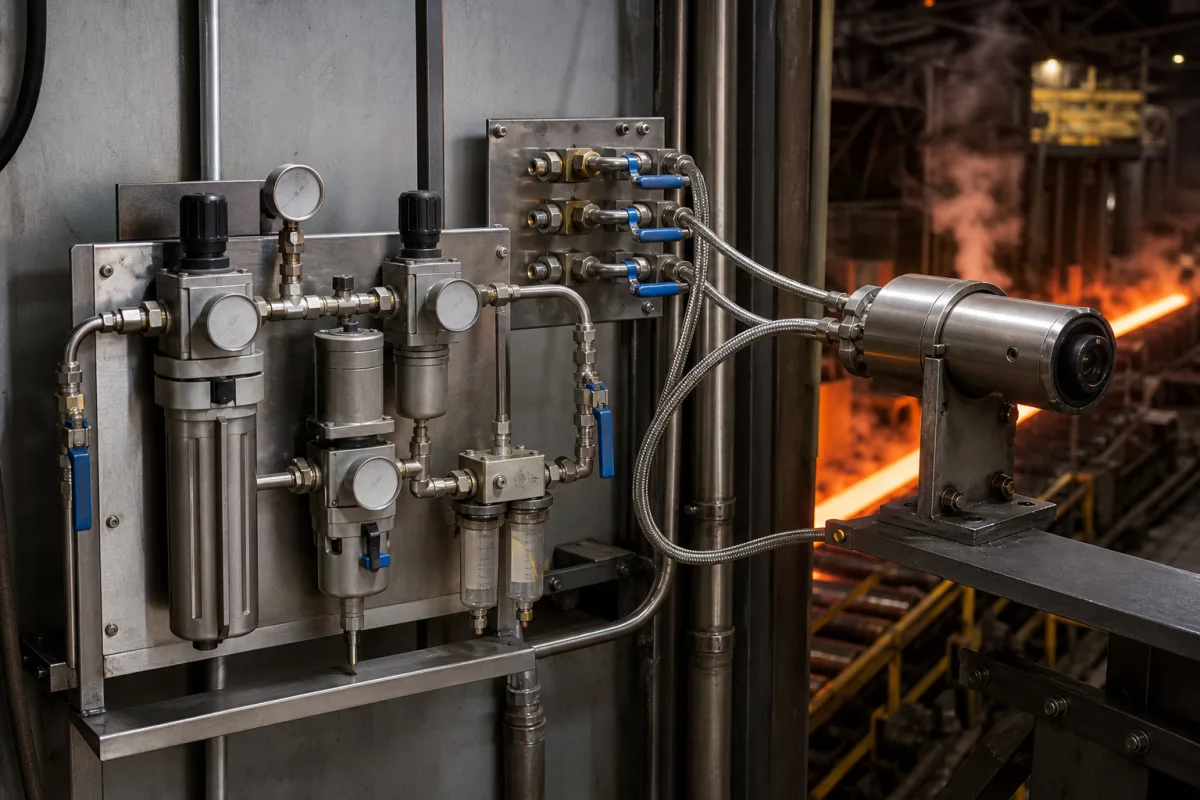
A canonical Purge Air System is characterized by the integration of Air Filter/Dryer and Pressure Regulator. In industrial production environments, manufacturers listed on CNFX commonly emphasize Stainless Steel (for housings and fittings) construction to support stable, high-cycle operation across diverse manufacturing scenarios.

A system that provides controlled airflow to clear optical paths and protect sensors in molten metal temperature measurement applications.
Product Specifications

Technical details and manufacturing context for Purge Air System

Definition
The Purge Air System is a critical component within Molten Metal Temperature Measurement Systems that delivers a continuous, regulated flow of clean, dry air or inert gas to optical windows and sensor assemblies. Its primary function is to prevent the accumulation of fumes, dust, and metal vapors on optical surfaces, ensuring accurate and reliable temperature readings by maintaining a clear line of sight for infrared pyrometers or other optical sensors. It also serves to cool and protect sensitive sensor components from the extreme heat and corrosive environment near molten metal baths.
Working Principle
The system typically consists of an air supply (compressed air line or dedicated blower), a filtration and drying unit to remove moisture and particulates, a pressure regulator and flow control valve to set the desired purge rate, and distribution lines or nozzles that direct the clean air across the optical window or sensor housing. The continuous airflow creates a positive pressure barrier that excludes contaminants from the measurement zone.
Common Materials
Stainless Steel (for housings and fittings), Aluminum (for manifolds), PTFE/Teflon (for seals and gaskets), Quartz or Sapphire (for optical windows)
Technical Parameters
  • Purge Air Flow Rate - The volumetric flow rate of air required to effectively clear the optical path and maintain sensor protection. (L/min or SCFH) Per Request
Components / BOM
  • Air Filter/Dryer
    Removes particulates, oil, and moisture from the incoming compressed air supply to prevent contamination and fogging of the optical window.
    Material: Stainless steel housing with coalescing filter elements and desiccant
  • Pressure Regulator
    Reduces and stabilizes the inlet air pressure to a consistent, lower operating pressure suitable for the purge application.
    Material: Brass or stainless steel body with elastomer diaphragms/seals
  • Flow Control Valve/Meter
    Allows precise adjustment and sometimes measurement of the purge air flow rate to the optical assembly.
    Material: Stainless steel or brass with needle valve or rotameter
  • Distribution Manifold & Tubing
    Directs the regulated and cleaned air from the control unit to the optical window or sensor housing via fittings and tubing.
    Material: Stainless steel or aluminum manifold with PTFE or polyurethane tubing
  • Purge Nozzle/Window Adapter
    The final interface that directs the airflow across the optical window surface in a specific pattern for optimal clearing.
    Material: Stainless steel or high-temperature alloy
Engineering Reasoning
0.5-2.0 bar (7.25-29.0 psi) at 20-40 L/min flow rate
Pressure drop below 0.3 bar (4.35 psi) or flow rate below 15 L/min for >30 seconds
Design Rationale: Insufficient boundary layer separation at optical interfaces due to inadequate Reynolds number (Re<2000), allowing particulate deposition and thermal radiation interference
Risk Mitigation (FMEA)
Trigger Filter saturation reaching 80% particulate loading by mass
Mode: Pressure drop exceeding 0.5 bar across filter housing
Strategy: Differential pressure switch with 0.3 bar threshold triggering maintenance alarm
Trigger Ambient temperature exceeding 60°C at compressor intake
Mode: Air density reduction to 0.95 kg/m³ causing 15% flow rate deficiency
Strategy: Thermally insulated intake duct with vortex tube cooling to maintain 25-35°C intake temperature

Industry Taxonomies & Aliases

Commonly used trade names and technical identifiers for Purge Air System.

Applied To / Applications

This component is essential for the following industrial systems and equipment:

Industrial Ecosystem & Supply Chain DNA

Complementary Systems
Downstream Applications
Specialized Tooling

Application Fit & Sizing Matrix

Operational Limits
pressure: 0.2 to 1.0 bar (3 to 15 psi) supply pressure, 0.1 to 0.5 bar (1.5 to 7 psi) at nozzle
flow rate: 2 to 20 L/min (0.07 to 0.7 CFM) adjustable
temperature: Ambient to 200°C (392°F) for purge air, protects sensors up to 1800°C (3272°F) molten metal proximity
particulate concentration: Max 5 mg/m³ for optical clarity, non-abrasive particles only
Media Compatibility
✓ Clean, dry instrument air (ISO 8573-1:2010 Class 2.4.2) ✓ Nitrogen gas (industrial grade, dew point -40°C or lower) ✓ Compressed air with coalescing filtration (0.01 micron, oil-free)
Unsuitable: Wet, oily, or corrosive atmospheres (e.g., chlorine gas environments, salt spray applications)
Sizing Data Required
  • Required optical path length (mm) for purge coverage
  • Molten metal temperature and measurement distance (mm)
  • Available supply pressure and desired purge velocity (m/s)

Reliability & Engineering Risk Analysis

Failure Mode & Root Cause
Filter media clogging
Cause: Accumulation of particulate matter, oil aerosols, and moisture from compressed air, leading to reduced airflow and increased pressure drop across the filter.
Diaphragm/valve seal degradation
Cause: Chemical attack from contaminants in the air supply, thermal cycling, or mechanical fatigue from frequent cycling, resulting in air leaks and loss of purge pressure.
Maintenance Indicators
  • Audible hissing or whistling from the purge air lines or connections, indicating air leaks.
  • Visible moisture or oil droplets in the purge air discharge, suggesting filter failure or contamination breakthrough.
Engineering Tips
  • Implement a routine filter maintenance schedule based on differential pressure monitoring, replacing filters before they reach terminal pressure drop to prevent bypass and contamination.
  • Install and maintain a coalescing pre-filter upstream of the purge air system to remove bulk liquids and particulates, reducing the load on the primary purge air filters.

Compliance & Manufacturing Standards

Reference Standards
ISO 8573-1:2010 Compressed air - Part 1: Contaminants and purity classes ANSI/ISA 7.0.01 Quality Standard for Instrument Air DIN 1946-4 Ventilation and air conditioning - Part 4: Ventilation in buildings and rooms of health care
Manufacturing Precision
  • Pressure rating: +/- 2% of specified value
  • Leakage rate: ≤ 0.1% of system volume per hour at operating pressure
Quality Inspection
  • Pressure decay leak test
  • Particle count analysis for air purity verification

Factories Producing Purge Air System

Verified manufacturers with capability to produce this product in China

✓ 95% Supplier Capability Match Found

P Procurement Specialist from Brazil Jan 19, 2026
★★★★★
"Standard OEM quality for Basic Metal Manufacturing applications. The Purge Air System arrived with full certification."
Technical Specifications Verified
T Technical Director from Canada Jan 16, 2026
★★★★★
"Great transparency on the Purge Air System components. Essential for our Basic Metal Manufacturing supply chain."
Technical Specifications Verified
P Project Engineer from United States Jan 13, 2026
★★★★★
"The Purge Air System we sourced perfectly fits our Basic Metal Manufacturing production line requirements."
Technical Specifications Verified
Verification Protocol

“Feedback is collected from verified sourcing managers during RFQ (Request for Quote) and factory evaluation processes on CNFX. These reports represent historical performance data and technical audit summaries from our B2B manufacturing network.”

19 sourcing managers are analyzing this specification now. Last inquiry for Purge Air System from USA (1h ago).

Supply Chain Compatible Machinery & Devices

Vacuum Induction Melting Furnace

Industrial furnace for melting metals under vacuum using electromagnetic induction

Explore Specs →
Electroslag Remelting Furnace

Secondary refining furnace for high-quality metal ingots

Explore Specs →
Molten Metal Flow Control Valve

Precision valve for regulating molten metal flow in casting and pouring operations.

Explore Specs →
Molten Metal Temperature Measurement System

Automated system for continuous temperature monitoring of molten metals during processing.

Explore Specs →

Frequently Asked Questions

What is the purpose of a purge air system in basic metal manufacturing?

A purge air system provides controlled, clean airflow to clear optical paths and protect temperature measurement sensors from contaminants like smoke, dust, and fumes in molten metal applications, ensuring accurate readings and extended sensor life.

What materials are used in purge air systems for high-temperature metal applications?

Our purge air systems use stainless steel for housings and fittings, aluminum for manifolds, PTFE/Teflon for seals and gaskets, and quartz or sapphire for optical windows to withstand harsh industrial environments and high temperatures.

How do I determine the right purge air flow rate for my molten metal temperature measurement setup?

The optimal purge air flow rate depends on factors like the number of purge outlets, distance to sensors, and environmental conditions. Typical systems operate at 5-20 L/min per outlet, with our engineers providing specific recommendations based on your application requirements.

Can I contact factories directly on CNFX?

CNFX is an open directory, not a transaction platform. Each factory profile provides direct contact information and production details to help you initiate direct inquiries with Chinese suppliers.

Get Quote for Purge Air System

Request technical pricing, lead times, or customized specifications for Purge Air System directly from verified manufacturing units.

Your business information is encrypted and only shared with verified Purge Air System suppliers.

Thank you! Your message has been sent. We'll respond within 1–3 business days.

Need to Manufacture Purge Air System?

Connect with verified factories specializing in this product category

Add Your Factory Contact Us
Previous Product
Pump Housing
Next Product
Quenching Tank