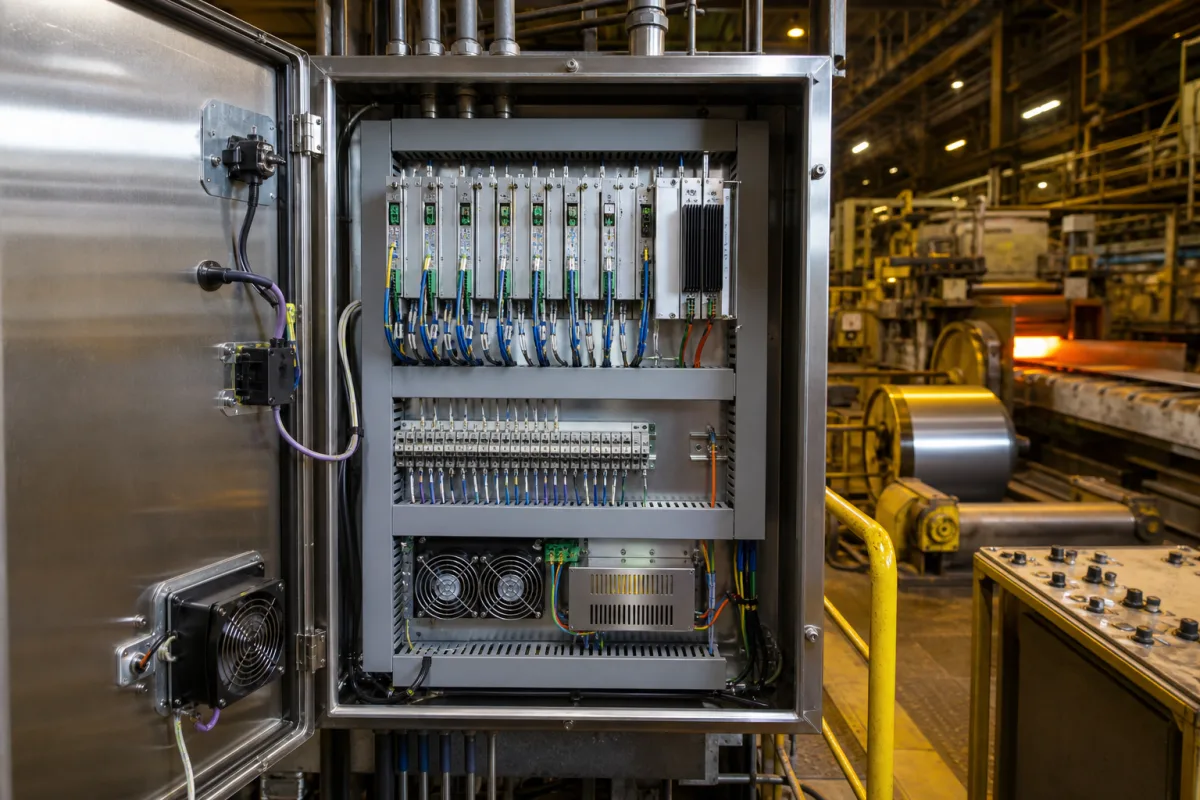
Signal processor for mill pyrometers: peak and valley hold, averaging and reset logic that turn a raw infrared reading into a usable temperature
Signal processing for infrared pyrometers in steel and metal mills · Peak hold, valley hold and holding time, advanced hold with threshold and hysteresis, averaging and external reset, and why scale, steam and intermittent hot metal need them
This page covers the signal processing applied to infrared pyrometer readings in steel and metal mills, whether built into the pyrometer or in a separate processor module: peak and valley hold over a holding time, advanced hold with a threshold and hysteresis, averaging, and resets from an external trigger. Ask three things first: what disturbs the reading at your measuring point (scale, steam, gaps between pieces), which hold and reset functions the processor offers and how they interact, and how fast the measurement and output respond.
Signal processing for infrared pyrometers in steel, aluminium and other metal mills, including peak and valley hold, holding time, threshold and hysteresis reset, averaging and trigger inputs, built into pyrometers or supplied as processor modules. DIN-rail signal conditioners and isolators for thermocouple, RTD, current and voltage signals are covered on the Industrial signal conditioner page, and load-cell amplifiers on the Load-cell signal conditioner page. Thermocouple and RTD temperature transmitters and the pyrometer optics themselves are outside this page.
CNFX editorial research · Sources checked October 12, 2026 · 5 sources
Scale, oxide, steam and intermittent hot metal at mill measuring points
Advanced Energy's hot rolling application note states that infrared sensors measure strip and sheet temperature so that rolling stands can be set to the steel's temperature, detect the presence of hot metal to time roll stand operation, and measure roll temperature while water quenches the roll, and that steam requires special spectral responses to measure accurately. [5] Keller states that its steel pyrometers record temperature within a few milliseconds and, to avoid interference from scale and oxide, use a Clean Surface Detection (CSD) function that, with a high-resolution lens and very short measuring time, filters out the true temperature of the scale-free surface; where heavy water vapour and smoke are in the field of view it uses short-wave two-colour pyrometers, for object temperatures from 500 °C, which compensate when the radiation is weakened by intermediate media. [4]
Give the supplier the measuring point (reheating furnace exit, roughing or finishing stand, coiler, roll), the temperature range, the distance and spot size, what passes through the view (scale, steam, water, gaps between pieces), the speed of the material, and the output and response time the control system needs.
02
Peak hold, valley hold and the holding time that decides when the output follows again
Optris describes peak hold as retaining the highest measured temperature over a set holding time and delivering it as the processed output: when the temperature falls below the held peak, the holding time starts, and when it expires the output steps toward the current value in increasing steps until it matches or the temperature rises again. Valley hold does the same with the lowest value. In the advanced mode, the held value resets only when the temperature crosses a threshold, returns past it and then moves by a user-set hysteresis. [1][2]
Editorial note: at a stand where scale or steam pulls the reading down between clean surface patches, a peak-type hold keeps the higher clean-surface value; ask the supplier how the holding time relates to your line speed and the spacing between clean readings.
Rises above threshold, falls below it, then rises by the hysteresis. [2]
03
Threshold, hysteresis and averaging in one processor, and a trigger input that resets the hold
Fluke's Thermalert 4.0 defines advanced post-processing by three parameters: a threshold temperature for resetting the hold, a hysteresis that must be non-zero (negative for valley hold, positive for peak hold) and an average time that slows the reading's response to rises and falls. It is mutually exclusive with plain peak or valley hold: setting either sets the hysteresis to zero and disables the advanced processing. A trigger input, briefly connected to −24 V (ground), resets any hold function and keeps the hold disabled while it stays connected, which Fluke notes is useful for delaying peak hold in some applications. [3]
Editorial note: a trigger from a hot-metal detector or the mill's tracking can reset the hold for each new piece, so the held value belongs to one bar or slab; confirm with the supplier which input levels and timing the trigger accepts.
04
Send the measuring point, disturbances and output needs together
Paste it into your enquiry below or into an email to a maker, then replace every bracket.
12 companies list this product among what they make. Company figures are quoted from each
company's own website; every card states where the relationship came from.
Explore company information and manufacturing capabilities, then discuss the scope of your project with a relevant supplier.
Share this page
Compiled and source-reviewed by the CNFX editorial team.
Each manufacturer above links to the page on that company's own website where the product is listed, with the date we checked it. How we source and review
· Page last updated 13 October 2026
Buyer questions
What does peak hold do on a pyrometer?
Optris describes it as keeping the highest temperature measured within a holding time as the output; after the holding time the output steps back toward the current reading. [1]
Why do steel mill pyrometers need special processing?
Scale, oxide, steam and smoke disturb the reading; Keller uses clean-surface detection and two-colour measurement, and Advanced Energy notes that steam needs special spectral responses. [4][5]
How can a pyrometer hold be reset for each piece?
Fluke's Thermalert 4.0 resets any hold function when its trigger input is briefly connected to −24 V (ground), and keeps the hold disabled while connected. [3]
Sources and what still needs a direct check
Sources checked 2026-10-12. Optris, Fluke, Keller and Advanced Energy describe the processing functions and applications of their own pyrometers.